Find advice on a range of topics to help you live life to the full, from diet and exercise to travel, work, sleep, relationships and leisure activities.
Our interactive Parkinson's map shows a range of resources across Europe, from member organisations to events, activity groups to research and campaigns
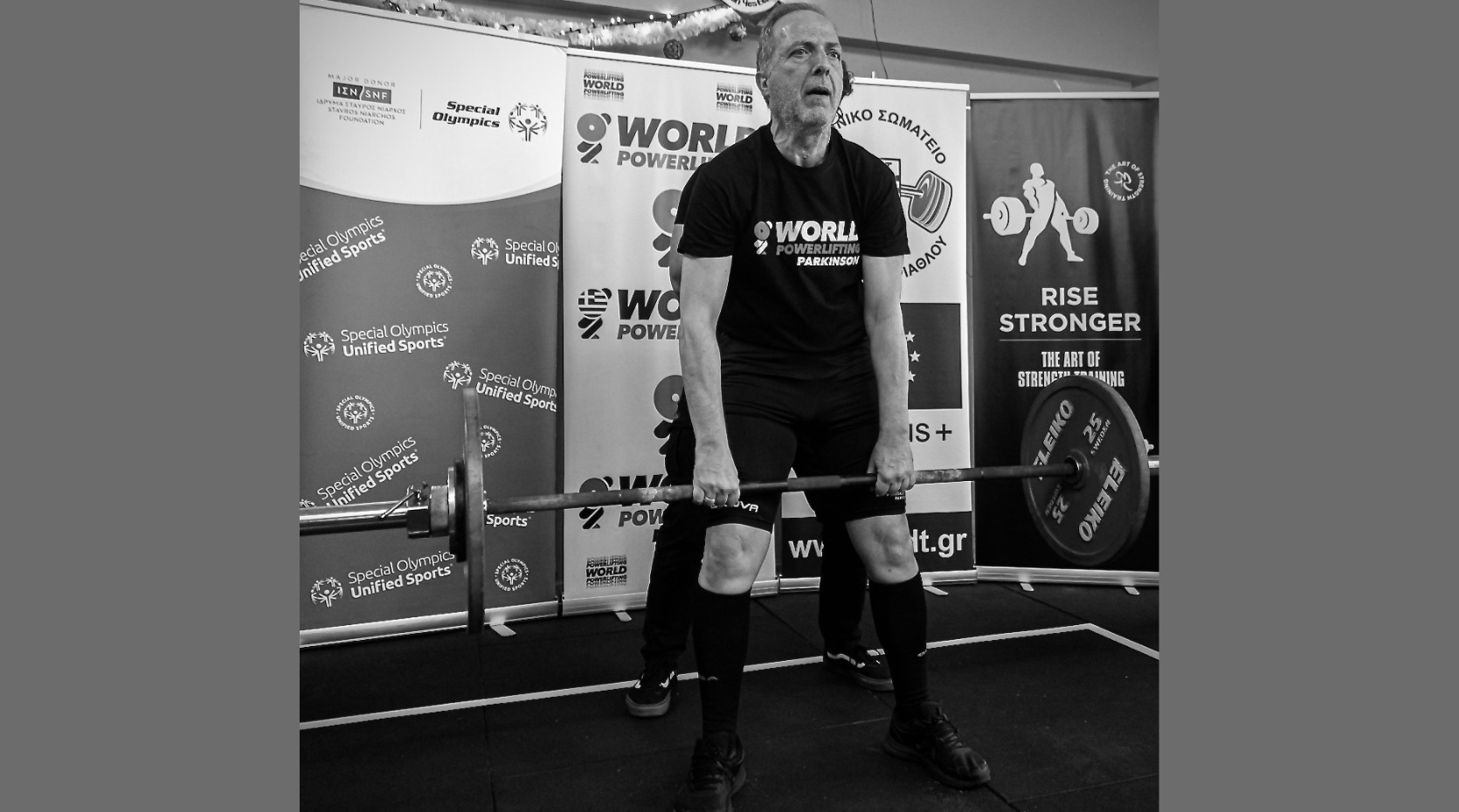
Living with Parkinson’s: a Greek professor’s quest for “Eudaimonia” through powerlifting
We speak to Antonis Glytzouris from Greece about living with Parkinson's in Thessaloniki, powerlifting, and his ongoing quest for "Eudaimonia", Greece's unique form of happiness.
The following article is adapted from a blend of conversations with Greek university professor Antonis Glytzouris and extracts from his personal essay “Deadlifts = Dead-Parkinson’s? Moments of Eudaimonia”.
“At the end of the day, perhaps it is true what Malvolio says in Shakespeare’s Twelfth Night: ‘Tis but fortune, all is fortune’,” Antonis says of being diagnosed with Early Onset Parkinson’s 17 years ago, at the age of 42. It will soon become clear that this philosophical approach has been key in the way Antonis has adapted to living with Parkinson’s.
“It was early 2007 when I noticed that the movement in my left hand was like that of a cog, and I also felt my left leg tightened,” he describes. A lifelong resident of Greece, Antonis was living in Crete at the time, and at first an orthopedist there misdiagnosed him with cervical syndrome. A neurologist later gave him cortisone treatment, but it wasn’t until 2009 that Antonis received his Parkinson’s diagnosis.
“I had no idea at the time about Early-Onset Parkinson’s – it was a slow-burning shock mixed with ignorance.”
To make matters worse, Antonis points out that diagnosis also coincided with the global financial crisis which hit his home country of Greece particularly hard, “crippling” its public services including healthcare, after which “the Covid health crisis plundered what was left”. This often makes it difficult for people with Parkinson’s to access the healthcare they need, including things like physiotherapy, counselling and support with physical activity, but more recently Greece has also been hit by the medicine shortages that are affecting much of Europe.
“[In the] last year we have been fighting fierce battles in Greece to find drugs such as Trivastal (Pronoran) or Symmetrel – and there have been more than a few times when, personally, I have had to find the drugs through friends in Romania or Germany.”
Despite this hardship, Antonis insists that the Goddess of Fortune “has thrown me a lot of good dice”, referring to his partner (or “sweetheart”, as Antonis calls her) and their two children, who are now in their early twenties: “Without them I wouldn’t be the same.”
He also credits his friends, colleagues and students (Antonis is a Professor of Theatre History at Aristotle University in Thessaloniki) among his good fortune in the “lottery” of life, but “above all, is my doctor, always available, always fighting, always pro bono. With so many good rolls of the dice, it’s a shame and unfair to talk about bad luck.”
This positive outlook while living with Parkinson’s is born of Antonis’ persistent quest for “Eudaimonia”, an ancient and uniquely Greek form of emotional wellbeing that he first started exploring many years ago after reading Aristotle’s Nicomachean Ethics during his summer holiday. Aristotle’s definition of Eudaimonia can be simply translated as “happiness is doing well and living well”, but the concept is more nuanced than that. It’s about living a life that is worthwhile and fulfilling– with the sense of contentment based more on your virtuous way of living than how fortunate your lot in life has been.
As Antonis aptly puts it:
“Trying to accept what you’ve been handed is half the truth. The other half is in what you do next.”
He explains further:
“If one is not so selfish as to give up, there is only one option, a one-way street – common to all mortals, Parkinsonian, and non-Parkinsonian alike: Eudaimonia. Fortune, Aristotle says, is necessary, but eudaimonia is not based on it. Misfortunes can, of course, crush it. But even in them, Aristotle continues, beautiful attitude spreads its splendor when it endures misfortunes patiently and – let us pay a little attention to this – it always does what is best in the given circumstances. In other words: there are no recipes.”
It was at one of his first meetings with his beloved doctor, Sevasti Bostantzopoulou, that Antonis discovered how important exercise would be to his quest for Eudaimonia while living with Parkinson’s:
“I went to my first meeting with my doctor in a scary basement of the local hospital. There, it started a kind of initiation into the mysterious group called the “Three P’s and an E”, P.P.P.E.; i.e., Pills, Patience, Positivity, Exercise.”
Of course, “pills” (or Parkinson’s medication) were an obvious first step towards improving life with Parkinson’s, and Antonis also discovered his “Patience” and “Positivity” lay in “a certain amount of self-deprecation, capable of laughing at my situation relatively easily, even in the difficult times.” And while this sounds pretty close to the concept of Eudaimonia already, he soon learned that there was one crucial missing element to creating a more contented life with Parkinson’s:
“All scientific research pointed in one direction. Exercise, exercise, exercise.”
His journey with exercise had several false starts – he was cruelly kicked out of the local swimming pool, a less-than-friendly gym refused to give him membership, and he struggled to relate to the more spiritual elements of Yoga and Tai Chi. It wasn’t until he visited the European Parkinson’s Centre in Italy in 2016 that his love of exercise started to click into place:
“Among the sports activities I encountered there, I was impressed by team sports in the lovely Boario’s garden and boxing. It was an extremely rewarding experience that convinced me that, to some extent, I could take control of my situation. Movement begets movement, while stagnation sinks you into immobility, helplessness, depression, introversion.”
Sadly, a sudden bereavement and period of ill health in 2017 knocked everything off course:
“I was in bed for a few weeks: complete immobility. I had to set my little finger, then my ring finger, and middle finger, then my index and thumb to gradually, after a long time, activate the rest of my body. The Aristotelian Eudaimonia was totally invisible. But I felt in my own skin that the dopamine does not grow by itself but is produced. In short, you must work for it every single day.”
Thankfully, part of his road to recovery included joining a gym in his home city of Thessaloniki in 2019, and it was here that Antonis found powerlifting, and things really started to turn around:
“The gym became my personal church; I have the gym like a religious man has his morning prayer. One thing led to another, and I was introduced to Powerlifting, with an emphasis on Deadlifts. I had just tentatively started dead-lifts when I read about the Parkinson’s games and pioneering Parkinson’s powerlifting coach Nikolas Koukoulakis in Parkinson’s Life. I reached out to him and we have been in contact ever since.”
Antonis now travels to Athens to take part in powerlifting events with Nikolas’ Parky Lifters group. “I have participated in two ‘open’ events (2022 and 2023) and one national championship. But a special moment for me was my participation in the Powerlifting World Championships in Rome last fall.”
Thanks to the great help and support from his trainer Dimitris Andrikos and his physiotherapist Spiros Vizirgianakis, he now trains on deadlifts twice a week, as well as doing Pilates, neuroplasticity excercises, and strengthening exercises with TRX suspension trainers and dumbbells.
The benefits of powerlifting – and its contribution to Antonis’ quest for Eudaimonia – are clear:
“The improvement is noticeable in strengthening my whole body, how I stand and walk, coordination of movements, my stamina in general. Beyond that though, Powerlifting taught me something else. I don’t know if it stands up scientifically, but I feel that dopamine is not only produced by exercise but also by the fulfilment of a goal, by expectation in relation to the moment of reward: that magical moment when you lift the bar. At that moment you have the feeling that you are close to what the modern Greek poet Elytis says: “a leap faster than decay”. Deadlift = Dead-Parkinson’s.”
Above all, he has discovered, the truth of Eudaimonia is it’s a journey, not a destination.
“It’s a goal. Let’s say something like a lighthouse so you don’t get lost: sometimes you see it right in front of you, sometimes you’re miles away, there are those times when you enjoy its warmth inside it and those times when you feel like you’re completely lost.”
“I know too well that living with Parkinson’s, the hard times are the most numerous, that the losses are the most numerous, that however much the painkillers of Shakespeare, Aristotle or Elytis may relieve, the game of degeneration and decay is handily lost. I know full well that the hard times are coming, that the disease will prevail. So what? That’s her job. And I, trying to do mine with no idea exactly how I’m going to pull it off tomorrow. In any case, even if we will lose the match let’s score some goals to cheer it up. ”
The European Inventor Award 2024 finalists have been announced, and include a French husband-and-wife team who are developing a potential new Parkinson’s treatment.
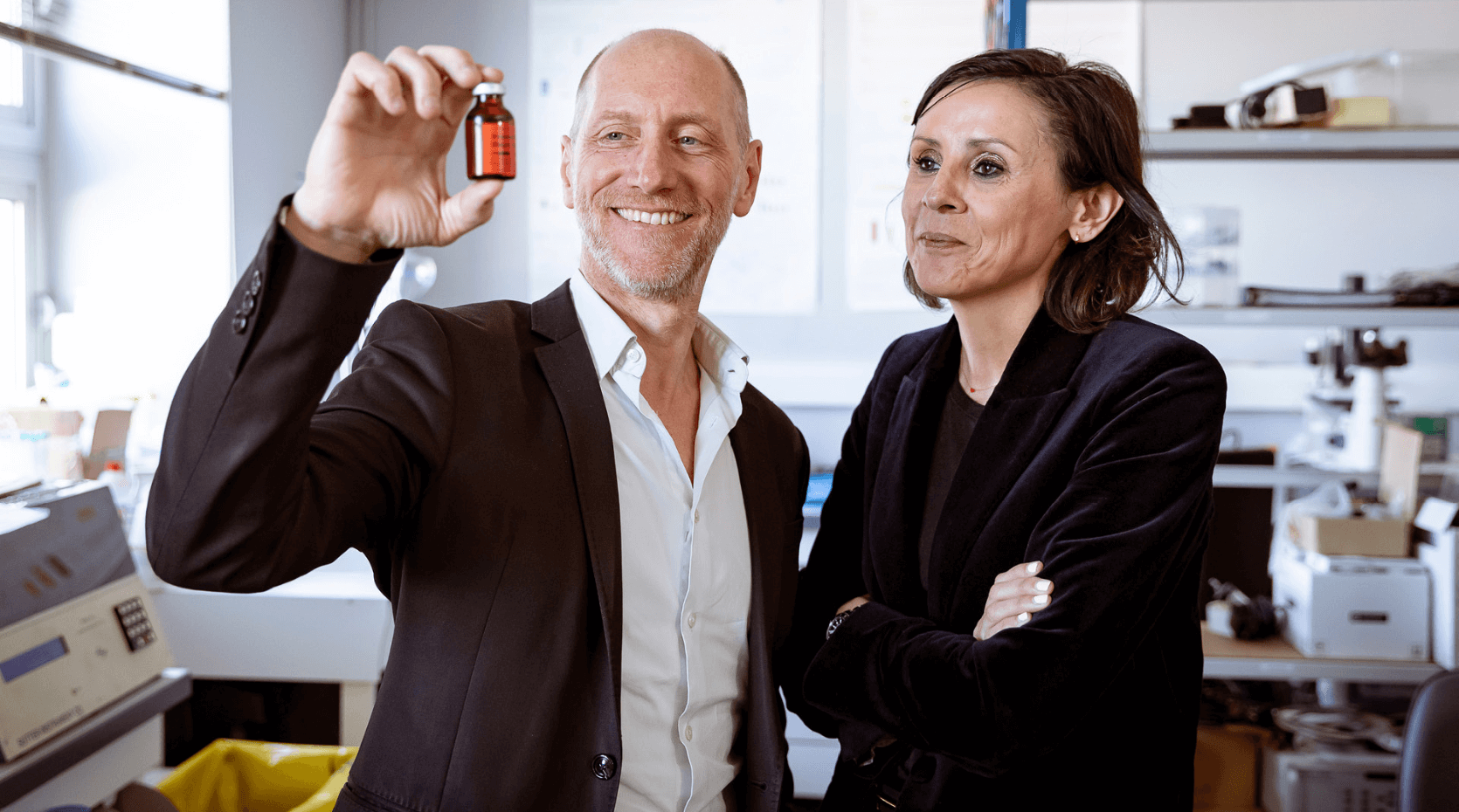
David Devos and Caroline Moreau, who work together at Lille University Hospital in France, beat over 500 applications to become one of three finalists in the Research category of the European Inventor Award this year. They are also in the running for the Awards’ “Popular Inventor Prize”, which is voted for by members of the public.
Devos and Moreau’s invention is a dosing pump that allows people with Parkinson’s to have anaerobic dopamine (or A-dopamine) delivered directly to their brain in consistent quantities. The aim of the treatment is to help combat the symptom fluctuations and “off” periods many people experience as their condition advances.
The catheters are designed to be internally implanted into the brain of the person with Parkinson’s, who can then administer the A-dopamine using the pump system when needed, with the pump’s dopamine supply being refilled every one to two weeks.
“It’s like giving a flower its precious water drop by drop all the time instead of drowning it,” David explains.
The pair developed Anaerobic dopamine (replacing the oxygen in a dopamine solution with dioxide and nitrogen in an anaerobic chamber) after previous efforts found that dopamine was ineffective when oxidised.
Watch the video below for more information about their work and why they’ve become finalists:
Their research project – the only health-related research project to make it through to the finals of the awards – began Phase I in September 2020, and will complete its Phase II trial in June 2024. If the results are positive a Phase III clinical trial will be their next step before they are able to get the pump and A-dopamine approved as a Parkinson’s treatment in Europe and the USA.
“We are very pleased to have been selected by the European Patent Office for our therapeutic innovation and we warmly thank the members of the jury,” reports Professor Devos, continuing:
“Treatment with A-dopamine considerably reduced the periods during which patients suffered from both dopamine-dependent tremor, slowness, pain, and difficulties in walking and communicating, as well as Levodopa-induced abnormal symptoms (involuntary movements, agitation) limiting their autonomy and quality of life. All the treated patients wished to continue the treatment over the very long term.”
“We are convinced that A-dopamine will be a groundbreaking therapeutic weapon administered on a long run to patients…. That said, we have to remain humble because we are not curing Parkinson’s disease.”
The Parkinson’s community can also vote for David and Caroline to win the Popular Inventor Award, with the public vote now open, and running until early July.
The winners will be announced at the finals of the European Inventor Award 2024 in Malta on 9 July 2024, with the ceremony also being live-streamed to the public online.
The European Inventor Award was launched in 2006 to give recognition to and inspire inventors, with its annual jury consisting of previous prize winners and finalists. Other categories for the awards include Industry, SMEs and Non-EPO Countries.
Find out more about the European Inventor Award 2024 on their website and vote for David and Caroline to win the Popular Inventor Prize.
Exercise and Parkinson’s: how to overcome barriers to physical activity
We speak to Josefa Domingos, a physical therapist specialising in Parkinson’s and other movement disorders, about the common exercise and fitness issues faced by people with Parkinson’s – and how to overcome them.
If there’s one thing we can all agree on, it’s that exercise is beneficial for health – especially so if you have Parkinson’s – but, as with all things, exercising with Parkinson’s comes with its own unique set of challenges.
Whether it’s something preventing you from getting started with exercise, or struggling to get back into physical activity after an injury or illness, barriers can hold us back and be incredibly disheartening.
But never fear: we’ve asked a Parkinson’s exercise expert for help!
Josefa Domingos doesn’t just have two decades of experience as a physical therapist working exclusively with people with Parkinson’s – she’s also been the National Health Coordinator at the Portuguese Parkinson’s Patients Association since 2006, co-founded the Young Parkies Portugal charity, and has just achieved a PhD in Practicalities of Community-based exercise in Parkinson’s.
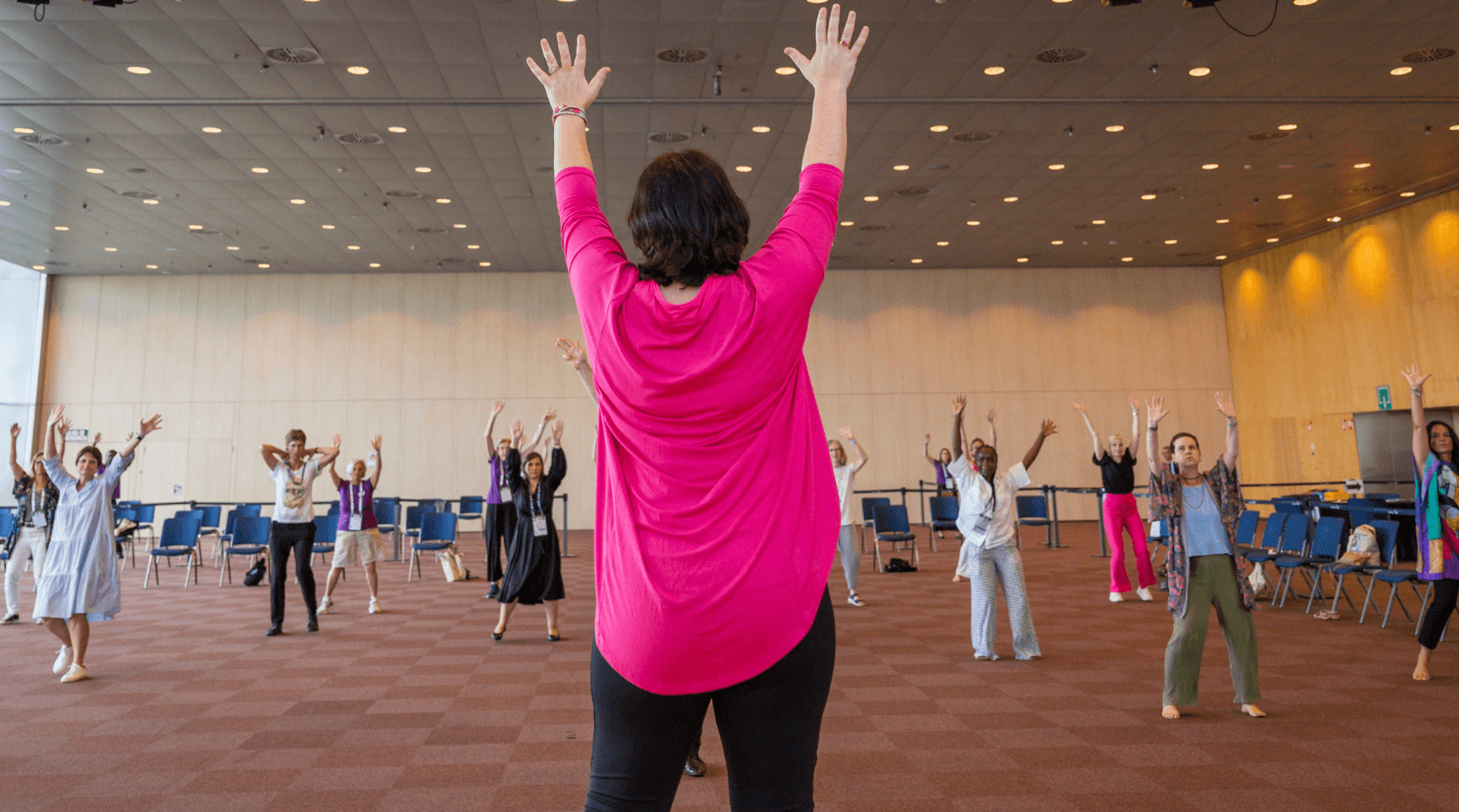
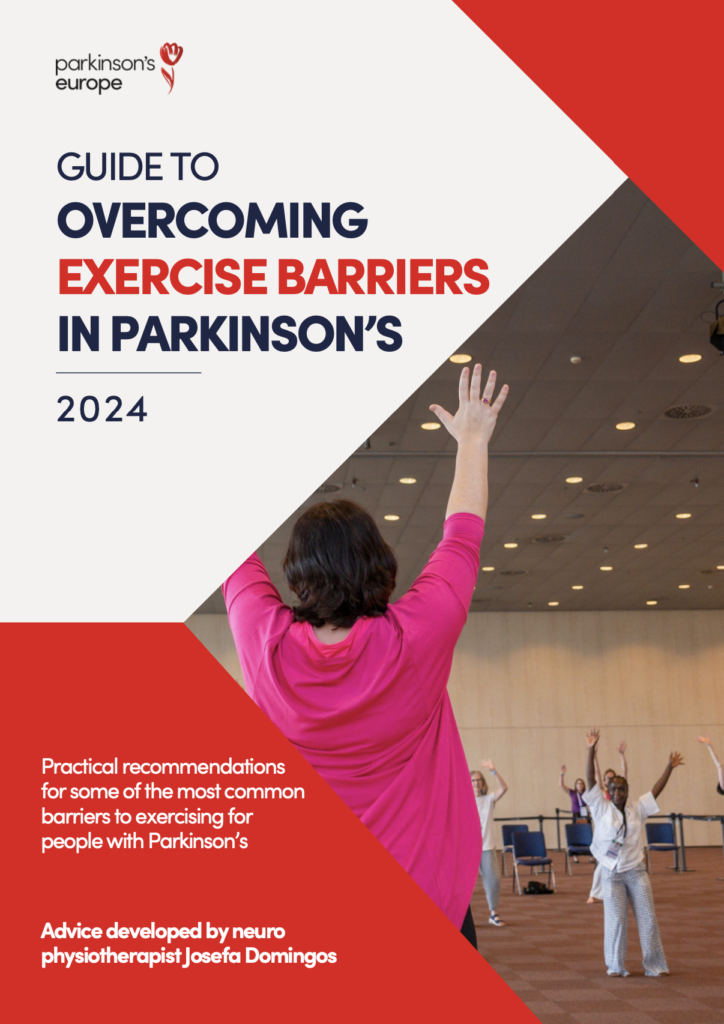
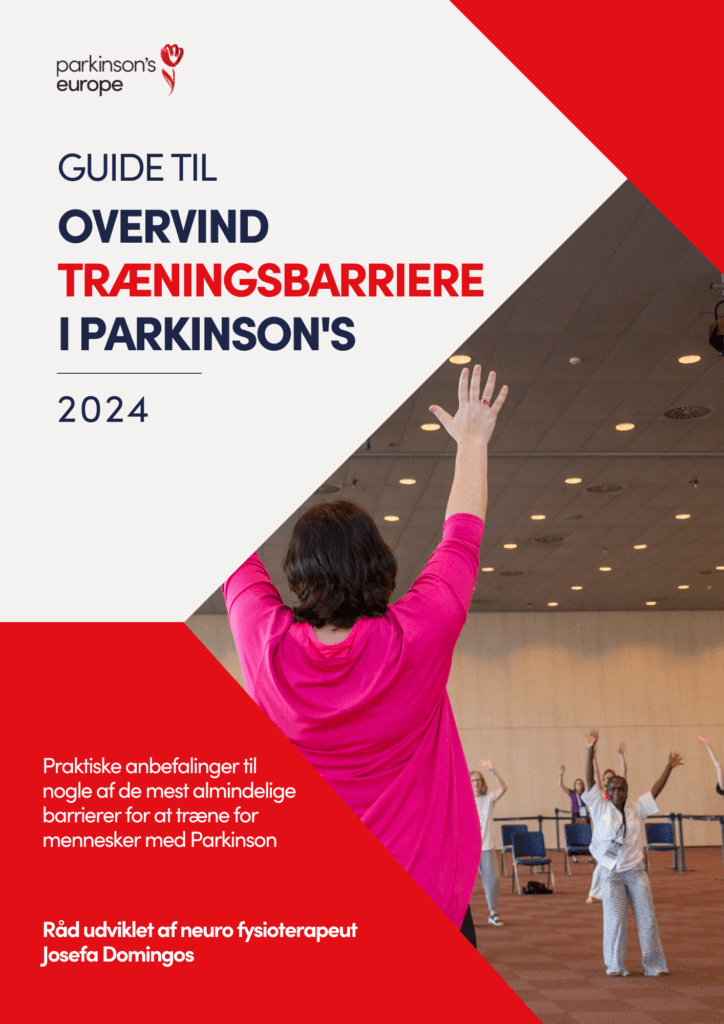
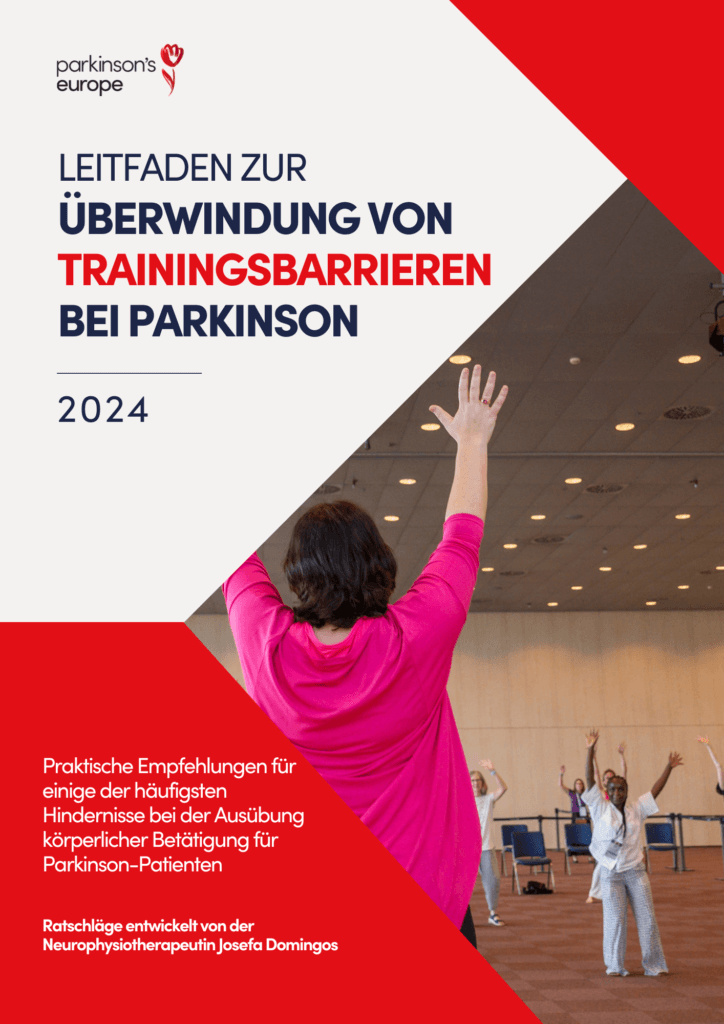
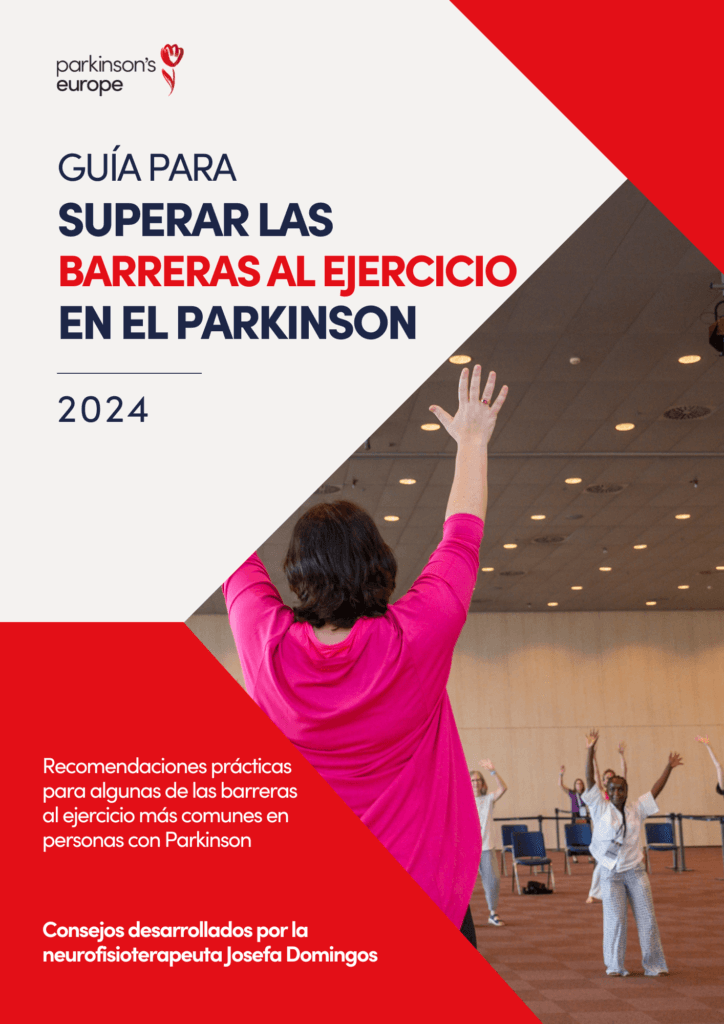
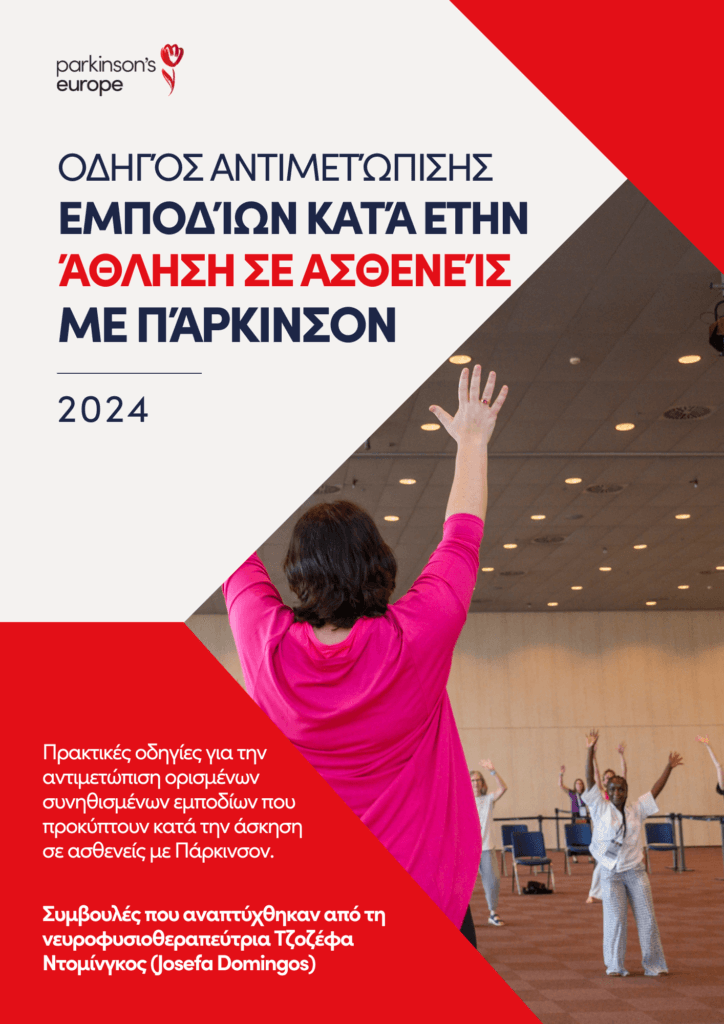
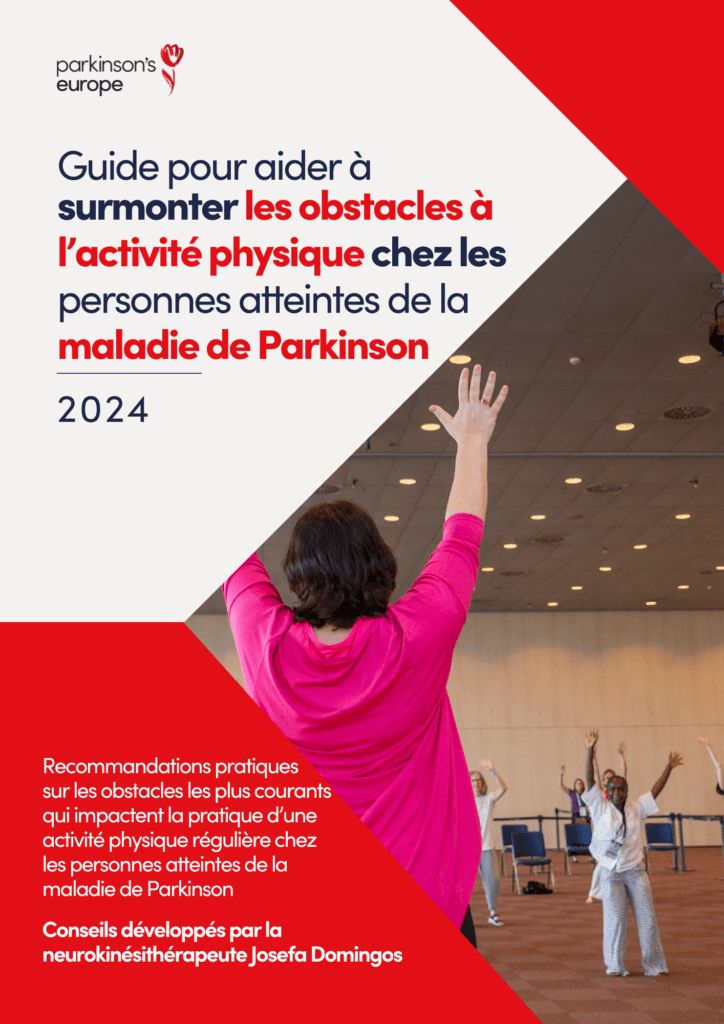
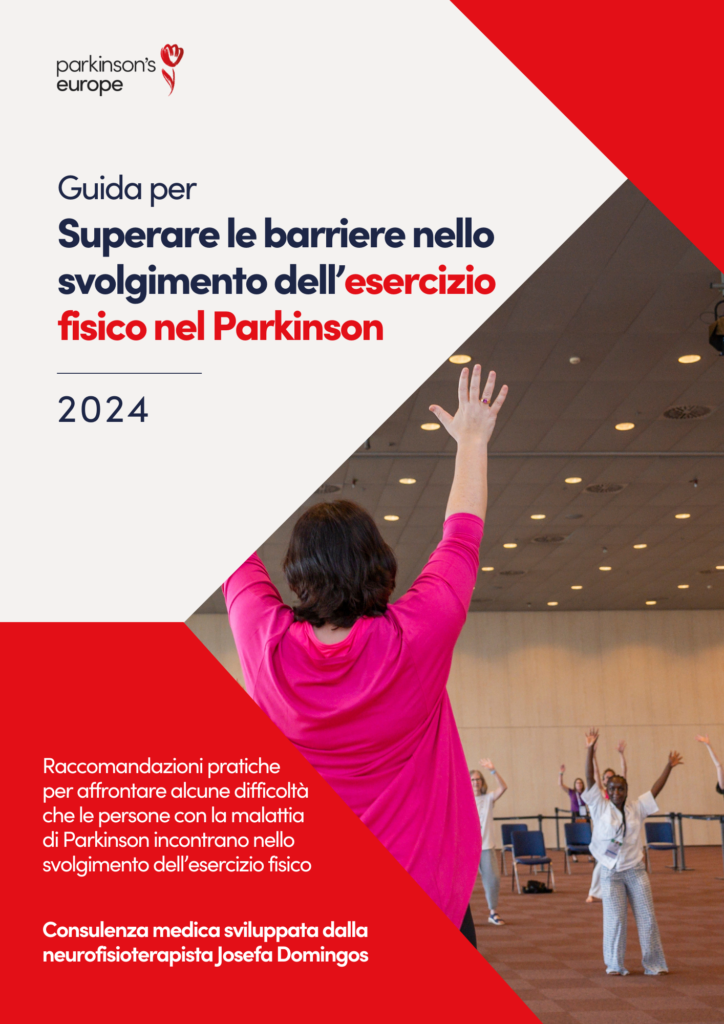
FREE guide to overcoming barriers to exercise with Parkinson’s – in NINE languages
We asked Josefa for her top advice on overcoming common barriers to exercising with Parkinson’s. You can read our interview with Josefa below, but we’ve also put together a free guide to exercise and Parkinson’s, which you can download at the end of this article.
Thanks to the kindness of several volunteers, you can now download this guide in eight languages: English, Dansk / Danish, Deutsch / German, Español / Spanish, Ελληνική / Greek, Français / French, Italiano / Italian, Português / Portuguese and Türkçe / Turkish.
What are the top three reasons why people with Parkinson’s might not consider exercise or sport?
The research literature frequently points to three main factors that can limit people with Parkinson’s from engaging in exercise: low self-efficacy, fear of falling, and reduced expectations of positive outcomes.
However, any barrier could be a sufficient reason for someone with Parkinson’s to avoid exercise. It’s whatever problem or barrier is challenging you.
And what has been your own experience of the main barriers to people with Parkinson’s and exercise, getting active, and playing sports?
There’s several, and these can be grouped into three main areas: health, personal, and environmental factors.
Each of these three areas plays a critical role in shaping the ability and willingness of people with Parkinson’s to engage in physical activity.
Okay, let’s start with health-related barriers to exercise and Parkinson’s – what are they?
Motor symptoms like tremors, rigidity, and bradykinesia can make movement challenging and uncomfortable.
Additionally, non-motor symptoms such as motivation fluctuations, anxiety, depression, fatigue, and apathy often undermine the consistency required for regular exercise.
Also, medication and disease-related issues like unpredictable on-off phenomena can create uncertainty about when someone will have the energy and mood to exercise, making it difficult to maintain a regular routine.
And what ways can people overcome these health-related issues?
One way is to work closely with experts – for instance, if you’re struggling to exercise because of a specific symptom, your doctor might be able to adjust your medication to help, or if mental health issues are affecting your motivation to exercise, address this with a therapist or counsellor.
Integrating exercise into your daily routine at a time when your medication is generally working the best can also help make exercise a regular habit, but on the flip side you also need to listen to your body, for example trying gentler exercise like yoga and walking when fatigue levels are high, or taking advantage of high-energy days by trying higher-intensity aerobic exercises like cycling or dance.
There’s more advice in the free guide below.
What about personal barriers to exercise?
Factors like low self-efficacy, fear of falling, reduced balance confidence, low expectations of exercise benefits, and physical discomfort can all deter individuals from engaging in physical activities.
A history of limited participation in sports or low levels of previous physical activity can also contribute to a lack of confidence.
Time constraints, often arising from other responsibilities, can further restrict opportunities for exercise.
What advice can you give to overcome these personal barriers to exercise?
Getting an exercise buddy can really help your confidence and reduce fears of falling, or listening to music can help distract you from any discomfort and make your exercise experience more enjoyable. Keeping a diary of your progress can also help grow your confidence and increase your expectations.
Time constraints are always challenging – but even doing short bursts of 10 minutes, or even 1-minute exercise “snacking” – can be just as beneficial. And you can also incorporate exercise into your daily activities, such as gardening, cleaning, walking the dog or going on a hike with your family.
There’s lots more advice in the free guide below.
And finally, what are the environmental reasons for issues around exercise and Parkinson’s?
There are several. A lack of social support from family or friends can lead to isolation and reduce motivation. Not having a workout partner or “exercise buddy” can make it less likely for individuals to commit to regular activity.
Concerns about exercising in public due to visible symptoms and their progression might lead to feelings of discomfort or embarrassment.
And practical issues like limited access to exercise facilities, transportation difficulties, bad weather, cultural barriers, financial constraints, and crowded environments can all also deter regular exercise.
How can we overcome these environmental barriers?
One major thing is using online exercise videos and virtual classes – this removes several barriers, including transportation, bad weather, relying on limited local availability of classes, and the sometimes daunting prospect of exercising in front of others or in crowded rooms.
It can also help with cultural challenges, for instance many online videos have subtitling for a diverse range of languages, and overcoming some cultural differences such as single-sex classes, but I’d recommend also making needs like these clear to local providers and asking them to accommodate them.
There’s more advice in the free guide below.
What about after injury or other set-backs: is there anything specific that you would advise people with Parkinson’s to consider?
Get a good assessment and guidance from a qualified Parkinson’s health or exercise professional before restarting. Also, it’s important to find ways to stay active even when dealing with an injury. For example, if you’ve injured your arm, focus on leg exercises like using a stationary bike or walking. This approach helps maintain fitness and mobility while allowing the injured area to heal. Try to be creative to stay active despite the set-backs.
Your FREE guide to overcoming barriers to exercise with Parkinson’s
Download our ten-page guide to exercise and Parkinson’s below – and please spread the word about this guide on social media so as many people as possible can benefit.
Paris 2024: Anthony Desjardins on the “joy” of carrying the Olympic Flame for the Parkinson’s community
Anthony Desjardins tells us about the honour of carrying the Paris 2024 Olympic torch in his home city of Montpellier as a young person with Parkinson's.
“It’s something that, disabled or not, young or old, I’d have never imagined doing in my life.” This is how 41-year-old Anthony Desjardins describes the news that, on Monday 13th May, he’ll be carrying the Paris 2024 Olympic Flame through his home city of Montpellier in France.
It’s been just three years since the father-of-two was diagnosed with Parkinson’s in July 2021, but he could never have predicted that so soon after joining the Parkinson’s community, he’d be chosen to represent them on an worldwide stage at Paris 2024.
He first started experiencing subtle rigidity issues when he was just 34, and to begin with he easily adapted to this symptom, but when the rigidity got worse and was joined by balance issues and bradykinesia (slowness of movement), he decided to consult a doctor. Just a few months later, at the age of 38, he received the news it was Parkinson’s.
“Finding out that I had Parkinson’s was actually a positive announcement for me,” Anthony explained. “Indeed, the months leading to my diagnosis were quite hard as I didn’t know what was going on so learning what I had was paradoxically positive.”
But the news of this diagnosis at such a young age also came as a shock to his close family and friends, who – like Anthony himself – had no previous experience with Parkinson’s beyond seeing famous people like Michael J Fox and Mohammed Ali with the condition, so he “created an Instagram account to show my relatives what living with Parkinson’s looked like.”
Another reason Anthony started documenting his Parkinson’s on social media is because “in France, people often have the assumption that Parkinson’s only affects elderly people and only causes tremor. I was 38 years old and didn’t have tremor so I wanted to show that Parkinson’s wasn’t only that.”
These humble beginnings have grown into an impressive platform: Anthony now has over 10,000 followers across his main social media accounts. He explained how he achieved this following after being put on medical leave at work following his diagnosis:
“I initially thought that I’d be prescribed a few drugs and I’d be back working but when I started to understand that it wasn’t going to be possible, I started online courses on digital marketing to learn how to build a social media presence, and how to manage it. Step-by-step, I managed to acquire my current following.”
More recently, Anthony has used his sporting background (including a previous job at the French Tennis Federation) to focus his message on the benefits of sports and exercise for Parkinson’s:
“Sport has always been part of my life. I had this taken away from me during my initial Parkinson’s symptoms phase, and when I started exercising again it was at the time when exercise was more and more proven to benefit people with Parkinson’s and to slow down its progression. So I told myself that was my silver lining: that loving sports will actually benefit me. I decided that I’d make sports and Parkinson’s my message.”
It was this that led to Anthony’s latest video series, Un Parki Chez Les Pros, in which he visits and plays a variety of sports alongside famous sportspeople.
“One evening at home, I thought to myself that I live near Montpellier which has numerous sports teams in the top division, and that if I wanted to spread my message to a larger audience, people with greater notoriety than me would help a lot. So I started contacting people and clubs.”
There’s now over a dozen Un Parki Chez Les Pros videos on Anthony’s YouTube channel, and he described filming each one as being a varied and overwhelmingly positive experience.
There were some surprises, too: for instance, when Anthony went to record a video with Hugo Gaston (currently ranked in the top 100 tennis players in the world) at the Open Sud de France (Southern French Open) at the Montpellier Arena:
“What was amazing was that at the last minute I learnt that we were playing on the main court which was an incredible feeling. I didn’t play amazing because of the emotions and the stress but it was great!”
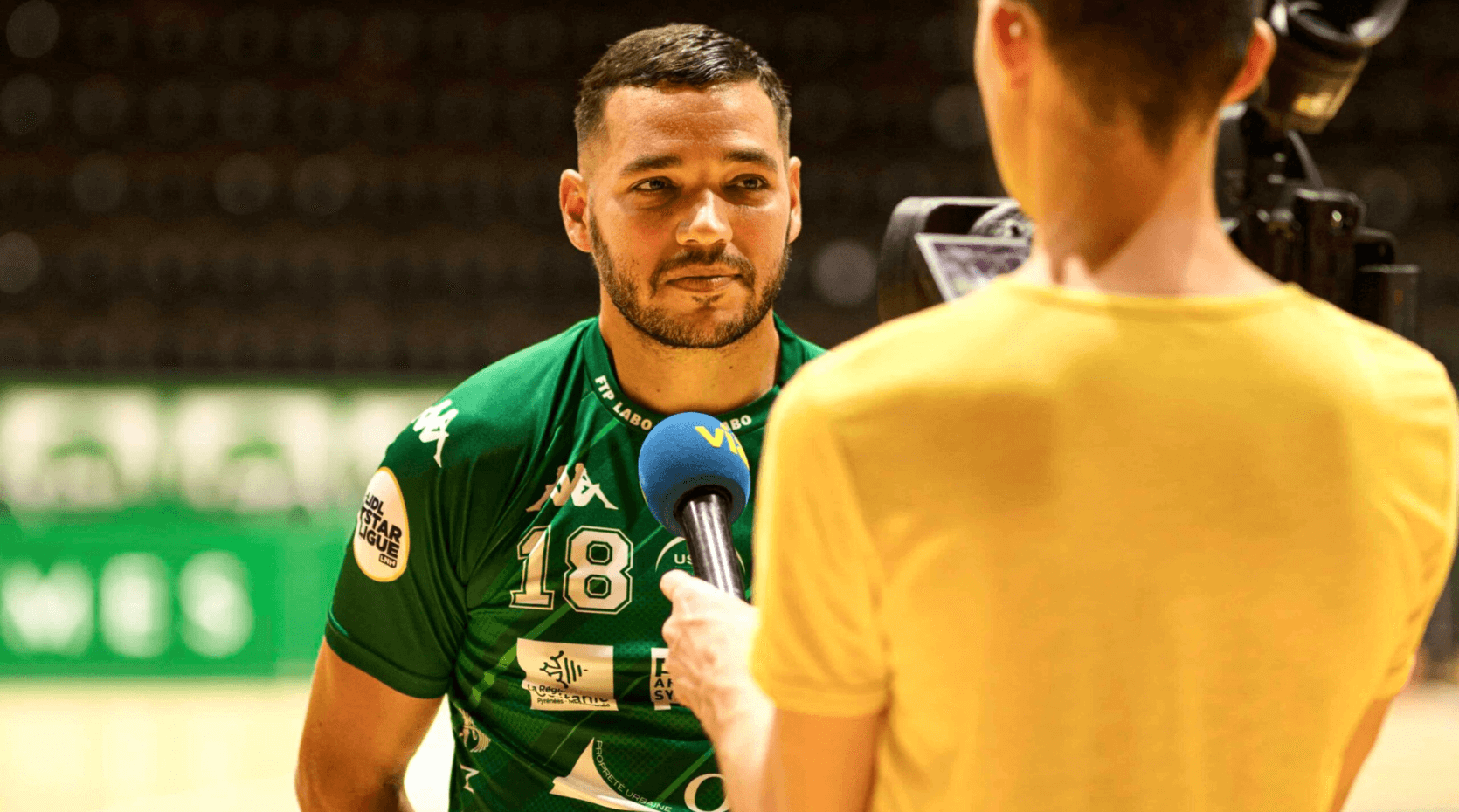
Another highlight was an episode with the Montpellier Rugby Club – “They were incredibly welcoming and the team spirit was amazing” – as well as episodes with the French Women’s volleyball team, kickboxer Jimmy Vienot, and three-times Olympic handball champion Michaël Guigou.
Anthony’s achievements with Un Parki Chez Les Pros makes it especially fitting that he has been chosen to represent the Parkinson’s community as an Olympic Torch carrier for Paris 2024, but it wasn’t an easy journey to get there.
After initially being nominated for the role by Jean-Louis Dufloux, President of France Parkinson, Anthony received an email saying that sadly, his application had been rejected.
“I was very disappointed,” he explained, “But in that email, they did say that I had a last opportunity to convince them by submitting a 15-second video explaining why I’d be the right candidate. I recorded that video as soon as I got that email and submitted it, reinforcing my message of promoting exercise as a young person with Parkinson’s.”
With much lower hopes this time, weeks went past with no news, until Anthony finally received a phone call from the Paris 2024 organisers:
“Unfortunately I was driving so I couldn’t take the call. I was so excited I couldn’t wait to know the answer, so I stopped at the first parking spot I could find to call them back – and finally heard the good news!”
As the happy news sunk in that he’d be carrying the Paris 2024 Olympic Torch through his home city of Montpellier, Anthony even received a letter of congratulations from the mayor, but he still can’t quite believe it’s going to happen.
“I probably will when they’ll dress me up with the official uniform and tell me that it’s now but I’m not even that sure as it’ll be such a special moment. I cannot wait!”
Unsurprisingly, Anthony is particularly thrilled about representing Parkinson’s on Paris 2024’s world stage:
“When I announced it on my social media accounts, it was a great honour to hear from people with Parkinson’s about their pride in seeing a person with Parkinson’s participate in such an event. They see me a little bit as their ambassador and it’s a great pleasure, pride and responsibility. I’m as happy to carry the torch for myself as I am to carry it for the entire Parkinson’s community.”
But throughout this life-changing experience, Anthony’s main focus remains helping people with Parkinson’s:
“When I launched Un Parki Chez Les Pros, the idea was not to show that I’m doing better than others with my disease or that everything is a breeze with Parkinson’s, the idea was to spread my message as far as possible by interesting a maximum amount of people to the disease and for me to take pleasure in doing so. The bottom line of the message is really to encourage people to not stay sedentary and to promote exercise. Whether it be standing up and sitting down a few times or playing with a very light ball, I think that anyone can exercise adapting it to their needs. And anyone can benefit from it, especially people with Parkinson’s.”
Keep up with Anthony’s work and updates on being a Paris 2024 torch bearer on his Instagram profile. For more information about staying active with Parkinson’s, explore our Summer of Sport campaign.
An A-level student from the UK has invented a game designed to improve cognitive fitness in people with Parkinson’s.
Maryam Naveed, who is 18 years old and from Windsor in the south of the UK, conceived the idea for and built the prototype for the Cognitive Fitness Game in her spare time outside school, where she studies maths, physics and chemistry.
“I first came across Parkinson’s when I found that the famous boxer Muhammad Ali had it,” says Maryam. “I investigated and found that there are different types of Parkinson’s, and in addition there are other symptoms, like memory problems. Looking at the extent to which Parkinson’s can impact mobility, I wanted to design a game that would not only be fun but also serve as an exercise to improve hand-eye
coordination.
“My aim was to create an experience that was both engaging and user-friendly, which influenced the game’s design. The game includes a grid of LED lights with switches next to them, arranged in a four-by-four matrix. When a light turns on randomly, the player presses the switch associated with it, causing it to switch off and another light to light up randomly. This continues until reaching the set time limit (which can be set for various durations). The game keeps track of how many times the switches are pressed, showing improved hand-eye coordination as this count increases,” says Maryam.
In a video demonstration of her cognitive fitness game on LinkedIn, Maryam describes her interest in the application of technology in healthcare, and said that creating the game “not only provided an enjoyable experience but helped me learn more about electronics and programming”:
Her theory is that with consistent practice and by making the game fun, such an activity could help with cognition in people with Parkinson’s.
Although the game has not yet been played by people with Parkinson’s, Maryam has reached out to Parkinson’s organisations and is providing the code and instructions to create the game for free so that others can make their own version of the cognitive fitness game.
“I have identified the low-cost components which can make it economical to build the game, by anyone,” says Maryam, who plans to study computer systems engineering at university when she leaves school. “I believe innovative improvements can be made when technology in healthcare is made open source, especially to people who will use the technology leading to better healthcare.”
She continues: “I am hopeful that the Cognitive Fitness Game can be used by people with Parkinson’s and that they find it an engaging exercise.”
You can find out more about the design process and much greater detail of the technology Maryam used to create the cognitive fitness game on her recent LinkedIn blog post.
Parkinson’s Europe is sharing this article for information purposes only; it does not represent Parkinson’s Europe’s views and is not an endorsement by Parkinson’s Europe of any particular treatments, therapies or products.
Today is the start of National Walking Month in the UK, but people with Parkinson’s all over Europe can get involved and enjoy the benefits of walking! Being active is one of the best ways to improve your Parkinson’s symptoms, and, for those with good mobility, walking is one of the easiest exercises you can do. It requires no special equipment (Nordic walking aside) – and you can do it in your garden, at your local park or simply by increasing your steps as you go about your daily life.
Four ways to get involved in National Walking Month – in the UK and beyond
To celebrate National Walking Month in the UK, Parkinson’s UK is holding a 100 Mile Challenge, where people with and without the condition can get active and walk a total of 100 miles however they like within the month of May while fundraising for vital research into treatments and a cure for the condition. The organisation is also holding further Walk for Parkinson’s events across the UK from June to October.Tim Morton, Physical Activity Programme Lead at Parkinson’s UK, says: “Being physically active is as important as getting the right medication in helping to manage Parkinson’s symptoms, and walking is a great and accessible option for many people. Just 2.5 hours of activity a week can make a real difference to living well with the condition and have a positive impact physically, mentally, and socially.”
Elsewhere in Europe, in northern Belgium Parkili.be is holding its annual spring walk on 25 May in Puyenbroeck park in Wachtebeke. You can sign up to walk 10 km or 5km, according to your ability.
And wherever you are based, you can join in with the European Brain Foundation’s #Move4YrBrain campaign. Simply join their Strava group to share your walks – or runs – with them.
Why not use National Walking Month as an excuse to look for Parkinson’s walking groups near you? Try contacting your local or national Parkinson’s organisation for help.
What walking does for me: Nordic walking
We spoke to some people with Parkinson’s about how walking has improved their health and wellbeing.
Mary Smith, from Brussels, was diagnosed with Parkinson’s 18 months ago. Since becoming aware of the benefits of exercise for the condition, the 81-year-old has made a concerted effort to increase the amount she walks, estimating that she has doubled the amount of walking she did before by walking to the shops and to appointments, amounting to about two hours a week. “If I walk and I don’t know the terrain or I know it’s rough, I will take a cane for balance,” she says.
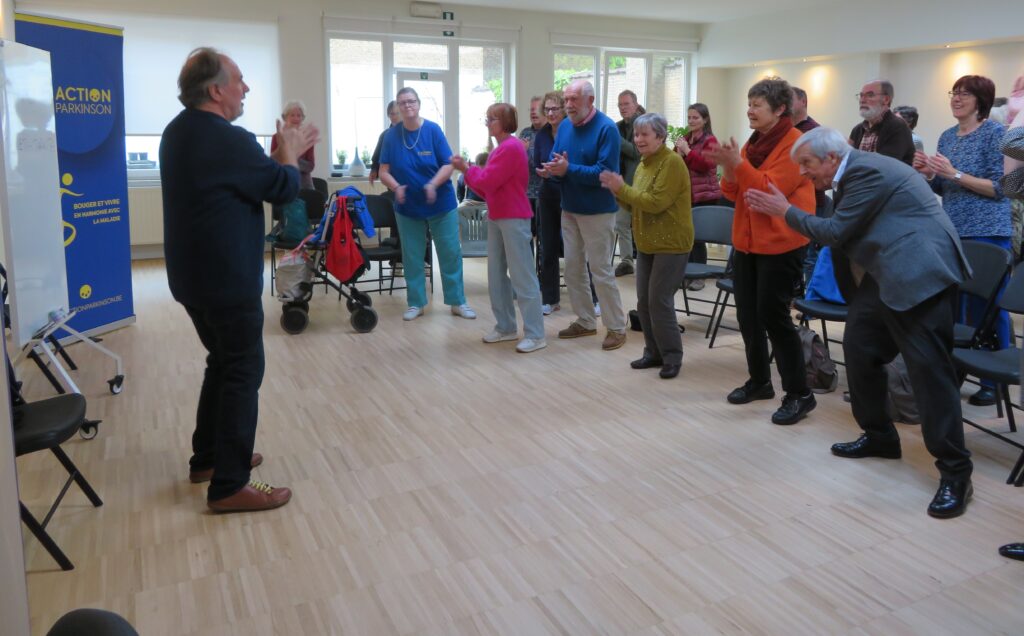
A year ago, Mary also took up Nordic walking because of its benefits for people with Parkinson’s. Arranged by the Belgian organisation Action Parkinson ASBL, she does this at a central park once a week with a small group of other people with the condition. Asked if it helps improve her Parkinson’s symptoms, she says, “I can’t say specific symptoms, but in general it certainly helps my mood and helps me feel healthy and feel good. It improves my outlook and gives me energy.”
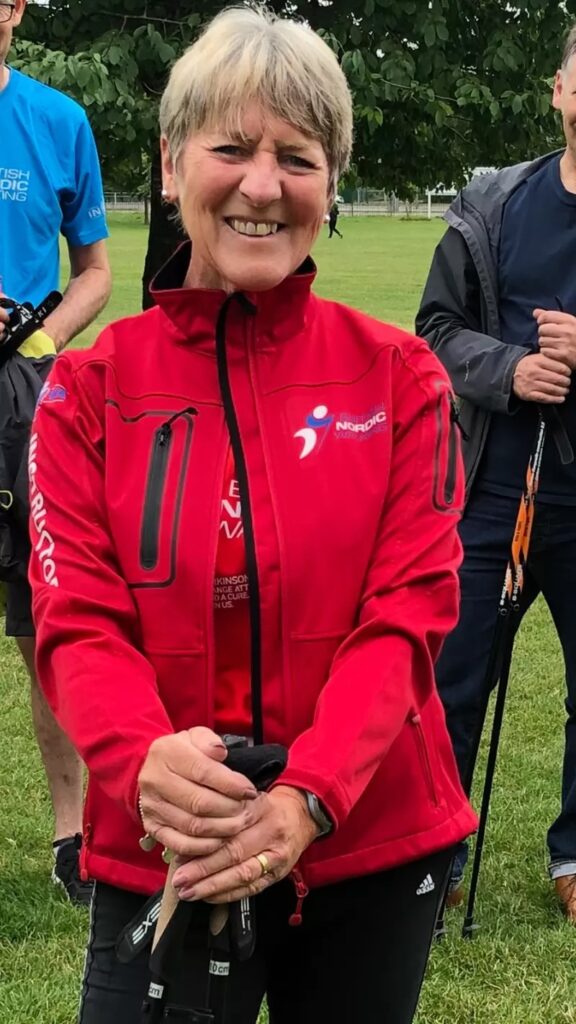
Nordic walking instructor, Christine
Christine, from the UK, is another person with Parkinson’s who can vouch for the benefits of Nordic walking, to the extent that she became an instructor and now runs two Nordic walking groups in the West Midlands.
“Nordic walking helps with posture, balance, coordination, cardio and overall fitness. Being outdoors helps you get more fresh air, feel good and manage your Parkinson’s. Most people with Parkinson’s can take part in Nordic walking, whatever stage they’re at in their journey,” she says.
“I really enjoy walking and catching up with others like myself. It gives me a real sense of hope! My biggest challenge is trying to walk as normally as I can, and checking my balance so I don’t fall.”
Stepping things up: hiking to the top of a mountain!
Irishman Ian O’Brien with friends on a mountain hike
Although walking is an accessible everyday exercise for people with Parkinson’s, some people with the condition are putting one foot in front of the other to achieve incredible personal challenges while also helping to raise awareness and funds to battle the condition – and inspiring others with Parkinson’s to exercise. In October this year, 22 people with Parkinson’s will head to Nepal to trek to the top of the Himalayas – an altitude of 4,984 metres – in an expedition organised by Belgian Parkinson’s organisation Parkili.be.
Irishman Ian O’Brien, 44, who was diagnosed with Early Onset Parkinson’s at the age of 38, is another example of someone whose condition has led to him tackling an amazing feat: reaching the highest elevation point in each of the EU27 countries and the UK in just 28 days.
The idea came to him after climbing Ireland’s highest mountain Carrauntoohil, a surprise suggestion made by Ian’s physiotherapist friend after he told him he had been diagnosed with Parkinson’s.
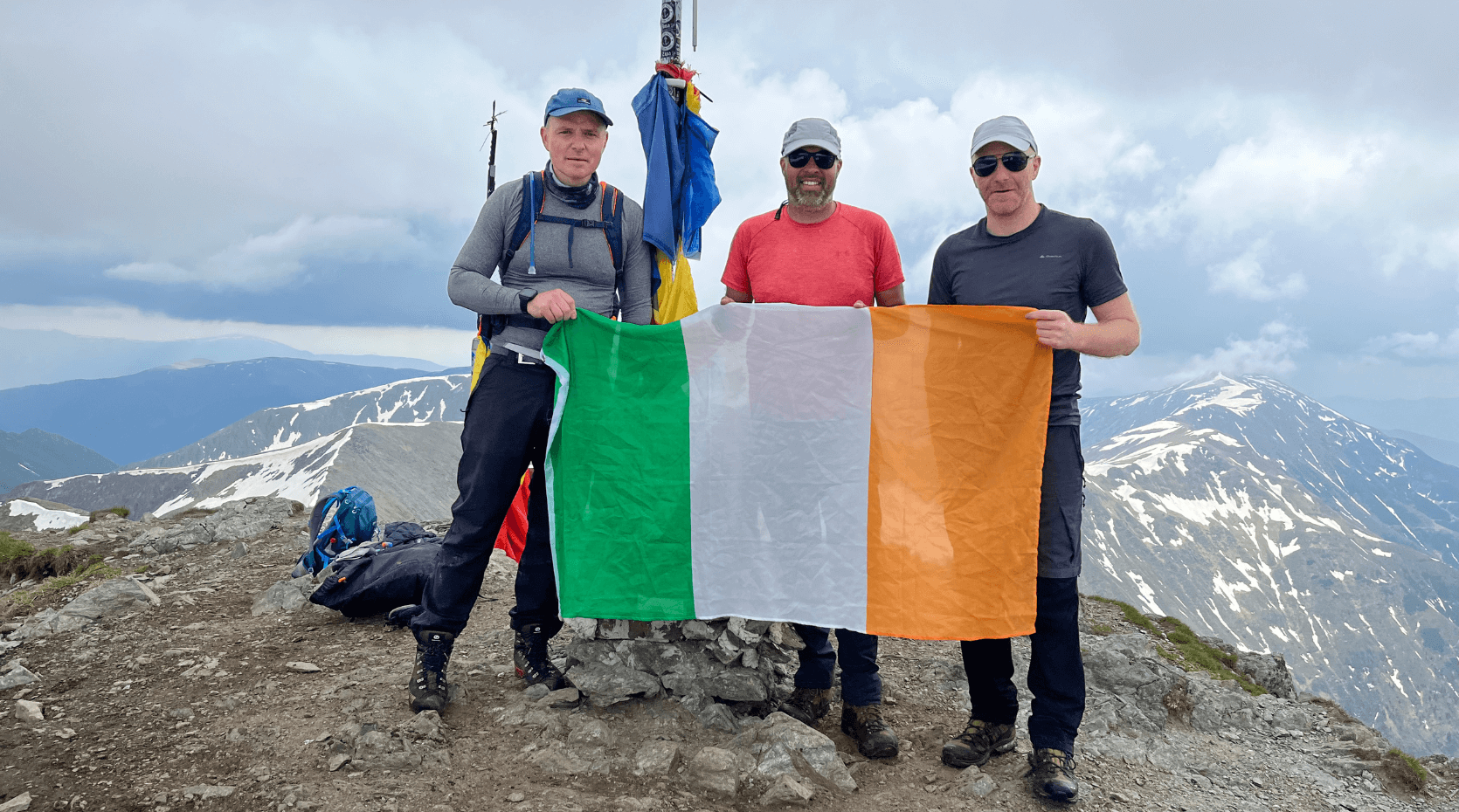
Ian holding the Irish flag with his cousin Darragh Isreal and friend Brian Cantwell in Moldoveanu, Romania
“He said, ‘Come on, let’s go and climb Ireland’s highest mountain, Carrauntoohil.’ And I said, ‘All right.’ So, we climbed it, and I enjoyed it. It’s a tough climb. I was out of breath, and I was like, ‘What am I doing? I’ve bitten off too much here.’ And he encouraged me, and I got to the top and I was wrecked.”
It was a pivotal moment. “I always kind of look at it as like, ‘If I’ve got on the top of Ireland’s highest mountain, I can get on top of my diagnosis,’” says Ian.
“From there I developed a passion for hiking. You can stop, have a bite to eat, you can take in the scenery, it’s great to be out in nature as well – it ticks a lot of boxes without putting too much pressure on me,” says Ian, who is currently training to take part in the Edinburgh Marathon at the end of May, but normally goes hiking two or three times a week. “My favourite thing is when you can get to a place where you can’t see anything manmade, you can’t see anyone else, you’re looking around and you see mountains around you. I think it’s a nice feeling that you’re really with nature,” he says.
Last June, Ian, accompanied by some of his friends, set off to climb Europe’s 28 highest peaks in 28 days to help raise funds for Parkinson’s.
Despite training hard, Ian found parts of it particularly gruelling – he had to pull out of climbing the last 1,000 metres to the top of Mont Blanc in France because his guide was worried about his balance and safety when climbing back down. Reflecting on this now, he says, “Not getting to the top I think was part of the story. I have Parkinson’s; I can’t get away from it. I’m not Superman.”
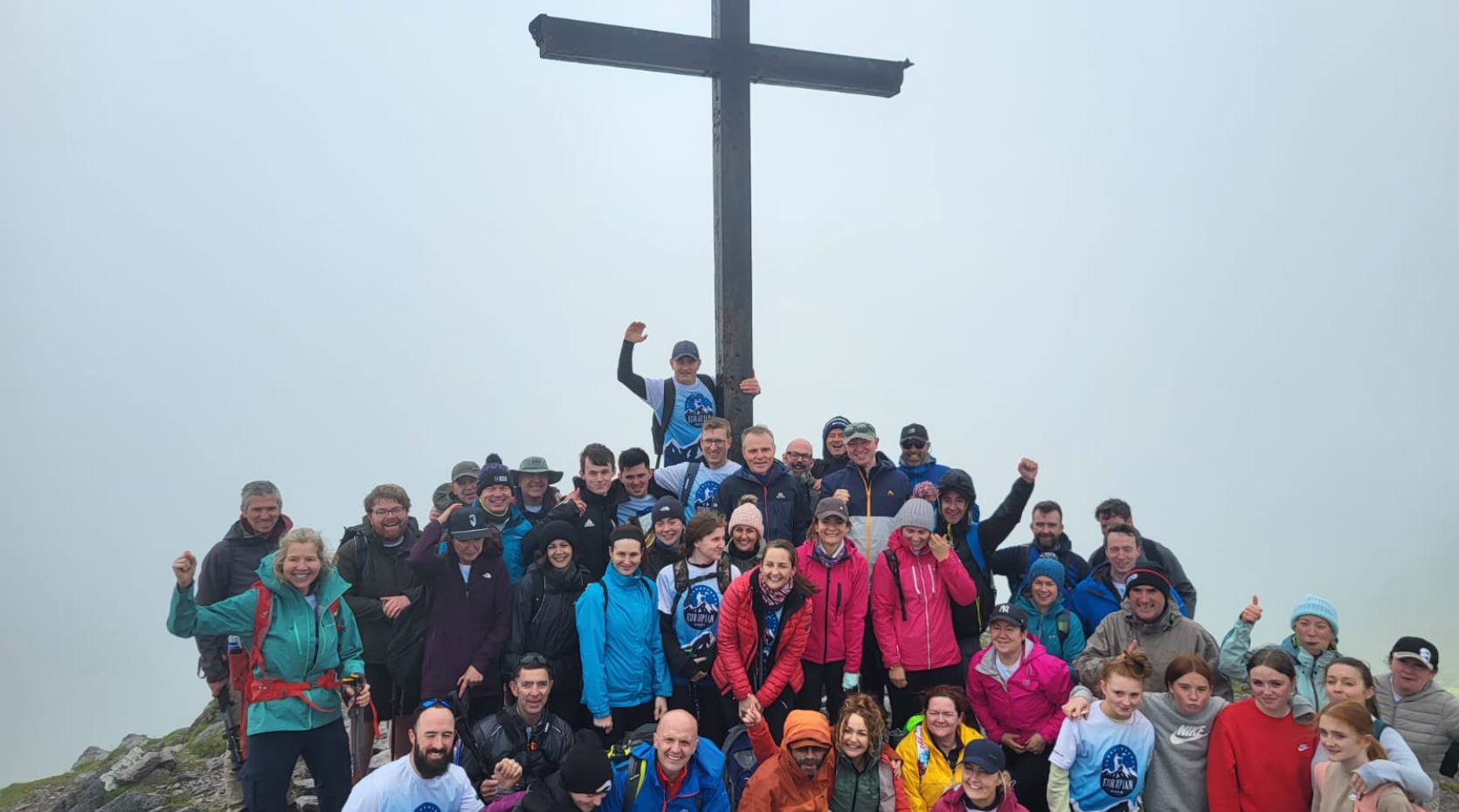
Ian stood at the top of Carrauntoohil in Ireland with all the people who climbed on the last day of his fundraising challenge
Ian finished his 28-day challenge by climbing Carrauntoohil once more. It showed him that setting himself such a physical challenge could reap benefits. “The funny thing about it was I skipped up and down that mountain. It was amazing how my body had acclimatised. I proved a point that when you do excessive exercise and put your body through it that it can relearn and retrain, and my balance was so much better.”
Although he is planning to climb some of the mountains he tackled last year again this summer, he is aware that not all people with Parkinson’s will be able to do the same.
“I’m always conscious to say, ‘If you can’t get off the chair today and you do tomorrow, or you can’t walk down the hall in your house and you do tomorrow, that’s your mountain for the day. Don’t think that you need to go out and climb mountains; just go and do something that you couldn’t do yesterday.”
Cure Parkinson’s Cup 2024: UK walking football tournament sees double win
Highlights from the Cure Parkinson's Cup 2024 walking football tournament at St. George's Park, with over 20 teams - and 200 people with Parkinson's - participating.
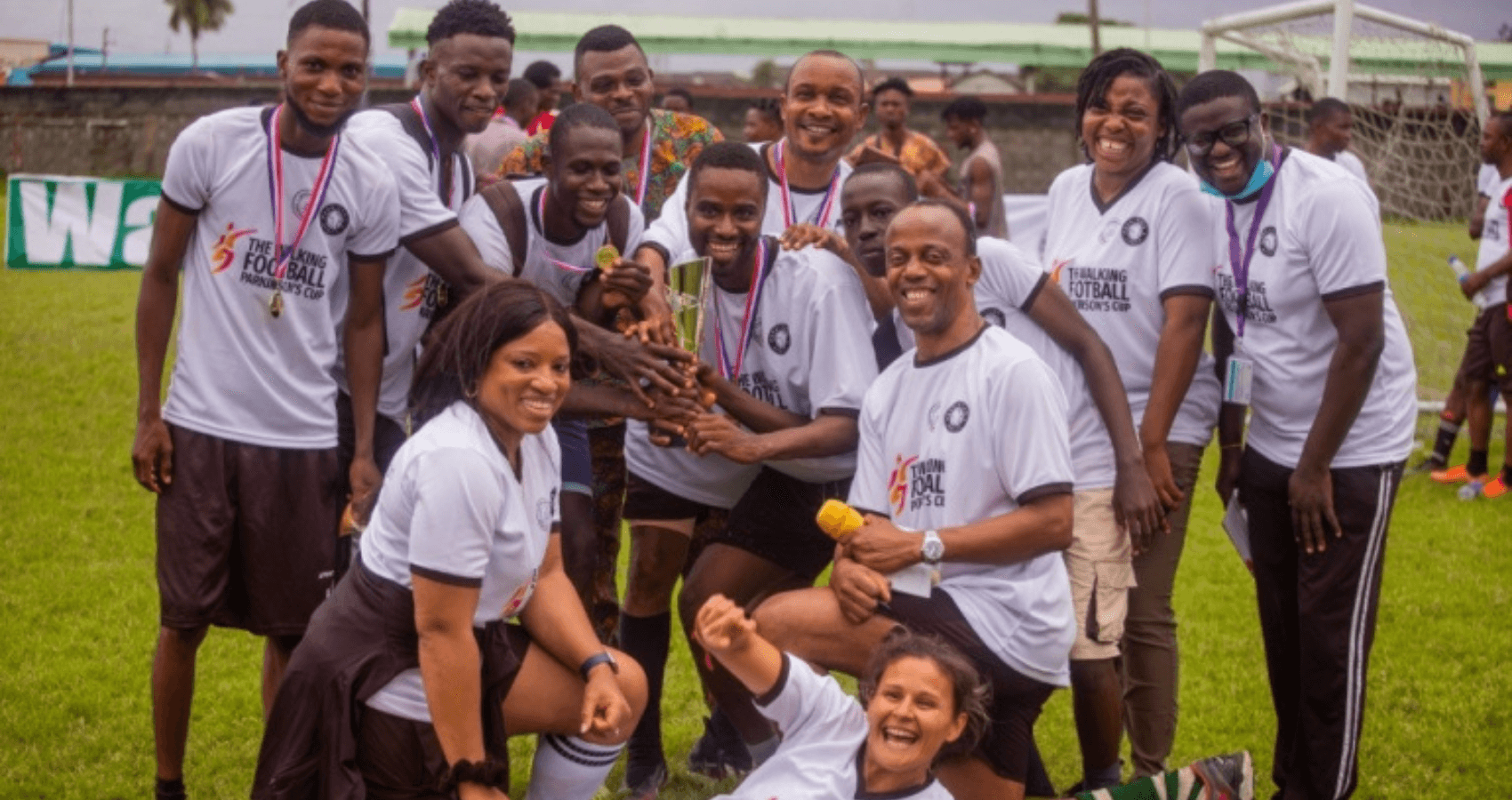
The UK’s Cure Parkinson’s Cup walking football tournament returned for its third year this week (21st April) with Cure Parkinson’s Cup 2024 taking place at St. George’s Park Football Centre in Staffordshire, the official home of England’s national football teams.
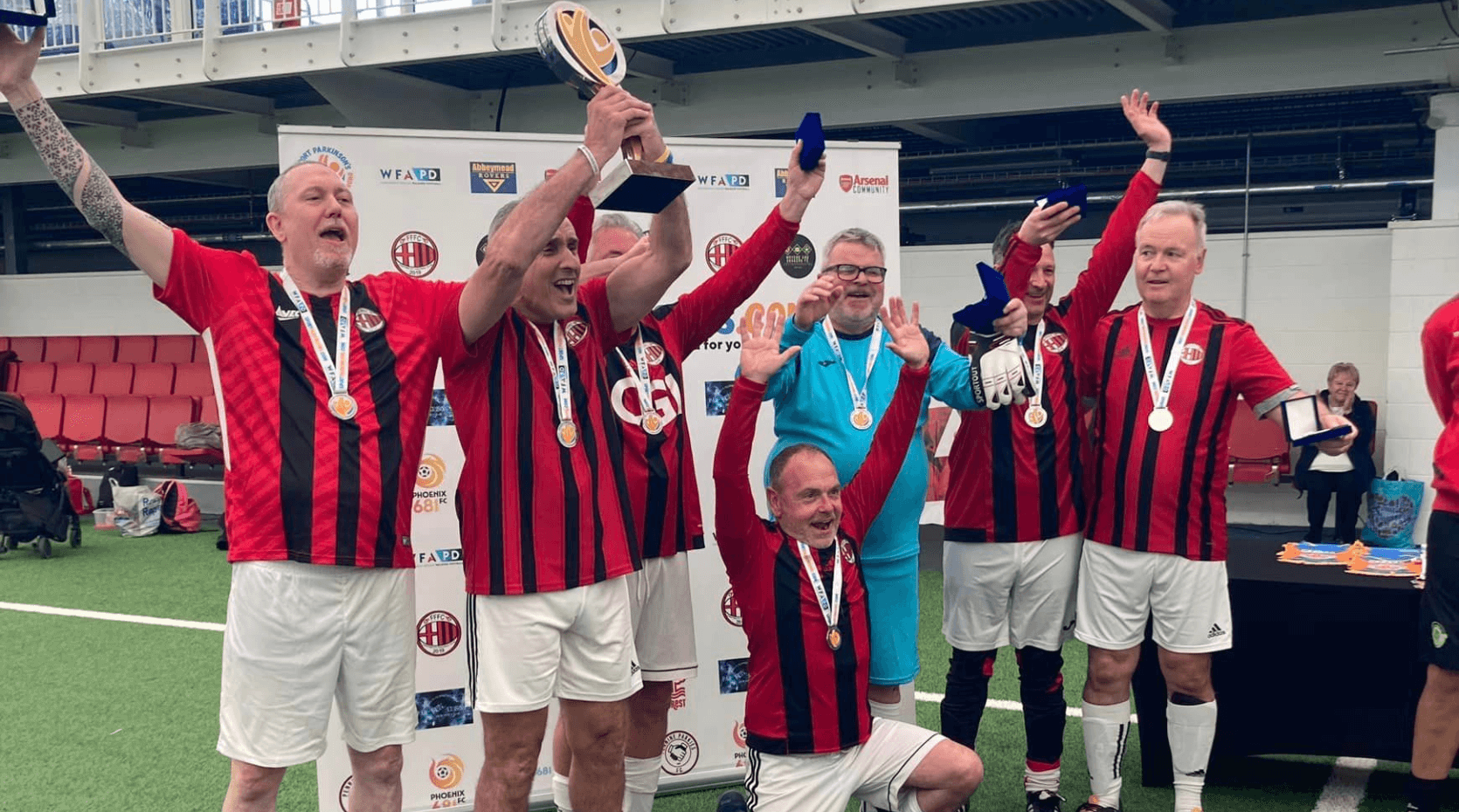
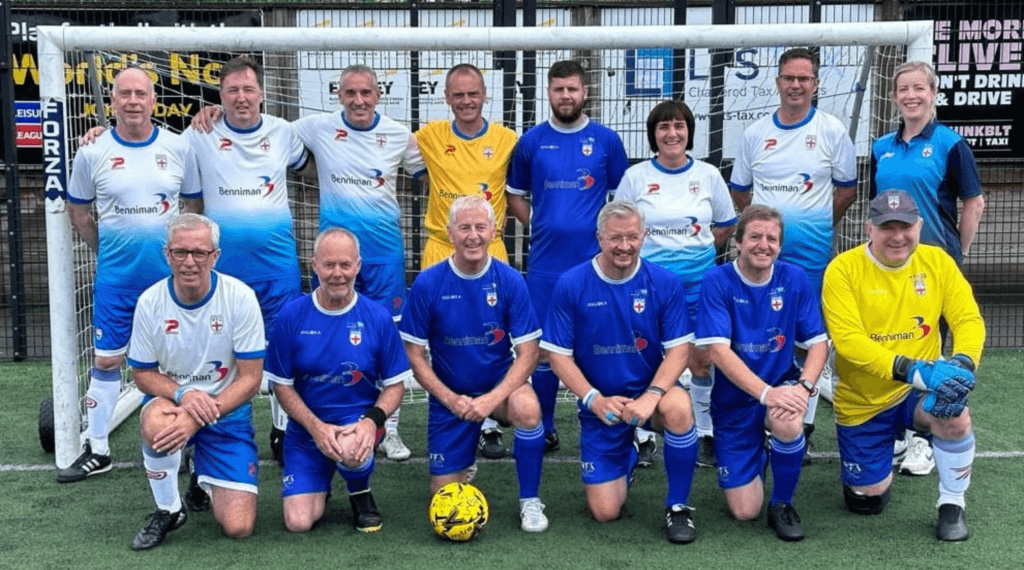
Hosted in collaboration with Sport Parkinson’s and The Walking Football Association (WFA), the 2024 tournament saw 20 Parkinson’s walking football teams from across the UK taking part, with over 200 people with Parkinson’s participating in this free event. Teams included the first women’s team to compete at the Cure Parkinson’s Cup, Parkinson’s Pioneers, who are coached by our recent interviewee Joe Gregory, as well as his Watford-based team Fighting Fit Football (who, like many of the participating clubs, were split into two teams, Red and Black).
There were two prizes on offer: the Cure Parkinson’s Cup and the Cure Parkinson’s Shield. The official draw for the group stage teams took place on 12th April, with the results revealed on Sport Parkinson’s social media:
Just over one week till the @parkinsonscup, we are delighted to share the official Group Stage draw with you.
The day at St. George's Park will see two competitions take place, one for the Cure Parkinson's Cup, and the other for the Cure Parkinson's Shield.
The the group stage games began, the results of which saw eight teams (Fighting Fit Football Red, Northern Lights Liverpool, Phoenix 681 FC Fire, Parkysaurus, Pennine Parkies White, Nottingham Forest, Birmingham and Pennine Parkies Black) progress to the quarter-finals for the Cup, while all other teams progressed to the second stage matches for the Plate prize.
The semi-finals for the Cup saw Fighting Fit Football Red beat Parkysaurus 2-0, while Pennine Parkies White won on penalties against Pennine Parkies Black.
In the Plate semi-finals, Movers and Shakers White and Fighting Fit Football Black both won 1-0 against their opposing teams (Family Team and Arsenal, respectively).
And then it was time for the Final:
And just like that, we’re down to the final games.
Cup Final: Fighting Fit Football Red v Pennine Parkies White
The result was a triumphant double win for Fight Fit Football, with their Red team taking the Cup, and their Black team taking the Plate! Both teams achieved their win with a 1-0 victory.
What a day we had at @parkinsonscup! 20 teams, 200 players, 2 trophies. And our 2 teams won the double!🏆🏆 A tough contest playing 7 games & 8 games respectively vs. top competition. Congrats to each & everyone one of you & thank you to @SportParkinsons@thewfauk for organising! pic.twitter.com/KE5OuqgZxk
— Fighting Fit Football (@FightingFitFoo1) April 23, 2024
Fighting Fit Football later posted on the social platform X to describe the event as “a truly memorable day that will live with us forever”.
Speaking about the 2024 Cure Parkinson’s Cup tournament, Director of Sport Parkinson’s, Garen Williams, said:
“This is the third year we have organised the Walking Football Tournament at St Georges Park, Home of England FA, and it continues to grow every year with more teams and spectators attending. It is so important for people with Parkinson’s to be active and exercise has been proven to slow down the progression. This event brings the Parkinson’s community together to enjoy, make new friends and have fun all in a relaxed and welcoming environment.”
The Cure Parkinson’s Cup 2024 tournament also received widespread praise on social media from participants and spectators:
Cure Parkinson's Cup (we all have #Parkinsons ) typical snapshot 🏆
Ian (left) recently had DBS brain surgery 🤕 Jonny is an esteemed and loved A&E doctor, and we'd just discussed his additional testicular #cancer diagnosis 😳
Inspiring day @SportParkinsons cure parkinsons cup. Congratulations to our friends @FightingFitFoo1 whose strong, supportive community took both trophies. Proud of everyone who took part not least our wonderful @PDPioneers who make me smile with their tenacity & positivity pic.twitter.com/WXuQNwYzER
Here’s to everyone playing, watching and organising @CureParkinsonsT the tournament goes from strength to strength. A credit to the positivity of the #Parkinsons community during amazing things. pic.twitter.com/56ry5GDPZ2
— Wansteadgroundhopper (@Wansteadground2) April 21, 2024
The date for the 2025 tournament has already been announced, with Sport Parkinson’s confirming that the fourth Cure Parkinson’s Cup will take place on Saturday 19th April 2025. Those who are interested in taking part should keep checking the Sport Parkinson’s and WFA websites.
Further information about the Cure Parkinson’s Cup can be found in this promotional video:
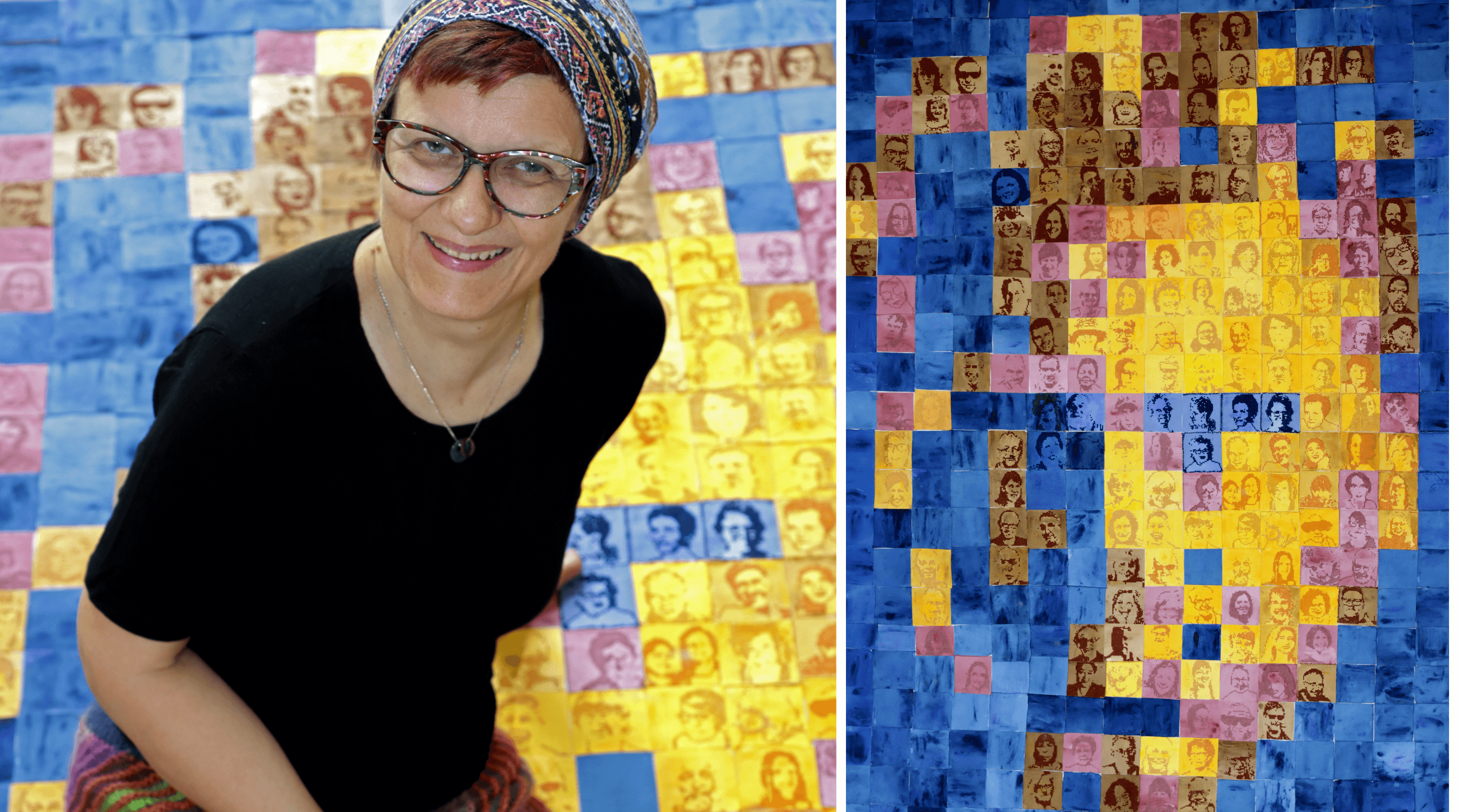
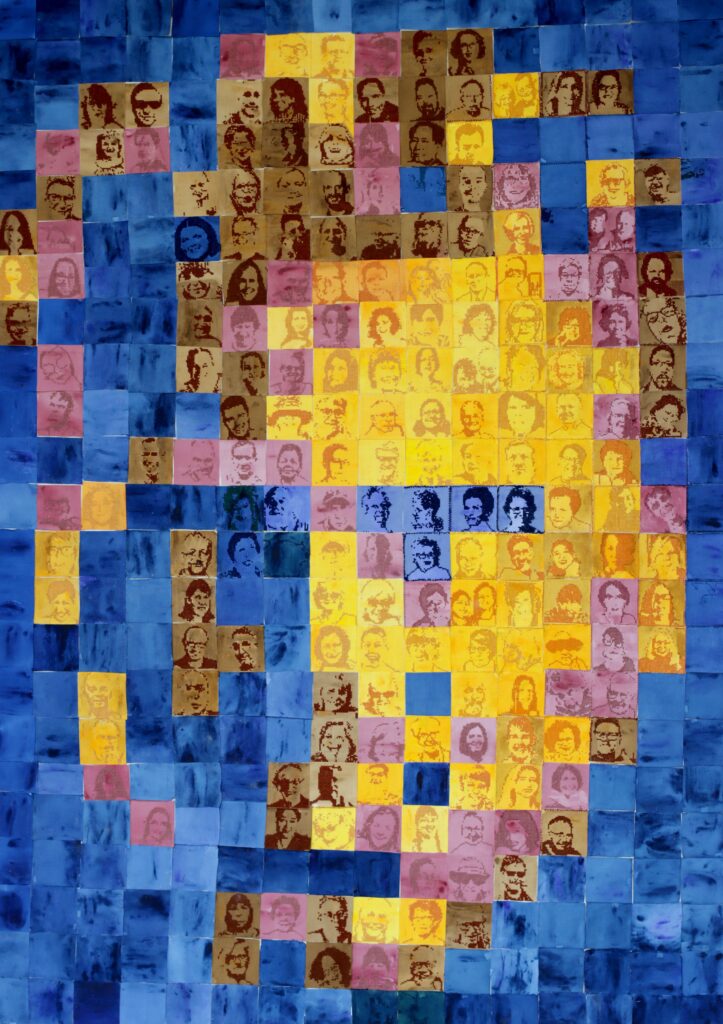
As this year’s World Parkinson’s Day (11 April) approached, Hamburg artist and person with Parkinson’s May Evers was busy sewing the final stitches of her P-Quilt, a handmade textile installation depicting the faces of 185 people with Parkinson’s from all over the world.
Three years ago, May began her project by calling on the international Parkinson’s community to send in photographs of themselves – and people from Germany, Switzerland, Austria, Spain, Italy, Great Britain, Ireland, the USA, Canada, Australia, Vietnam, India and the Canary Islands responded.
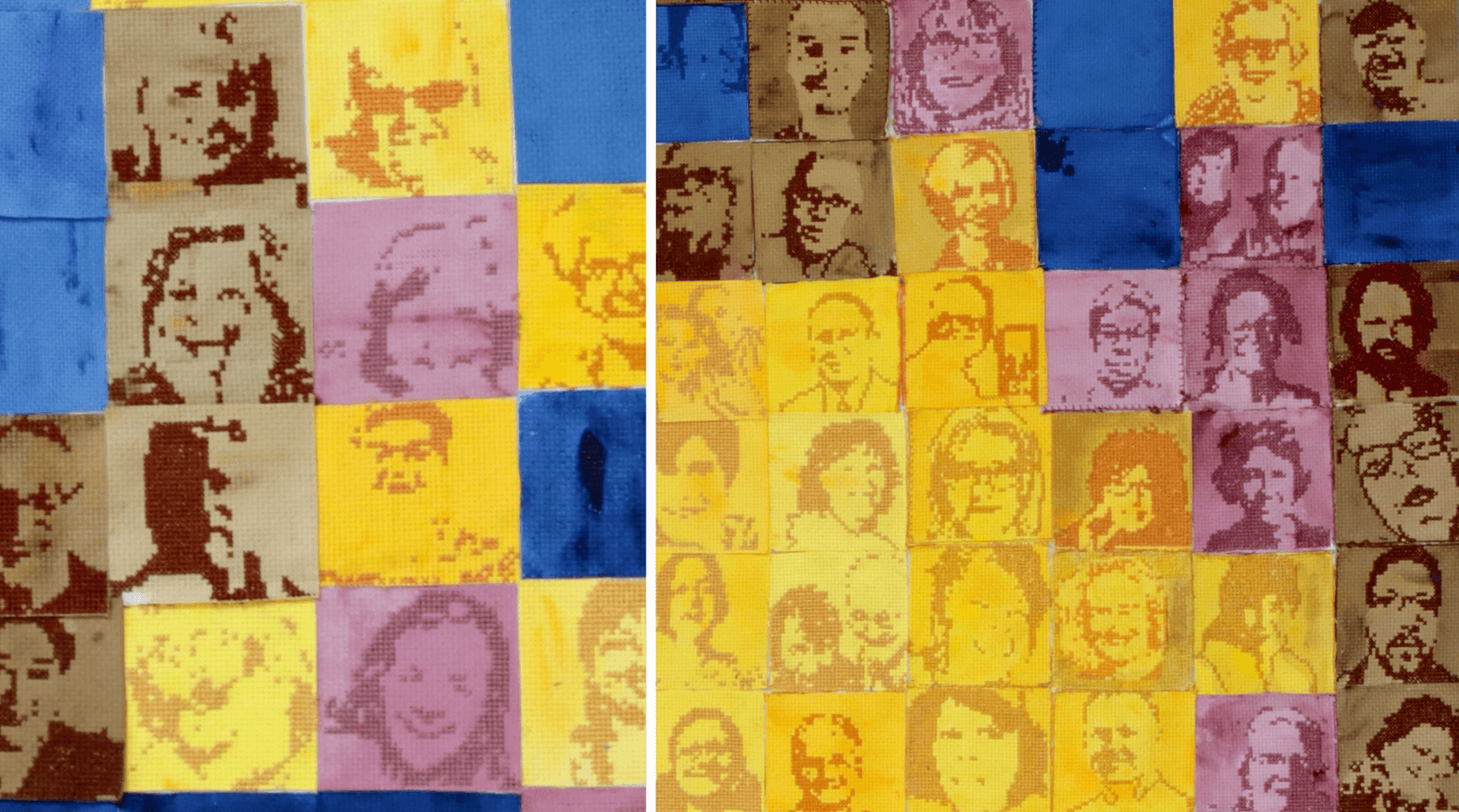
May used the photographs to cross-stitch monochrome portraits by hand onto coloured squares of brown, purple, yellow and blue fabric. She then joined the squares together to create a 2-metre by 1.60-metre tapestry. Together, the images form a large face that symbolises the close bond the Parkinson’s community has forged through having the condition.
Close-ups of some of the portraits featured in the P-quilt
“The initial inspiration came from a friend who makes pop-art photographs, and then I came across some pixel-art pictures and took it from there,” says May, who was diagnosed with Parkinson’s ten years ago at the age of 50. “What I want to express with the picture is fairly simple. I wanted to show in a creative way that each and every person has a very individual experience of Parkinson’s and yet we are all in the same boat.”
She adds, “Art and creativity are powerful tools to address complex issues like Parkinson’s. With art, we can encourage dialogue and understanding of the challenges people with Parkinson’s face every day.”
May also documented the painstaking process of creating the quilt on her blog, Der Erste Fisch (The First Fish), on which she writes about her various other crafting projects, including crochet, knitting and embroidery, and her journey with Parkinson’s. On the blog, she poetically described the process of creating the quilt as:
“With each cross stitch, the life story of the person whose portrait I was embroidering unfolded. I knew many people personally, and I only got to know many of them through the project. Many have told me their stories or written as part of the project. Some I only got to know long after I had stitched their portrait and it was as if I already knew them.”
The finished P-quilt
She also described the moment she realised she’d finally finished the Parkinson’s quilt, coincidentally just in time for World Parkinson’s Day, as being “filled with a mixture of feelings of awe, melancholy and pride at the completed project.”
Now it’s finished, May is hoping that the 10-metre-square quilt can be displayed publicly somewhere, and she also hopes she might be able to sell the quilt and donate the proceeds to the Hilde-Ulrichs-Stiftung für Parkinsonforschung (Hilde-Ulrichs Foundation for Parkinson’s Research) – a German charity that helps people with Parkinson’s access non-medicinal therapies – at which May is a patient representative. She’s asked that anyone with knowledge of potential sponsors, curators or other ideas should contact her via her blog.
Find out more about the creation of the P-quilt and May Evers’ other crafting projects on her blog, Der Erste Fisch
The World Parkinson Coalition has announced that World Parkinson Congress 2026, which is to be held from 24-27 May, will take place in Phoenix, Arizona in the United States.
This will be the seventh World Parkinson Congress, with the 2026 event seeing the congress returning to North America for the first time in a decade. It will also mark the 20th anniversary of the World Parkinson Coalition, which was formed in 2006.
The announcement was made on 23 April on social media, beginning with a Facebook Live event, with the World Parkinson Coalition also announcing a new website – wpc2026.org – has been launched giving key details about the next congress. This includes the venue – the Phoenix Convention Center – located in the heart of the city, with over 500,000 square feet of exhibition space. During the Facebook Live, a video showed Parky the raccoon, the World Parkinson Congress mascot, has recently been to visit the convention center, and seemed suitably impressed.
While the event is still two years away, there are already various ways that future attendees can get involved in the congress.
For instance, the congress’ website has announced that a monthly raffle will take place during a live social media Q&A from 31 May, which can be entered by posting a photograph of a sign saying “See you in Phoenix at the WPC 2026”, and either submitting the photo via the WPC website or posting it on social media. During the Facebook Live event, it was confirmed that raffle prizes will include WPC 2026 merch, which will be handed out to raffle winners at the congress itself.
“Each time we host the World Parkinson Congress, we select a small group of Ambassadors, both Ambassadors living with PD (Parkinson Ambassadors) and Ambassadors who are researchers (Science Ambassadors) to help us raise awareness of the Congress but also to help extend our very small team so we can reach more communities to make sure they have this incredible experience on their radar for 2026.”
There’s further details about what these ambassador roles involve and how to apply on the WPC website.
From 2025, there will be other opportunities to get involved in the congress, including a video and song competition and abstract submission opportunity, with registration for the event itself opening in September 2025.
The last World Parkinson Congress was held in July 2023 in Barcelona, Spain, with over 2,500 people from 73 countries attending, including neuroscientists, clinical researchers, clinicians, rehabilitation specialists like physiotherapists and occupational therapists, nutritionists, people with Parkinson’s, their care partners and more.
Previous World Parkinson Congress events have been held in Kyoto in Japan, Portland in Oregon, USA, Montreal in Canada, Glasgow in the UK and Washington DC, USA.
More details about the 2026 World Parkinson Congress will be announced on the WPC 2026 website in the coming months.
Essential Tremor and Parkinson’s disease: two different diseases with one thing in common – stigma
Essential Tremor is the most common movement disorder, with approximately 60 million people affected around the world, compared to an estimated 10 million people living with Parkinson’s globally. While they are very different conditions, people with either condition can experience stigma.
18 April 2024
Verity Willcocks Sponsored by Insightec
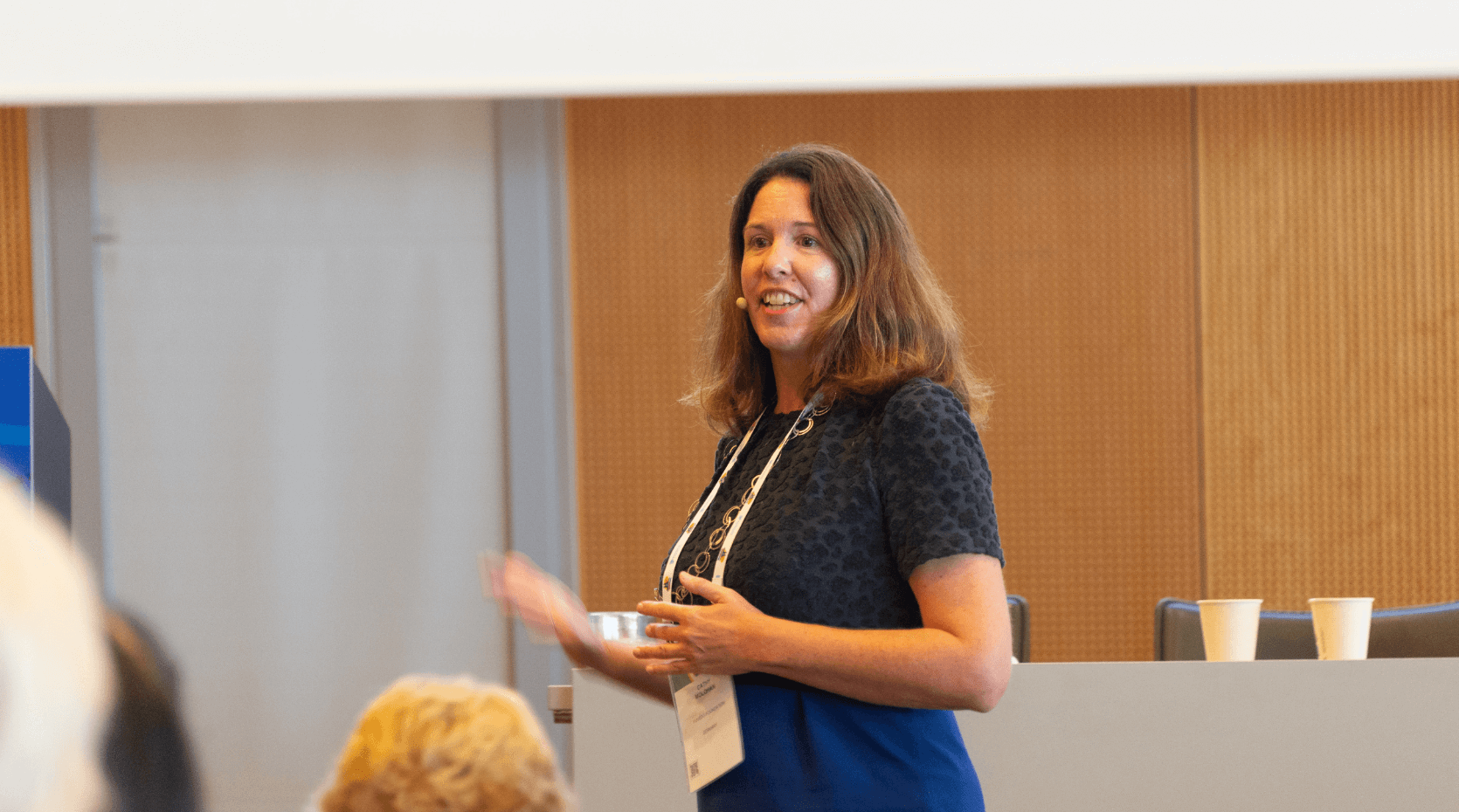
Here, Dr Antonella Macerollo, who is Consultant Neurologist with expertise in movement disorders at The Walton Centre in Liverpool, UK, and Honorary Clinical Senior Lecturer at the University of Liverpool, discusses clinical features and available treatments of Parkinson’s disease and Essential Tremor. Afterwards, we hear from Cathy Molohan, a person with Parkinson’s disease, and Jackie Farrell, who has Essential Tremor, to learn how they have each experienced stigma and what can be done to reduce it.
Dr Macerollo on Parkinson’s disease and Essential Tremor
What are the differences between Parkinson’s disease and Essential Tremor?
Essential Tremor and Parkinson’s disease are two completely different conditions that are part of the wide family of movement disorders. These disorders can be present in the same patient due to the high prevalence of both of them. Parkinson’s disease is a neurodegenerative condition involving the basal ganglia. Usually, the peak of incidence is around 65 years old, but there are young onset forms with an onset before 50 years old which are often genetic. The main motor symptoms are resting tremor, rigidity, slowness of movement and changes in posture. Moreover, patients are affected by several non-motor symptoms (for instance, lack of sense of smell, fatigue, pain).
Essential Tremor was defined in the past as benign Essential Tremor because it is not associated with a neurodegeneration of the brain. However, although we label it as benign, it is a condition that progresses over a lifetime, and it is significantly disabling. The age of onset can be as young as primary-school or secondary-school age, but the peak of incidence is between 60 and 70 years old.
The Essential Tremor is an action or postural tremor and not present at rest (contrary to the Parkinsonian tremor). Typically, the patients describe the presence of the tremor during voluntary actions (e.g. holding a cup of tea). Essential Tremor is also associated with changes in a part of the brain called the cerebellum, causing balance difficulties in this group of patients. Unlike in Parkinson’s disease, cognitive function is not affected in those with Essential Tremor.
What sort of treatment is there for Essential Tremor?
Essential Tremor is treated in the first instance with pharmacological treatments, such as propranolol, primidone, gabapentin, pregabalin, and zonisamide. These are symptomatic treatments to reduce the severity of the tremor. However, only 50 per cent of patients respond to the pharmacological treatments. Moreover, these therapies lose efficacy over time due to the progression of the tremor. It is important to note that many patients have side effects, such as drowsiness, and they have to come off these medications. For those patients who are medication-refractory, advanced therapies may be considered.
What advanced treatments are there for Essential Tremor?
Once we have tried at least three different pharmacological treatments, the next step is to discuss with the patient the possibility of an advanced therapy such as deep brain stimulation and MRI-guided focused ultrasound thalamotomy.
Deep brain stimulation is a treatment discovered and established about 30 years ago by Alim Benabid and his team in Grenoble, France.
MRI-guided focused ultrasound thalamotomy is a relatively new treatment which has been available for around eight or nine years in different European countries, especially in Spain. Magnetic resonance-guided focused ultrasound (MRgFUS) is an incisionless technology using MRI imaging to guide high-powered, focused ultrasound to a sub-millimetre point. At that point, molecules are vibrated extremely quickly, which createslocalised heat. First, with medium power and thermal imaging feedback this can be used to clinically test the safety and efficacy. Then, once the target is confirmed, this can be used to create a permanent lesion, blocking the faulty signals.
MRgFUS allows clinicians to target a very specific focal point, so only the targeted tissue is affected. Patients remain awake for the approximately two-hour treatment, often experiencing an immediate reduction in their tremor and in many cases leaving hospital the same day.
As for every neurosurgical procedure, there are selection criteria to be eligible for this treatment such as pharmaco-resistant tremor, no significant balance impairment, and no significant cognitive difficulties.
MRI-guided focused ultrasound is CE marked and approved for staged bilateral treatment, meaning treatment of both sides of the body, for Essential Tremor in countries where the CE label applies including the UK. However, only unilateral treatment (treatment of one side of the body) is currently covered in the UK by the National Health Service. For non-NHS patients where a staged bilateral treatment is being considered, specific conditions of treatment should be discussed with an expert centre.”
Does DBS for Essential Tremor work in the same way as it does for Parkinson’s disease?
The mechanism of action is the same, but the stimulation is directed to a different region of the brain.
What sort of treatment is there for Parkinson’s disease?
We have several pharmacological treatments such as dopamine agonists, levodopa, MAO-B inhibitors, and COMT inhibitors.
The first-line therapy is dopamine agonists in the young-onset forms of Parkinson’s disease; however, side effects are very common (especially impulsive control behaviour disorders). Levodopa is the most used therapy; however, some patients can develop side effects in the long-term such as involuntary movements (dyskinesia).
What advanced treatments are there for Parkinson’s?
There are advanced therapies such as deep brain stimulation, apomorphine pump and duodopa. Notably, MRI-guided focused ultrasound is now CE mark approved for the treatment of Parkinson’s disease but is yet to be available on the UK NHS.
From your experience of Essential Tremor, what sort of stigma have people experienced?
Stigma affects especially young people. For example, I have a 28-year-old patient who is a chef, and the tremor significantly affects his job’s activities. The main stigma is that patients feel continuously observed in social environments and, if this is the case, they become isolated to avoid these situations.
In addition, patients with Essential Tremor very often describe feeling stressed by constant questions such as “why do you have tremor? Is it Parkinson’s disease? Are you drunk?”
Importantly, some patients with Essential Tremor start to drink excessive amounts of alcohol to reduce the severity of their tremor. Indeed, Essential Tremor typically responds to alcohol – but this is of course not medically recommended.
What stigma have you heard about from people with Parkinson’s disease?
People with Parkinson’s disease feel the stigma of other people watching them in the social environment. Moreover, people often confuse dementia and Parkinson’s disease; therefore, patients with Parkinson’s disease feel the stigma that other people are thinking they have dementia when they do not.
Cathy Molohan
Cathy Molohan at the World Parkinson Congress 2023
Cathy Molohan is a 50-year-old Irish woman with Parkinson’s who lives in Germany. She was diagnosed when she was 38 after noticing a finger tremor. She has had DBS, which has reduced her hand tremors. Here, she discusses her experience with stigma and tells us what she thinks needs to change.
What has your experience been with stigma – from yourself or from others?
Self-stigma is definitely more of an issue for me than stigma I’ve experienced from others. I’ve been very lucky in that sense. For a while the tremor in my hand was the worst symptom: carrying two drinks from the bar was impossible. So, I’d only take one and the barman would be thinking, ‘What’s wrong with you, why can’t you carry two glasses?’ You get odd looks from people where you know they’re thinking, ‘What’s wrong with her?’ Why does she walk funny or have a tremor, or whatever. You’d have people looking at you in a restaurant when you’re trying to cut steak and you’re like this [shakes both hands], so I noticed when I went out, I was avoiding ordering something like steak and would order risotto or something easy to use a fork with. That’s when the self-stigma kicks in.
Have you experienced stigma at work?
I ran my own business for years, and I just told my business partners and my colleagues: “This is the story.” I told them pretty much straight away. They were super relaxed about it. I was very aware of the fact that I didn’t want to have to hide my symptoms at work and I knew the tremor was visible, and I didn’t want people to think I was drunk or nervous or having withdrawal symptoms from drugs or something like that.
I was doing sales for my own company, so I was very client-facing, and I just contacted clients of mine and said: “This is what is going on” and they were all super understanding.
As I had my own business, I knew I couldn’t be fired. I knew I wouldn’t be disadvantaged because of my symptoms, so it was a very privileged position to be in. Not everybody is in that position.
When you say people have given you funny looks, has that made you withdraw in any way or stop doing things you used to do?
In the beginning, I would try to hide symptoms. I’ve kind of learnt to get on with it now. I wouldn’t say I don’t care, that’s not the case, but I’ve learnt to say, “This is who I am: take it or leave it.”
I’m lucky in that I don’t have severe dyskinesia or something that would draw lots of attention to myself. I can see people on the train if my leg is shaking thinking ‘God, she’s very nervous.’ Or if I’m having a bad day and my gait is maybe a bit funny.
What can be done to reduce stigma?
I think the key to battling stigma or self-stigma is openness and education. There are situations, for instance, if you’re in a group yoga class and you’re struggling to do the moves as fast as everybody else, or you fall over when you’re told to do the balancing exercises. In those situations, when the teacher asks, “Does anybody have any restrictions?” at the beginning of the class, I’ll always put up my hand and say, “I’ve got Parkinson’s, so don’t worry if I look a bit funny.” And then 95 per cent of people will just smile and go, “Fair play.” That’s western society in a big city where people tend to be more aware.
I think a lot of people aren’t aware that you can get Parkinson’s young, so I get a lot of looks like ‘Ooh, Parkinson’s at your age; God, that’s unusual.’ I try to enter into dialogue and say, “It’s not as rare as you think.”
That’s where we as a community need to work to change the image of Parkinson’s. When you google Parkinson’s, you get an image of a very bent-over, shaky old man with a stick, and we’d love to change that, just to change the perspective in people’s heads and for people who are newly diagnosed as well. Even if you’re diagnosed when you’re older, it can take a long time till you get to that bent-over, shaky, dependent stage.
You ran a workshop on stigma at the World Parkinson Congress in Barcelona last year. What have you discovered from talking to other people with Parkinson’s about stigma?
It’s a huge range. You’ve got people who are scared to say they have Parkinson’s because they’re the main breadwinner in the family. They’re afraid of losing their jobs. You’ve got people in African countries who literally get accused of witchcraft, and that’s a real issue in some places. We had examples of people who don’t go out anymore because they’re afraid of being judged or laughed at and who suffer then from massive social withdrawal symptoms, isolation, loneliness. You’ve got people who themselves don’t know about the disease, so they don’t know what to tell other people. They mightn’t have the vocabulary or knowledge to explain what’s going on with themselves, never mind to help other people understand.
What needs to change to relieve stigma for people with Parkinson’s?
We need data; we need to prove that this is a huge issue that impacts people’s wellbeing, mental health, financial status, workplace situation. Based on that data, we need coordinated campaigns to educate people about Parkinson’s and other neurological diseases, so that people with the condition feel more aware, more empowered, more comfortable to talk about their diagnosis and therefore don’t get excluded from the workplace or from social life.
A lot of people could keep on working but they’re afraid to say, “I need to work slightly differently,” or, “I need a dictation program for my computer.” Or “I need to start a bit later in the day because my medication doesn’t kick in in the morning.” Or “I need to work part time because I get fatigued very often.” People try to push themselves to be normal – whatever that is. They reach their limits and then they crash out at the workplace and become a financial burden for the state instead of being a contributing member of society for as long as possible. If I hadn’t had an understanding team around me, I would not have been able to keep working.
We need universal language that’s culturally aware, where people can describe their symptoms and their fears, and we need education from school age upward. I was in Ireland a couple of days ago babysitting my nieces, and the seven-year-old says “How’s your Parkinson’s?” I just think it’s lovely that my brother brought her up to be aware and not to be afraid to ask.
What would your advice be for someone with Parkinson’s who is battling stigma?
I would encourage people to network, to talk to other people with Parkinson’s, and to reach out to organisations. If you’re finding yourself tending to hide away, really try to battle that. There are people out there who can help you to fight that.
It’s about accepting differences in society, I think we’ve all become very Instagrammable, TikTokkable: you have to be perfect; you have to be sexy; you have to be gorgeous; you have to be clever – and you’re not allowed to have a shake or have something wrong with you. We need to really move away from this image of ‘everything is perfect’ for people’s mental health as well because who is perfect? We really need to combat that in our society. It just adds to it all.
Jackie Farrell
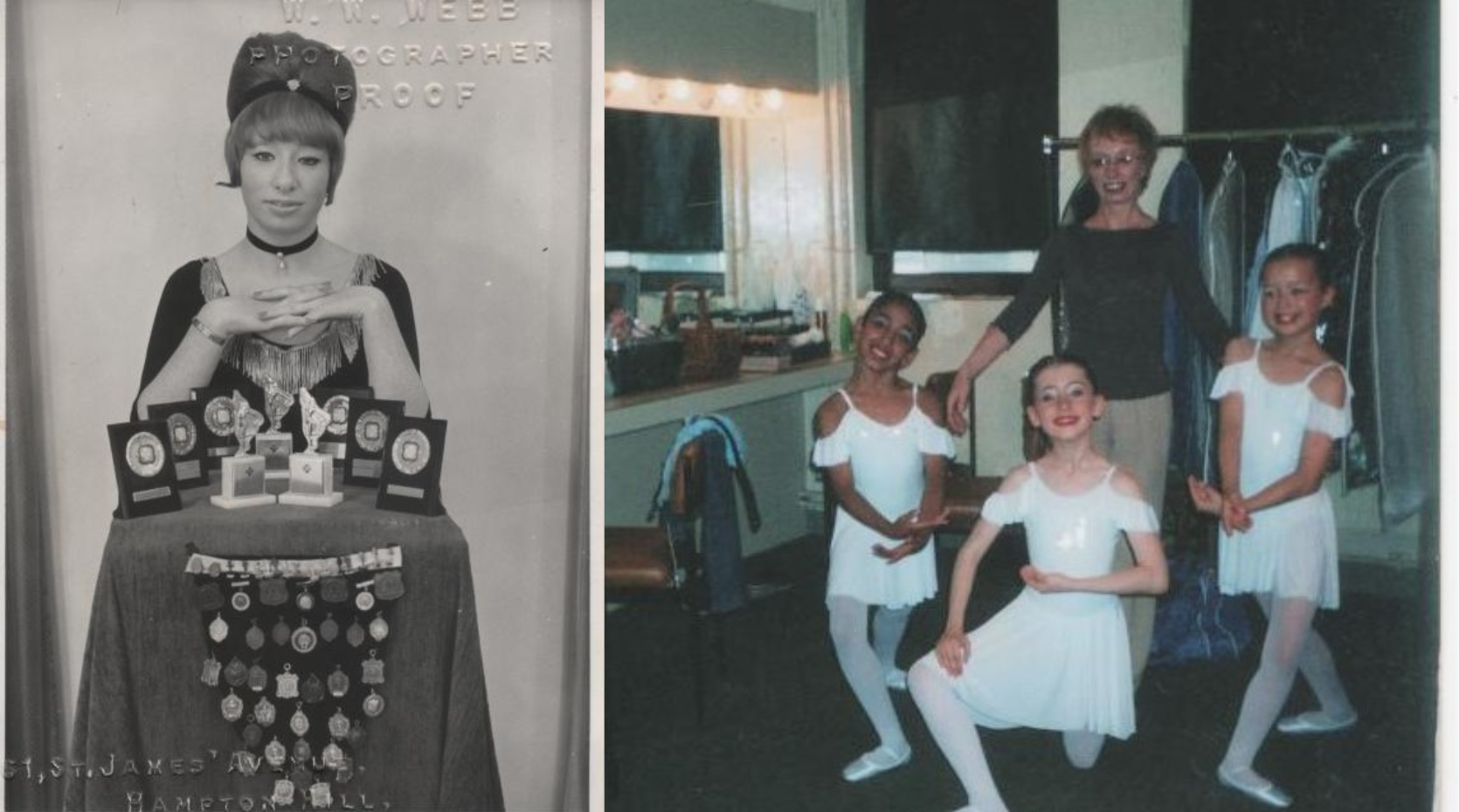
On the left: Jackie with her dance awards; on the right: Jackie with her classical ballet pupils
Jackie Farrell, 77, from the UK, was diagnosed with Essential Tremor back in the 1970s when she was in her twenties, after a friend noticed a tremor in her hand. A retired dance teacher, her condition has since progressed; her hand tremor has worsened and now she has a head and jaw tremor and also experiences leg tremors. She does not take medication, preferring to manage her condition through practising daily meditation and mindfulness, which she finds helps calm the tremors. She now volunteers as Support Group Coordinator for the National Tremor Foundation (NTF) in the UK. Here, she tells us her experiences with stigma and what she believes can be done about it.
How does Essential Tremor affect your life?
My hand tremor affects eating, drinking, writing, mobile phones, technology, cutting nails – any fine motor task. And when you have a head tremor you have other challenges: for example, putting on makeup. One of the biggest challenges is going to the dentist. On rare occasions, my leg tremors can trigger a wave of tremors up the body, and then I’m left looking a bit like I’m a wobbly jelly or I’m having a fit.
How has it affected your work?
I’m a retired dance teacher and I started my school in 1964. I’ve always been self-employed. I had a mild tremor in my hands back then, so it didn’t really affect my teaching – but with hindsight maybe it did. Classical ballet was the main subject I taught and, as you can imagine, you have to have very precise hand movements. Because the hand tremors had started to progress from about 2000, I knew that the time would come when I would have to stop teaching, and that was in 2004. I’d had my school 40 years. It was a devastating time for me, not only with the school, but because dance had been my life since the age of three.
How has stigma affected your life?
Going back many years ago when there was no internet and no associations, we really were on our own. If you were out in a social environment, or out in a restaurant or a cafe, that could be very embarrassing when you had never met another person with the disorder, and I would notice people looking at me, and I’d automatically think: ‘They’re looking at me because I’m shaking. Do they think I’m drunk; do they think I’m on drugs?’ And some people have thought I have Parkinson’s, so all these things would go through my mind.
And on some occasions, if a person had been sitting on a table next to me, they would move, just one table along. My mind would think: ‘They’re moving because of my tremors,’ but of course I had no reason to believe that was the case. At checkouts, I’d be standing there trying to get the money out of my purse or to pay by card. And then it would take so long that a queue would build up behind me and I could hear, “Tut, tut, she’s taking so long.” These days, I say very politely to those behind me “Please excuse me, I have tremors.”
I was at St Pancras International station in London a few years back. All the trains had been cancelled, and I was panicking as I had no idea how I was going to get home. Stress and anxiety will increase the tremor, and it caused a whole-body tremor, and people just moved away. It really hit me that nobody was coming to see if I was OK. All I wanted to do was find somewhere to sit down as if I sit down, the tremors will calm down. It took a while, but then one kind lady came up to me and asked if I was all right. And I said, “Oh, thank you, I just need to sit down.” A station attendant then came over and he was brilliant and kept me updated on the train situation.
I’ve never experienced any stigma from family or friends – I’ve been quite fortunate. However, I do hear from other people who withdraw from society through embarrassment, who won’t even go to eat with family members.
Did you experience self-stigma?
I didn’t avoid going anywhere. A lot of people will hide their tremors, and years ago I was one of those. We’ll sit on our hands, or we’ll let them relax, because if our hands are relaxed, they will generally be still.
How have you dealt with stigma?
Going back to when I was teaching, before 2004, I never told the parents about my tremor. Looking back, I wish I’d have had the confidence to tell them. I had ways I could hide the tremors while I was teaching. It was only when I had to stop teaching that I told the parents for the first time: “This is what I have.”
About 12 years ago, after I’d retired from teaching, I thought ‘What can I do that would help others with Essential Tremor?’ So, I started raising awareness and supporting people, and for the last eight years I’ve been Support Group Coordinator for the National Tremor Foundation.
What is your advice to others about dealing with stigma?
Contact the NTF and meet others with the condition. I run two support groups myself face to face, and meeting others helps lift any self-stigma. People say: “It’s so lovely to talk to somebody else who knows what it’s like.” We support one another – and myself as well – but it’s also an opportunity to have fun and make new friends.
Since I’ve been a Support Group Coordinator, people have told me “I feel alone”, and “I don’t go out; I stay at home through embarrassment.” One of the things that we encourage people to do is to talk about their tremors. For example, if you’re at a social occasion and there’s people there that you don’t know, if you explain in the beginning that you have a tremor, if they see you shaking, they’ll know not to worry. The president of the NTF is Lord Julian Fellowes, creator of UK TV series Downton Abbey, and he’ll encourage people to explain in advance if you’re in a social environment: it helps put the people around you at ease. And it helps the person with the tremors to relax as well. But it does take a lot of confidence to take that first step: to talk about your tremors and to just not worry what people think.
The NTF has a handy Essential Tremor leaflet, so what I sometimes suggest to those with the disorder is, “Look, have some of these leaflets in your bag.” I have them in my bag, so if I’m stopped anywhere and somebody wants to know more about the condition, I say, “Here’s a little leaflet,” and that’s quite a simple thing to get over the embarrassment.
I found that once I started talking about my tremors, it was almost like a weight had been lifted. And that first time is the hardest. But the more I started talking about it, the easier it got. I’m not so embarrassed now. This is who I am, and if people do move then they move – that’s not my issue.
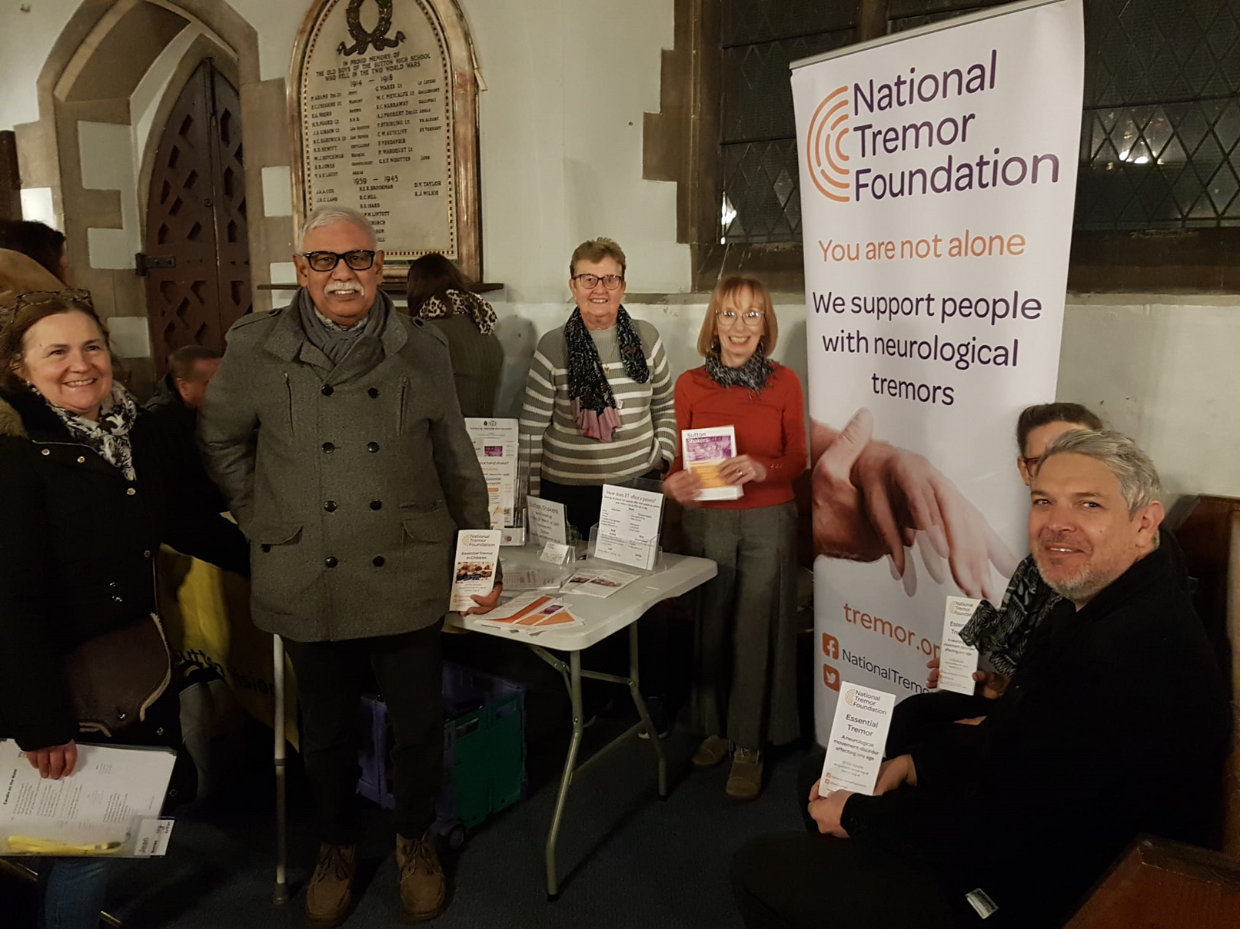
Jackie volunteering as Support Group Coordinator for the National Tremor Foundation
What can be done to reduce stigma in general society?
More awareness: that’s what Essential Tremor needs. And in the medical profession as well. People have told me: “I was diagnosed but basically just sent home; there was nothing to give me any information or tell me where I could go for advice.”
Of course, there are neurologists that are very supportive, so I do hear the other side, from people that tell me how good their neurologists/GPs have been to explain in more detail, and even to point them in the direction of the NTF, which is great to hear, but we need that right across the board.
And in schools, teachers don’t know about Essential Tremor, and I never say it disrespectfully; it’s just a lack of awareness. But if a parent doesn’t know if their child has Essential Tremor – they haven’t been diagnosed – teachers may think the child is naughty, fidgety.
At NTF, ITV’s Coronation Street actor Rob Mallard has Essential Tremor in real life, and he’s recently been appointed as NTF Ambassador for Young People. His condition is hereditary, and he has been very instrumental in helping raise awareness. By having younger people that are out there on social media does help and helps the parents as well.
Parkinson’s Europe is sharing this article for information purposes only; it does not represent Parkinson’s Europe’s views and is not an endorsement by Parkinson’s Europe of any particular treatments, therapies or products.
Every year we think “Wow, that was the best World Parkinson’s Day ever!”, and then the next year comes around, and the global Parkinson’s community exceeds our expectations once again. And World Parkinson’s Day 2024 was certainly no different.
From an advocacy campaign that captured headlines across the world to milestone events, successful fundraisers, and Parkinson’s communities coming together to enjoy music, sport and dancing, here are our global highlights from World Parkinson’s Day 2024:
Worldwide
1. Lighting up landmarks for Parkinson’s
Once again, beautiful buildings across the world were lit up to mark World Parkinson’s Day, and in 2024 there were an array of colours raising Parkinson’s awareness: the UK, US, Italy and Canada lit up blue, in Spain it was red, Australia turned its landmarks purple and in Denmark it was green.
🔵La fontana del Nettuno in piazza del Duomo s'illumina di blu la sera dell'11 aprile in segno di supporto verso chi convive ogni giorno con la malattia di Parkinson.#Parkinsonsawarenessmonthpic.twitter.com/VNZbjBv8Eu
(See more Australian landmarks lit up purple for World Parkinson’s Day 2024 here)
2. The “Sit to Stand” challenge
Once again Stand Up To Parkinson’s hosted a global exercise challenge, encouraging people around the world to collectively complete 2 million “sit to stand” exercises for Parkinson’s awareness.
We were blown away by the response to our new video showing the power of everyday people with Parkinson’s taking on a new sport and finding a sporting community they can enjoy belonging to. Watch the video below and find out more about what’s coming up in the Summer of Sport.
4. The Movers and Shakers take their Parky Charter to the UK Prime Minister
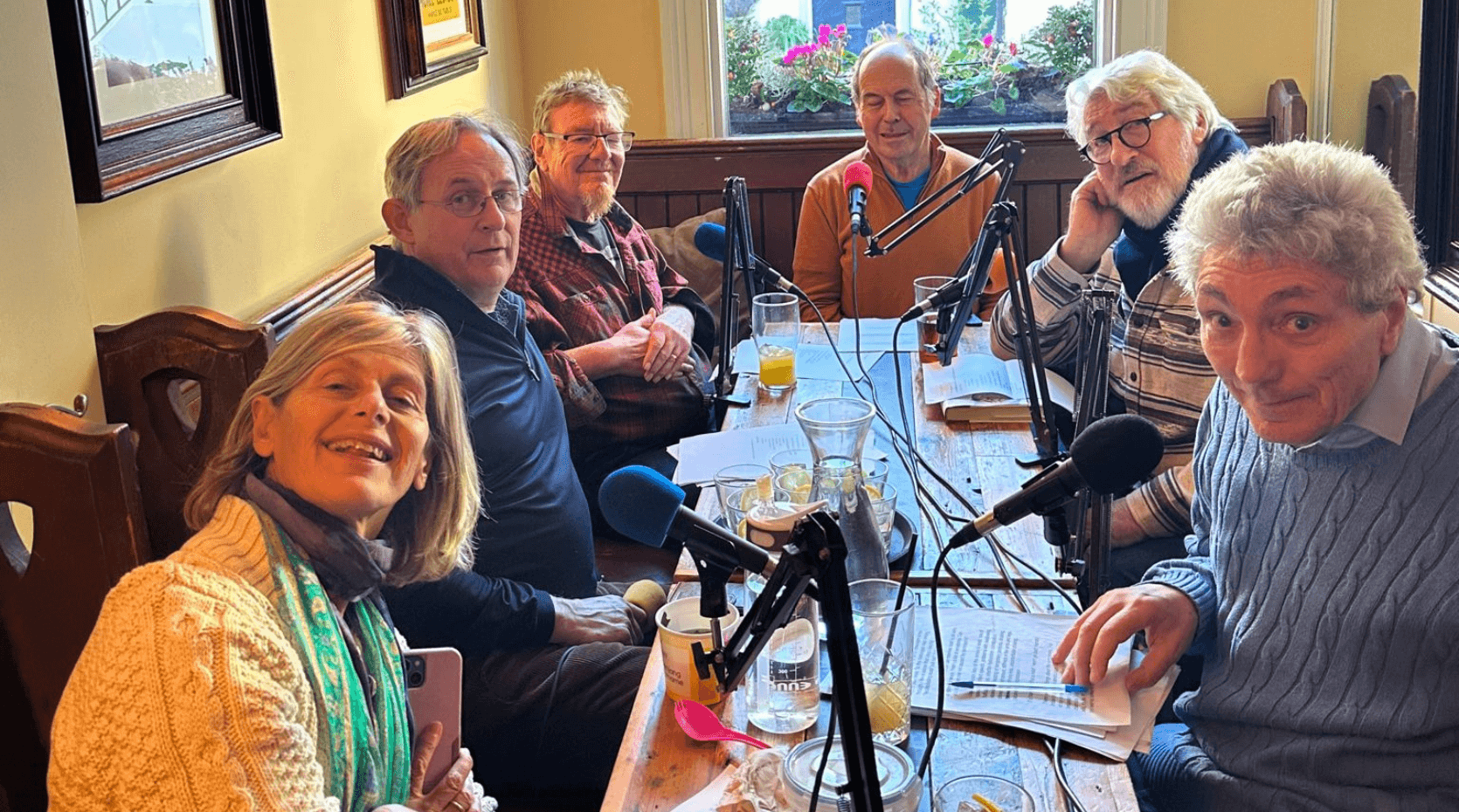
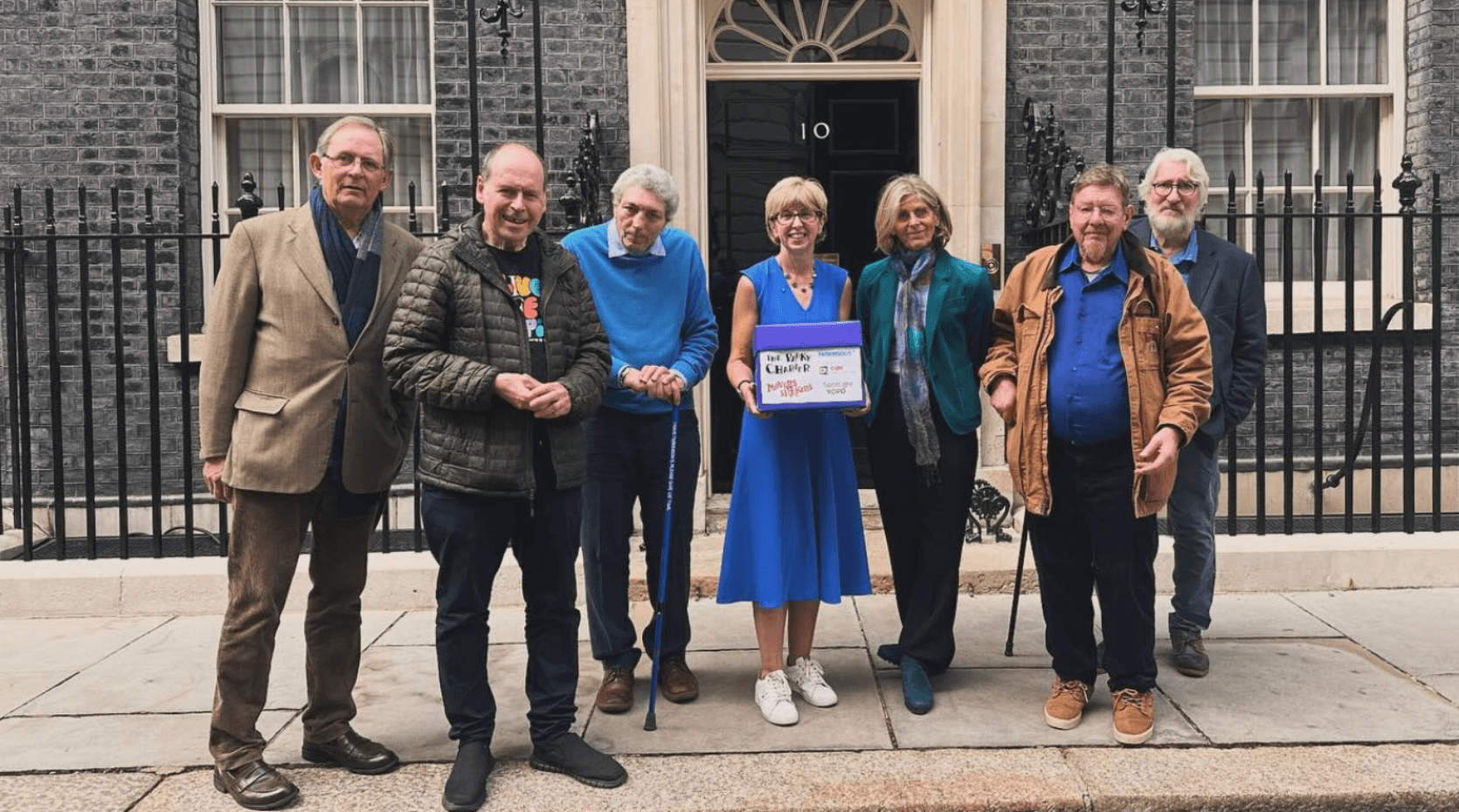
After amassing over 20,000 signatures on a petition supporting their Parky Charter, the hosts of the Movers and Shakers podcast (including TV presenters Jeremy Paxman and Rory Cellan-Jones, and comedy writer Paul Mayhew-Archer) presented the charter to 10 Downing Street, home of the UK Prime Minister:
After a week-long digital campaign called There Isn’t One Parkinson’s Journey, featuring moving and enlightening videos telling the stories of a range of people living with Parkinson’s, Parkinson’s UK then took over the Picadilly Lights billboard at London’s Picadilly Circus during the evening of World Parkinson’s Day 2024 with a short film and over 100 photographs of people with Parkinson’s:
We're shining a light on the daily lives of people with Parkinson's and their loved ones. The good. The bad. The funny. The sad. The ons. The offs. And everything in between. pic.twitter.com/8VGOzdpLBI
6. Brunel University releases new Parkinson’s psychotherapy research paper
The study investigated whether a type of psychotherapy called compassionate mind training – a form of mindfulness – could enhance the well being and quality of life of people with the condition, with results showing that the therapy helped fight against the stigma that is often felt by people with Parkinson’s:
Exciting news on #WorldParkinsonsDay! Our latest research investigates how compassionate mind training could enhance the wellbeing of those with Parkinson's disease.
Join us in raising awareness & supporting innovative approaches to improve lives ➡️ https://t.co/FbwRYe5l9t
7. Parkinson’s Walking Football tournament between Spain and the UK
This friendly tournament for World Parkinson’s Day took place in Bilbao, Spain, with the Spanish side up against the England national Parkinson’s football team:
— Asociación Parkinson Bizkaia ASPARBI (@ASPARBI) April 11, 2024
8. FEP launches “Reivindiquemos la Inteligencia Emocional” campaign
Launching the campaign with a moving and thought-provoking video, “Reivindiquemos la Inteligencia Emocional” aims to encourages a more humane approach to Parkinson’s, valuing the emotional skills we possess to tackle the condition in a more personal, empathetic way. Find out more on the Inteligencia Emocional website.
Germany
9. The Berlin Symphony Orchestra play at the Yuvedo Foundation’s World Parkinson’s Day 2024 event
As the stunning video below shows, the World Parkinson’s Night concert was special indeed. The event was also attended by the German Minister for Health Karl Lauterbach.
Ireland
10. First-ever national audit of Parkinson’s care in Ireland published
This milestone study was eagerly welcomed by the Irish Parkinson’s associations, including our Member Organisations Parkinson’s Ireland and EOPD.IE:
12. Young Parkies Portugal launch new Parkies At The Table series
In this video series, a chef, an expert and a member of the public sit down together over a meal to discuss Parkinson’s, encouraging a wider conversation on the condition throughout Portugal, removing stigma, and sharing delicious recipes from Portuguese chefs at the same time! The first episode is now live on YouTube.
The Netherlands
13. Parkinson Vereniging’s annual World Parkinson’s Day conference
Highlights of this event included a poem read by Peter van den Berg, who lives with Parkinson’s (you can read the poem here), and Dutch neurology professor Bas Bloem and ParkinsonNet’s Marten Munneke both receiving a prestigious “koninklijke onderscheiding” (royal decoration) award.
Gisteren ontvingen Marten Munneke & ik beiden een koninklijke onderscheiding. Totale verrassing! Extra bijzonder omdat lintje is toegekend op voorspraak van mensen met #Parkinson. Fantastisch dat we tegelijkertijd dit lintje kregen. We hebben alles van meet af aan samen gedaan. pic.twitter.com/yqYPFOyltN
14. Parkinson Schweiz hold World Parkinson’s Day 2024 conference in Lugano
The event (which you can see a video interview from below) took place at USI in Lugano, with over 100 people in attendance, and there was also a large turnout at the Lido where various sporting activities took place.
Croatia
15. Double-event at both Zagreb and Rijeka
Our Member Organisation, Parkinson i Mi, held dual events at two locations – Zagreb and Rijeka – in Croatia on World Parkinson’s Day, including awareness-raising, an art workshop, lectures and dancing!
There’s lots more photos and videos on their Facebook page.
USA
16. PD Avengers host 24-hour Spark The Night livestream
Hosted by Larry Gifford, the live-stream featured inspiring interviews, music from Grammy-award-winning artists, and powerful documentaries.
17. Research paper gives a new theory for the origin of Parkinson’s
Released on World Parkinson’s Day, this new research paper from the University of Rochester, USA, puts more emphasis on the possible environmental causes of Parkinson’s, such as pesticides, air pollution and contaminated food and drinking water.
19. Cure Parkinson’s NZ releases feature-length documentary “1 in 37”
Telling the personal stories of five people living with Parkinson’s in New Zealand, this hour-long film was released on World Parkinson’s Day, and can be viewed in full below:
Kenya
20. Milestone event takes place in Kenya
This first event of its kind was hosted at the Mama Grace Onyango Social Centre in Kisumu County, featuring experts, caregivers and people with Parkinson’s coming together as a community to raise awareness.
You can see more photos from the event on Facebook.
EDIT: Even more World Parkinson’s Day updates!
Since publishing this article, we’ve heard from even more wonderful Parkinson’s organisations about their World Parkinson’s Day 2024 activities. Here’s a few more highlights to inspire you for next year:
Slovenia: Društvo Trepetlika Press Conference
In Ljubljana in Slovenia, Društvo Trepetlika held a press conference, during which its young member Egon Pahor presented his Parkinson’s story with a short video. Then Prof. Dr. Maja Trošt, Dr. Grabljevec, Assoc. Prof. Dr. Dejan Georgiev, Slavko Stošicki (a person with Parkinson’s) and the President of Društvo Trepetlika, Cvetka Pavlina Likar, spoke about the strategy of the Association. This included the group rehabilitation that is now legalised in Slovenia, the activities carried out by Društvo Trepetlika, and about the problem of financing associations like theirs, which are the extended arm of the healthcare system and are extremely important for people with Parkinson’s. The conference was well attended, well recorded and had a great response among journalists and the public.
Belgium: Action Parkinson
As part of Action Parkinson‘s World Parkinson’s Day activities, they held some movement workshops hosted by Arnold Massart, Chairman of the Rhythm Department at the Royal Conservatory of Brussels, and Magaly Bartholomeeusen, Head of Occupational Therapy at CTR-Erasme. You can see just how much these sessions were enjoyed in the video and photos on the Action Parkinson’s Facebook page.
Belgium: Vlaamse Parkinson Liga
Werelddag parkingson 2024
The Flemish Parkinson League (Vlaamse Parkinson Liga) held its annual World Parkinson’s Day (Werelddag) conference at the ICC in Ghent, including informative lectures, the latest updates on Parkinson’s research, and musical performances from the Ghent Madrigal Choir. As you can see from the photograph above, the event was very popular, with over 650 people in attendance.
There were hundreds more World Parkinson’s Day events taking place across the world – we were grateful for every single one of them. Browse more events on our Parkinson’s map or on social media using the hashtag #WorldParkinsonsDay.
“I was diagnosed with Parkinson’s on World Parkinson’s Day”
Five years ago, Joe Gregory found out he had Parkinson's on World Parkinson's Day. Now, thanks to his Parkinson's Walking Football teammates, he's happier than ever before
On World Parkinson’s Day, Joe Gregory, 65, a retired social worker with Parkinson’s, will be living his dream of playing football for England in Bilbao, Spain. He will be playing for the national walking football Parkinson’s squad in a tournament against the Basque Parkinson’s walking football team, and the Basque over-65s walking football team.
World Parkinson’s Day holds particular significance for Joe as it was on that day five years ago that he was diagnosed with Parkinson’s. In another uncanny turn of events, it was his lifelong passion for football that led him to find out that he had the condition in the first place.
“I hadn’t played football for about 20 years, and I wanted to play again,” says Joe, whose father and brother John were professional footballers, with John playing for England in the 1980s. But when Joe decided to work on his fitness so that he would be able to play to a good standard, he noticed something odd.
“When I was out running, I noticed that my leg strangely just wasn’t working – it was dragging to some extent – and I noticed that my left arm didn’t feel right.”
After being referred to a neurologist by his GP, he was told on 11 April 2019: “Are you ready to hear this? You’ve got Parkinson’s.”
“I was almost very relieved right from the start because at least I knew what was the matter with me, and I could potentially do something about it,” says Joe, who lives in Reading. “My biggest thought was ‘I shall never now play football.’ That was one of my biggest fears, and I probably play more football now than the rest of my life put together.”
Since joining the England Parkinson’s Walking Football team when it began in July 2022, Joe has played for England all over the world, from Singapore to Guernsey – and now Spain.
In the UK, he plays several times a week, belonging to three clubs as well as the England squad. He joined Watford-based Parkinson’s football club, Fighting Fit Football, six months after his diagnosis in 2019, moving on to walking football for Parkinson’s when the club was the first in the UK to take it up in 2021. He also plays for Berks and Bucks Neuro walking football group, and he proudly coaches the women’s nationwide walking football team, Parkinson’s Pioneers.
Joe says that Parkinson’s has made him grab life with both hands. “I was always a person that used to put things off – partly through fearing I was not going to be good enough. Once I was diagnosed with Parkinson’s, I just thought ‘I will now return to football. What does it matter if I’m no good? At least I’m playing football.’ That’s been my philosophy since diagnosis. As well as the football, I’ve cycled, I’ve swam, I’ve done [mud run and obstacle course] Tough Mudder; I’ve done all sorts of things that I would have put off beforehand. Since having Parkinson’s, it was like, what more can happen that’s bad anyway, why not just enjoy what you can do?”
Joe after completing the Tough Mudder challenge and Fit4Cure cycle ride
Joe loves the camaraderie and friendship that walking football has brought him. “In all honesty, my Parkinson’s football teammates and I, we feel quite guilty about it, but in some ways, we have a happier life, a more fulfilling life, than before. I’ve got more friends now than I had probably in the rest of my adulthood put together.”
Over the past five years, Joe has raised money for Parkinson’s charities by – you’ve guessed it – using his football skills.
During the Covid lockdown, Joe would kick the football about in his garden and do keepy-uppies – where you use your feet to juggle a football and keep it off the ground. “I found I could do a few hundred to start with, then it was a few thousand, then in April 2020, during the Covid lockdown, I decided to try and do 10,000 keepy-uppies without dropping the ball during Parkinson’s Awareness Week to raise money for Parkinson’s UK and Cure Parkinson’s. In two-and-a-quarter hours, I managed to do 13,500 keepy-uppies before I voluntarily dropped the ball.”
Setting himself new challenges is part of Joe’s new philosophy on life: “As well as thinking to myself, ‘I’m not going to not do things anymore,’ I want to do things that are not generally humanly possible perhaps. I want to do things that even people without Parkinson’s potentially couldn’t do either. I wouldn’t have attempted the keepy-uppies if I didn’t have Parkinson’s because there wouldn’t have been so much motivation to do it.”
In 2021, he did a sponsored walk doing keepy-uppies all the way from his current home in Reading to the house where James Parkinson – the first to describe “the shaking palsy” in 1817 – was born, lived and practised in Hoxton Square, London. (In another coincidence, Hoxton is where Joe’s family comes from.) It took Joe four days, and he raised money for Parkinson’s UK and Cure Parkinson’s, as well as for some local community groups in Hoxton.
Joe after completing his fundraising walk to the former home of James Parkinson in Hoxton
In September 2022, he did the London marathon, again juggling a football, and ended up being the fourth last person to finish, at half past ten in the evening.
And Joe is not stopping there – his next dream is to walk to Africa in order to raise funds to improve care for people with Parkinson’s who live there. Watch this space!