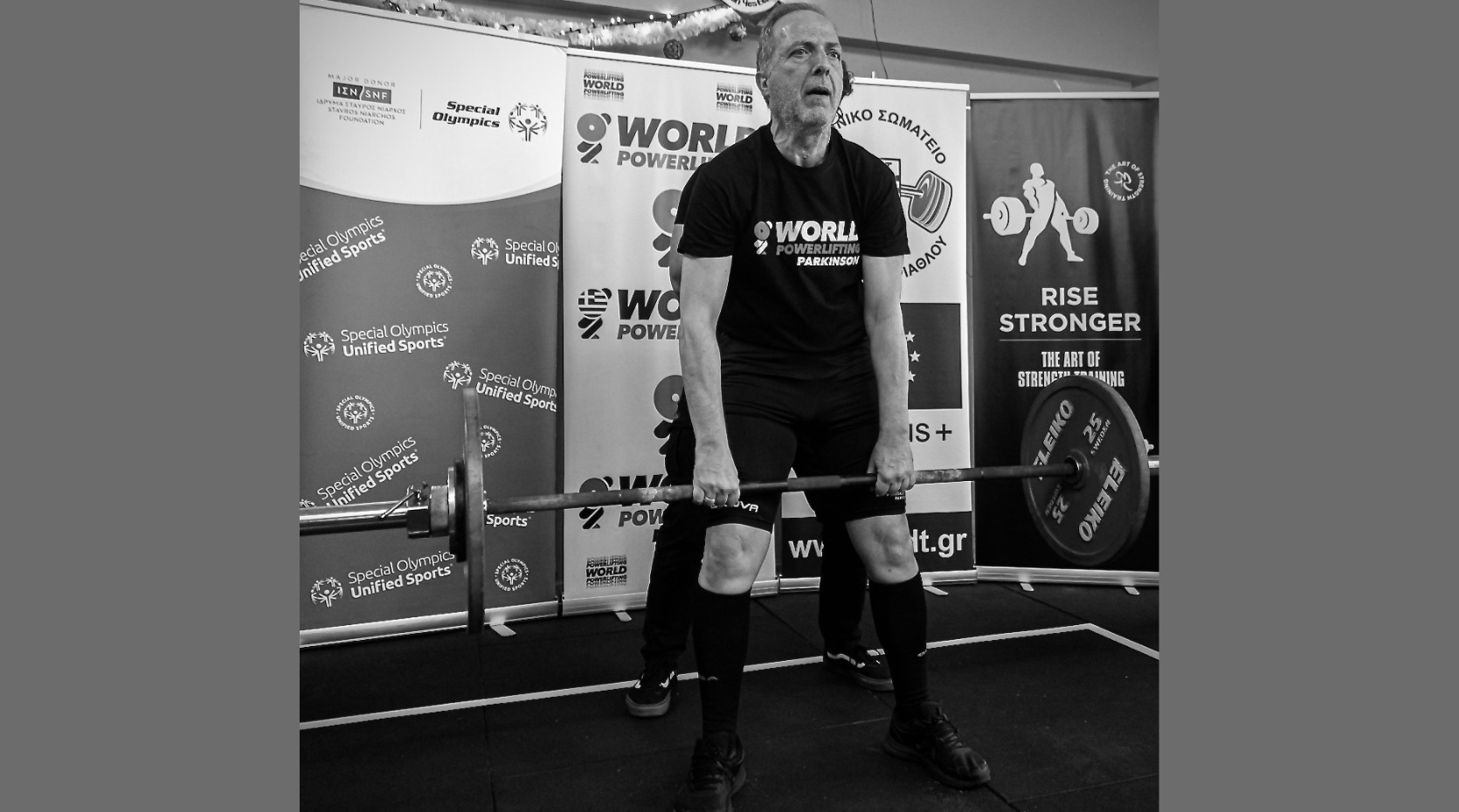
The following article is adapted from a blend of conversations with Greek university professor Antonis Glytzouris and extracts from his personal essay “Deadlifts = Dead-Parkinson’s? Moments of Eudaimonia”.
“At the end of the day, perhaps it is true what Malvolio says in Shakespeare’s Twelfth Night: ‘Tis but fortune, all is fortune’,” Antonis says of being diagnosed with Early Onset Parkinson’s 17 years ago, at the age of 42. It will soon become clear that this philosophical approach has been key in the way Antonis has adapted to living with Parkinson’s.
“It was early 2007 when I noticed that the movement in my left hand was like that of a cog, and I also felt my left leg tightened,” he describes. A lifelong resident of Greece, Antonis was living in Crete at the time, and at first an orthopedist there misdiagnosed him with cervical syndrome. A neurologist later gave him cortisone treatment, but it wasn’t until 2009 that Antonis received his Parkinson’s diagnosis.
“I had no idea at the time about Early-Onset Parkinson’s – it was a slow-burning shock mixed with ignorance.”
To make matters worse, Antonis points out that diagnosis also coincided with the global financial crisis which hit his home country of Greece particularly hard, “crippling” its public services including healthcare, after which “the Covid health crisis plundered what was left”. This often makes it difficult for people with Parkinson’s to access the healthcare they need, including things like physiotherapy, counselling and support with physical activity, but more recently Greece has also been hit by the medicine shortages that are affecting much of Europe.
“[In the] last year we have been fighting fierce battles in Greece to find drugs such as Trivastal (Pronoran) or Symmetrel – and there have been more than a few times when, personally, I have had to find the drugs through friends in Romania or Germany.”
Despite this hardship, Antonis insists that the Goddess of Fortune “has thrown me a lot of good dice”, referring to his partner (or “sweetheart”, as Antonis calls her) and their two children, who are now in their early twenties: “Without them I wouldn’t be the same.”
He also credits his friends, colleagues and students (Antonis is a Professor of Theatre History at Aristotle University in Thessaloniki) among his good fortune in the “lottery” of life, but “above all, is my doctor, always available, always fighting, always pro bono. With so many good rolls of the dice, it’s a shame and unfair to talk about bad luck.”
This positive outlook while living with Parkinson’s is born of Antonis’ persistent quest for “Eudaimonia”, an ancient and uniquely Greek form of emotional wellbeing that he first started exploring many years ago after reading Aristotle’s Nicomachean Ethics during his summer holiday. Aristotle’s definition of Eudaimonia can be simply translated as “happiness is doing well and living well”, but the concept is more nuanced than that. It’s about living a life that is worthwhile and fulfilling – with the sense of contentment based more on your virtuous way of living than how fortunate your lot in life has been.
As Antonis aptly puts it:
“Trying to accept what you’ve been handed is half the truth. The other half is in what you do next.”
He explains further:
“If one is not so selfish as to give up, there is only one option, a one-way street – common to all mortals, Parkinsonian, and non-Parkinsonian alike: Eudaimonia. Fortune, Aristotle says, is necessary, but eudaimonia is not based on it. Misfortunes can, of course, crush it. But even in them, Aristotle continues, beautiful attitude spreads its splendor when it endures misfortunes patiently and – let us pay a little attention to this – it always does what is best in the given circumstances. In other words: there are no recipes.”
It was at one of his first meetings with his beloved doctor, Sevasti Bostantzopoulou, that Antonis discovered how important exercise would be to his quest for Eudaimonia while living with Parkinson’s:
“I went to my first meeting with my doctor in a scary basement of the local hospital. There, it started a kind of initiation into the mysterious group called the “Three P’s and an E”, P.P.P.E.; i.e., Pills, Patience, Positivity, Exercise.”
Of course, “pills” (or Parkinson’s medication) were an obvious first step towards improving life with Parkinson’s, and Antonis also discovered his “Patience” and “Positivity” lay in “a certain amount of self-deprecation, capable of laughing at my situation relatively easily, even in the difficult times.” And while this sounds pretty close to the concept of Eudaimonia already, he soon learned that there was one crucial missing element to creating a more contented life with Parkinson’s:
“All scientific research pointed in one direction. Exercise, exercise, exercise.”
His journey with exercise had several false starts – he was cruelly kicked out of the local swimming pool, a less-than-friendly gym refused to give him membership, and he struggled to relate to the more spiritual elements of Yoga and Tai Chi. It wasn’t until he visited the European Parkinson’s Centre in Italy in 2016 that his love of exercise started to click into place:
“Among the sports activities I encountered there, I was impressed by team sports in the lovely Boario’s garden and boxing. It was an extremely rewarding experience that convinced me that, to some extent, I could take control of my situation. Movement begets movement, while stagnation sinks you into immobility, helplessness, depression, introversion.”
Sadly, a sudden bereavement and period of ill health in 2017 knocked everything off course:
“I was in bed for a few weeks: complete immobility. I had to set my little finger, then my ring finger, and middle finger, then my index and thumb to gradually, after a long time, activate the rest of my body. The Aristotelian Eudaimonia was totally invisible. But I felt in my own skin that the dopamine does not grow by itself but is produced. In short, you must work for it every single day.”
Thankfully, part of his road to recovery included joining a gym in his home city of Thessaloniki in 2019, and it was here that Antonis found powerlifting, and things really started to turn around:
“The gym became my personal church; I have the gym like a religious man has his morning prayer. One thing led to another, and I was introduced to Powerlifting, with an emphasis on Deadlifts. I had just tentatively started dead-lifts when I read about the Parkinson’s games and pioneering Parkinson’s powerlifting coach Nikolas Koukoulakis in Parkinson’s Life. I reached out to him and we have been in contact ever since.”
Antonis now travels to Athens to take part in powerlifting events with Nikolas’ Parky Lifters group. “I have participated in two ‘open’ events (2022 and 2023) and one national championship. But a special moment for me was my participation in the Powerlifting World Championships in Rome last fall.”
Thanks to the great help and support from his trainer Dimitris Andrikos and his physiotherapist Spiros Vizirgianakis, he now trains on deadlifts twice a week, as well as doing Pilates, neuroplasticity excercises, and strengthening exercises with TRX suspension trainers and dumbbells.
The benefits of powerlifting – and its contribution to Antonis’ quest for Eudaimonia – are clear:
“The improvement is noticeable in strengthening my whole body, how I stand and walk, coordination of movements, my stamina in general. Beyond that though, Powerlifting taught me something else. I don’t know if it stands up scientifically, but I feel that dopamine is not only produced by exercise but also by the fulfilment of a goal, by expectation in relation to the moment of reward: that magical moment when you lift the bar. At that moment you have the feeling that you are close to what the modern Greek poet Elytis says: “a leap faster than decay”. Deadlift = Dead-Parkinson’s.”
Above all, he has discovered, the truth of Eudaimonia is it’s a journey, not a destination.
“It’s a goal. Let’s say something like a lighthouse so you don’t get lost: sometimes you see it right in front of you, sometimes you’re miles away, there are those times when you enjoy its warmth inside it and those times when you feel like you’re completely lost.”
But, despite everything, Antonis remains pragmatic:
“I know too well that living with Parkinson’s, the hard times are the most numerous, that the losses are the most numerous, that however much the painkillers of Shakespeare, Aristotle or Elytis may relieve, the game of degeneration and decay is handily lost. I know full well that the hard times are coming, that the disease will prevail. So what? That’s her job. And I, trying to do mine with no idea exactly how I’m going to pull it off tomorrow. In any case, even if we will lose the match let’s score some goals to cheer it up. ”
Find out more about powerlifting, and to read more from Antonis Glytzouris.