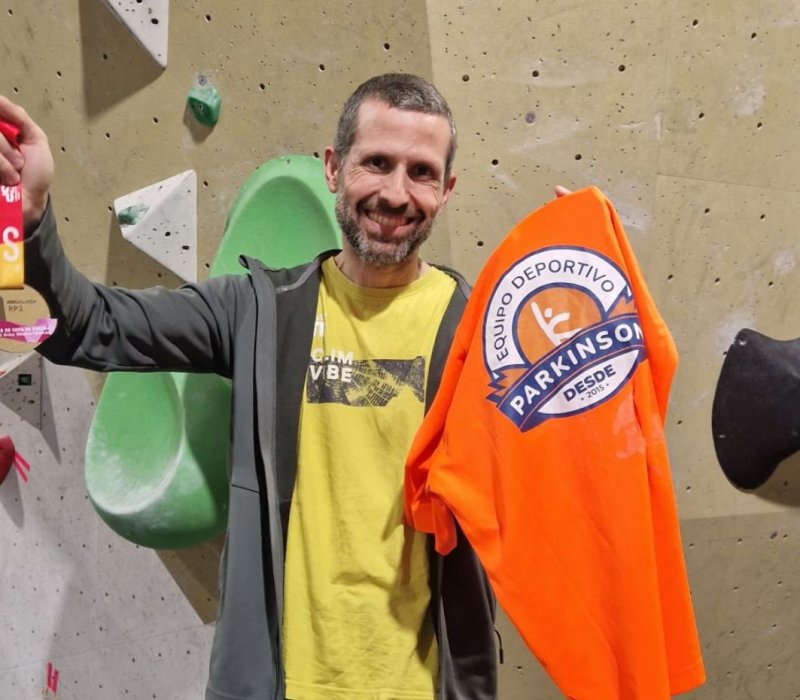
Carl Beech was diagnosed with Young-Onset Parkinson’s just last year, in 2023, at the age of 51. However, he is already making big waves in the Parkinson’s community, thanks to his recent invention of a wearable device (called a Beech Band) which aims to reduce speech issues like stammer. It may also help with other Parkinson’s symptoms like freezing, and symptoms of separate conditions, like tics in Tourette’s.
The inspiration behind the Beech Band
After his Parkinson’s led him to slur his speech, Carl developed a serious speech issue, including a stammer which became much worse during “off” periods. But then one night in June, while he was “sat eating a double decker and watching Apocalypse Now“, he had a eureka moment and discovered a tapping technique that allowed him to speak:
“I found out that not only a beat but tapping myself had a profound impact on me,” Carl explained.
“I discovered I could beat to syllables or just a constant beat worked. And I could tap gently anywhere. Since then I realised the comforting and distracting nature of it took my mind off the problem.”
That night, not only did Carl decide to share this technique with the Parkinson’s community via his Instagram profile, he developed a vision for a wearable device that could automate this technique:
“I realised that we need something that’s accessible to all. Particularly for those who tremor and can’t tap or find multitasking hard. Just a simple, cheap comforting tap/vibration at a certain frequency and speed that all can use with no fiddly controls, no apps, no advanced software. Something that those who are digitally excluded can use. That those who have fine motor control issues can operate. Regardless, we can all use this technique.”
How does the Beech Band work?
The Beech Band is a wrist band device with a haptic pulse, which essentially mimics the feeling of tapping a finger against your skin, just as Carl had been doing when he discovered it helped his stammer. This tapping is a form “cueing”, a technique that has been proven to help alleviate Parkinson’s symptoms.
While the Beech Band uses tactile cueing with its rhythmic pulsing, cueing can also be auditory and visual. For example, people with Parkinson’s might use the beat of a song to help improve their walking/gait, or put coloured tape on the floor to help with feet placement, and prevent freezing.
Together with his friend Nick Whiteley, Carl created a prototype which proved his theory correct:
Can the device be used for more than just stammer?
Carl and Nick have been through several prototypes, refining the Beech Band’s pulsing rhythm to a “sweet spot” of efficacy, and reducing the volume of the pulsing. They’ve also discovered the band helps with gait problems and dyskinesia (involuntary movements).
The pair are continuing to research the capabilities of the device, with the goal of being as honest as possible about how long and in which situations it will work. For instance, he stresses that it’s currently not a device to use all the time for alleviating stammer:
“My feeling is that for speech it’s for situations where you need a Get Out Of Jail card. Going into a shop. Ordering at a restaurant. Otherwise your brain will get used to it.”
Carl does have higher hopes for the device’s longevity for other symptoms such as gait. And he’s also had interesting results when testing if the band can alleviate more than one symptom at once:
“If I use the device for speaking, I can sometimes bring dyskinesia under control at the same time. But I can’t use it to cure my gait and speech [at the same time]. It’s almost like I can direct where I want that pulse to be fixing stuff.”
Why Carl isn’t developing a digital device or app
Spending three decades working in the charity sector has inspired Carl to keep the Beech Band as simple and affordable as possible.
“I’ve seen people struggle for most of my working life and not having access to the help that they need,” Carl explained. “When it came to discovering the Beech Band, one of my principles was that I wanted it accessible for everyone. A level playing field. We could produce something that looks amazing and is super high-tech but it just puts it out of the reach of people who need it. So we’re creating one simple product. It’s people before profit. Helping those who need it most.”
It’s hoped that the finished device will retail at around £15 to keep it affordable, with the potential of bringing the costs down if the device can eventually be produced at scale.
Powered by the people
Carl has already had an enthusiastic response to his Beech Band. A GoFundMe set up to raise the £10,000 startup funds met its goal within a week. The goal has now been doubled to £20,000, (at the time of writing, £16,000 has been raised), with assurances that “every pound raised over the 10k will be a ‘pay it forward’ fund to enable us to give a free device to those in financial hardship.”
He’s also been hosting Zoom chats and sharing videos sent in by followers who have discovered that the Beech band tapping technique has helped their own symptoms. The technique has proven effective not just for Parkinson’s, but Essential Tremor, Tourettes and anxiety:
A hopeful future
Carl has high hopes for his Beech Band device. Recent updates include aspirations to make more adjustable versions of the device for greater personalisation, and confirmation that he and Nick have selected a manufacturer based in their native Great Britain.
He’s also announced that at least 25% of profits will be going to four charities, including Parkinson’s UK, the Cure Parkinson’s Trust, and Spotlight YOPD, of which Carl is CEO.
They hope to release the first batch of Beech Bands by the end of the year. Speaking on a recent video, Carl said:
“We’re hoping that by Christmas we’ll have the first thousand, maybe more. And next year we’re going into full production. We are working like the wind to get this to you.”
In the meantime, there will soon be a Beech Band website where you can register your interest and potentially pre-order a device, as well as additional free resources.
“The website is also going to contain all the tapping techniques I’ve discovered, the methodology behind them and how you use them. That will all be freely available.”
Follow Carl Beech on Instagram for updates, and donate to the GoFundMe here.
Find out more about Parkinson’s and technology.