Madrid-based rock climber with Parkinson’s Jordi Cruz has been climbing since his early twenties. When faced with an early-onset diagnosis at the age of 39, the experienced climber could see one way forward: to adapt. He tells Parkinson’s Life how his diagnosis has shaped his approach to the sport, and has given rise to a Paralympic vision for 2028.
The physiotherapist also shares why he moved from working with high-performance athletes to exclusively treating people with Parkinson’s. And how his lived experience helps build a bond, and deeper understanding, with his clients.
Jordi, please tell us a little about yourself.
“My name is Jordi Cruz. I am 46 years and I live with my partner Rebeca in Madrid, Spain, whom I met one year after my diagnosis. I call her ‘my tulip’.
“After almost a year together we discovered that the tulip is the Parkinson’s symbol. Rebeca has a tattoo that is a tulip. She got it years ago before we met, as she lived in the Netherlands and this tattoo is in memory of her childhood there. Is this not curious? She with a tulip finding me? Or me finding her? Everything happens for a reason.”
You were diagnosed with young-onset Parkinson’s aged 39. What was your path to diagnosis like?
“I started to feel a small tremor when I extended my right arm. Also when I was brushing my teeth I realised my hand and arm were not really following the instructions of my brain. The same happened when I was writing, the pen just stopped! I was kind of frozen, at least that was my feeling.
“So I decided to visit the doctor. The doctor sent me to the neurologist and after some examinations he asked me, as I was a physiotherapist, what I thought my disease was. I replied ‘I believe I have ALS (Amyotrophic Lateral Sclerosis) and I might die’. Then I started to mention other diseases, the last one being Parkinson’s, and the neurologist told me that indeed it was.
What was your initial reaction to being diagnosed with Parkinson’s at a young age?
“I felt kind of relieved. As I was not going to die! When I left the doctor’s office I realised my price was not death, but there was a price I needed to pay. Also I started to think about all the projects I had planned. I needed to change them, or at least to adapt them to my new situation.
“From the beginning I decided not to hide my new situation, and to be open about it, so that people around me could understand what was happening.
“Also another important decision for me was to adapt my professional life. From working in a clinic I moved to the Madrid Parkinson’s Association to work only with people with Parkinson’s. Some people think that it might be a risky decision, as it is hard to see what is going to happen in my body. But I saw it as an opportunity to better understand this illness and take personal advantage of it.”
As a physiotherapist, who worked with high-performance athletes, how do you think this influenced your response to Parkinson’s?
“As I have been working in the past with high-performance athletes, I have learned to adapt myself to the different situations life brings me. One of the most important things those athletes have is they never give up! They always fight for their objective or target, so that has been a fantastic experience.”
For the past four years, you have been working at the Madrid Parkinson’s Association (APM). Tell us more.
“Well, this is quite a funny story. I wanted to change my professional life, and I was a member of the APM. I told my partner – who I had then just met – that I would love to work at APM. She suggested I open a Linkedin profile. I doubted, as I thought it was not a social space to find a place as physiotherapist. But then we saw an open position at APM! So I applied for it, and boom!
“My partner has always believed in me and supported all my changes from the moment we met. This is just another example of this. At APM I visit our ‘customers’ and help them with some exercises.
“Working here made me feel that studying physiotherapy was the right decision. Sometimes during my career I doubted it was something that I really wanted. But working with them, encouraging them, receiving from them all the love, has made me realise how important this profession is and that it was definitely a good decision.
“For my clients, it was also good to have a therapist with this disease. It creates a strong relationship between them and me. It is an experience that is difficult to explain. Before my diagnosis I had also worked briefly with people with Parkinson’s. But once you have it yourself… the bond we create is so beautiful.”
How did you first discover rock climbing, and what does it mean to you?
“I met a girl that I really liked, and she told me she was dating a guy that was a rock climber. So I thought ‘I can also do that’, and went to buy my harness and climbing shoes. That was 24 years ago, she is now my best friend, she does not climb and here I am!”
How has Parkinson’s changed your experience of rock climbing?
“Well, I had and still have an amazing passion for this sport, so my level was quite high. For people familiar with rock climbing grades: I was sending 8b before diagnosis. The first years I was still trying to do some hard routes and I managed to do a couple of 7c+.
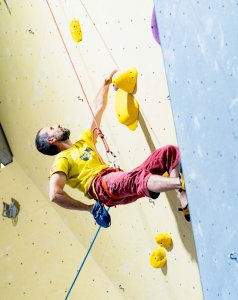
“My objective was to send 8b+, harder routes than before Parkinson’s, so that I could tell the world and myself that nothing was impossible. While trying and testing a 8b+ I broke a tendon in my finger! So I needed surgery and my finger has lost movement. Also Covid19 came, and my symptoms increased. So I adapted myself and started to do ‘easier routes’ but always around 7a.
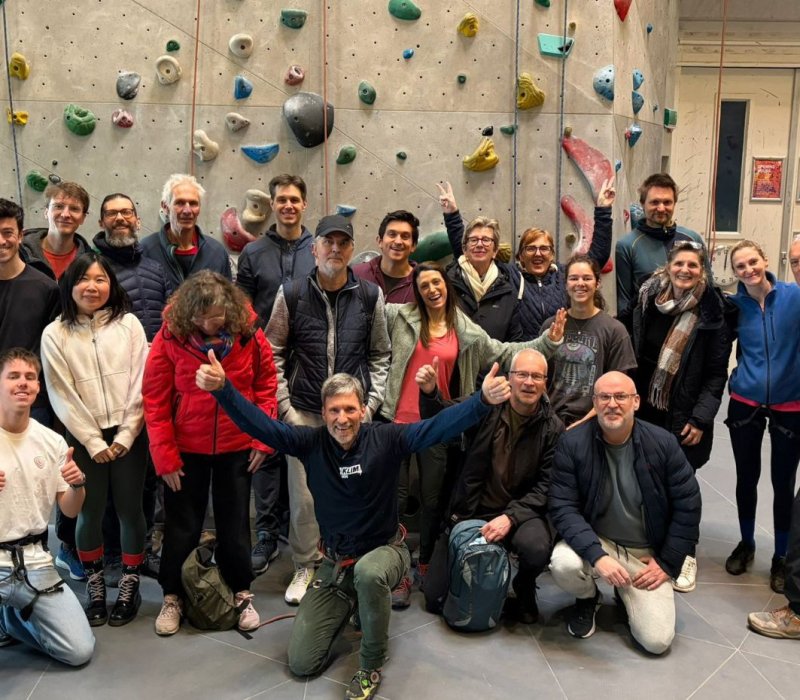
“During the coronavirus, they opened a very big climbing gym close to where we live. And as I said, I always adapt myself. So I thought this was also going to be a great place to climb in a more controlled environment.”
How did you come to join the Para-climbing team of the Federación Madrileña de Montañismo?
“During a trip through Europe my partner Rebeca stayed a couple of days in Innsbruck, Austria, and we noticed a paraclimbing competition at a climbing hall we know there. Rebeca told me: ‘You can do that, you can also compete’. But at that stage I did not feel like it, and I rejected that idea.
“In September 2024, I heard about a guy who wanted to go by bike from one city to another in Spain, to spread the word about Parkinson’s. Something woke up inside me. I felt that I had to do something for people with Parkinson’s, and then I remembered what Rebeca told me years ago: ‘compete in paraclimbing’.
“Climbing is something I do well, I love, and overall I believe that climbing is an amazing sport for Parkinson’s. You work with balance, strength, coordination.
“And there, my challenge started! Competing in order to spread the word about Parkinson’s to the world. To encourage other Parkies to keep on dreaming awake, and let the world see with some studies that climbing has a lot of benefits for people with Parkinson’s.”
Please tell us more about your goals for the next few years, and what you hope to achieve for the Parkinson’s community?
“When I started to train in September 2024, I heard that climbing would be a parasport in the LA2028 Paralympic Games in Los Angeles, USA. There my project, ‘Dreaming Awake’ was born: to try to compete at the Paralympics.
“If I take part, the press will interview me. If I am in the press, the world will read about me and about Parkinson’s. As far as I know only one person with Parkinson’s has been at the Olympics, a rower from the USA. If I achieve this objective, I will be the first person competing in Paralympics in an individual sport.
“But the most important thing is not to achieve the objective. The most important thing is to enjoy and see all that is happening during this journey. I am in touch with universities that are willing to do studies about climbing and Parkinson’s. I am getting texts from people thanking me for what I am doing on social media. And this is the beauty of this story.
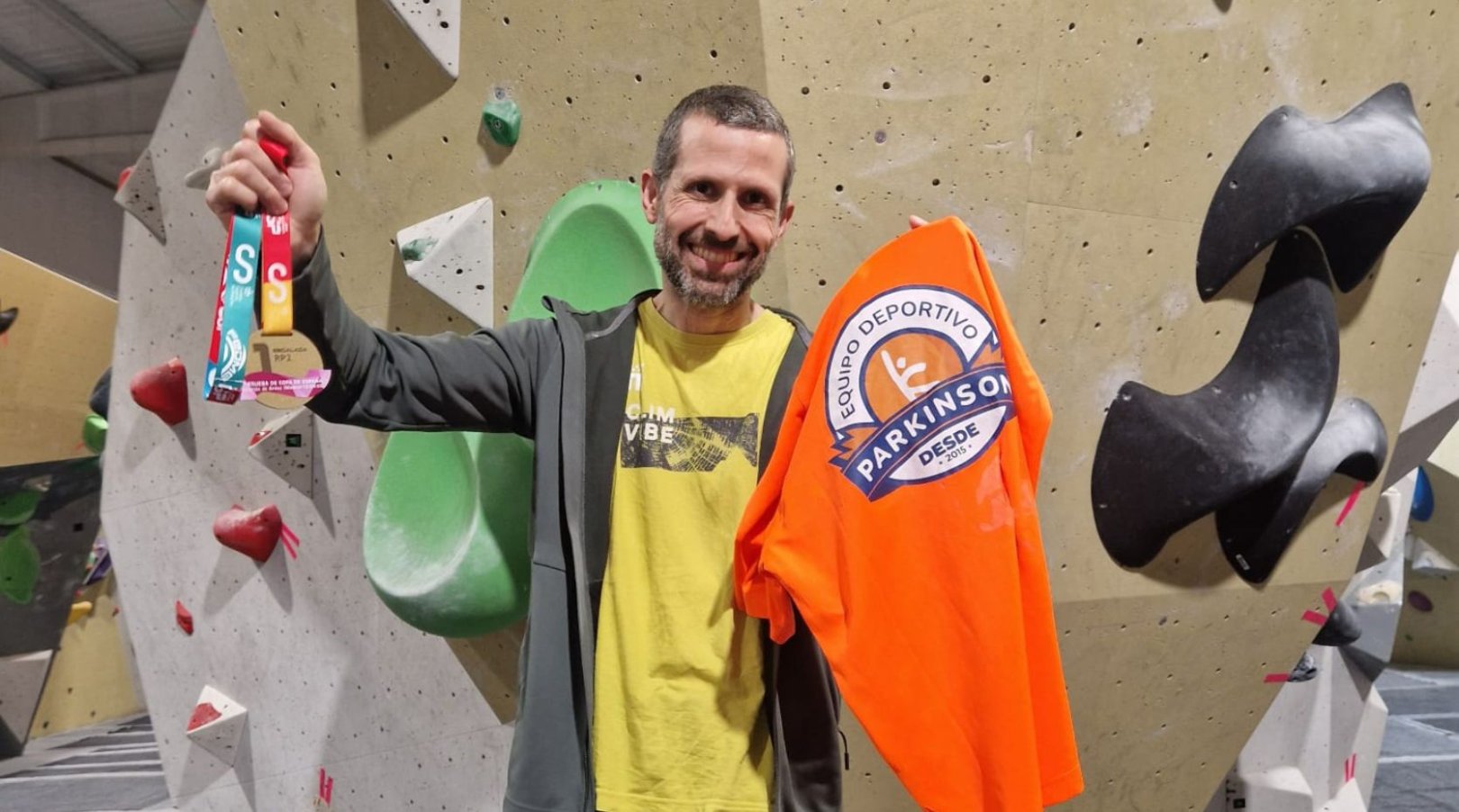
“All the medals that I am winning will be donated. APM has one, my neurologist has another one. They will all go to a place where they will have a meaning, and where they will be helping people to make them understand life and not stop after the diagnosis.”
What message do you have for anyone reading this who has Parkinson’s, who is interested in trying rock-climbing for the first time?
“Go for it! Try it! Do not be scared. There is a climbing gym in the USA where only people with Parkinson’s go, and they even have people starting to climb at the age of 90. There are a lot of studies that are saying how good this sport is for us! So try to go to a climbing gym, and if you need help, contact me.”