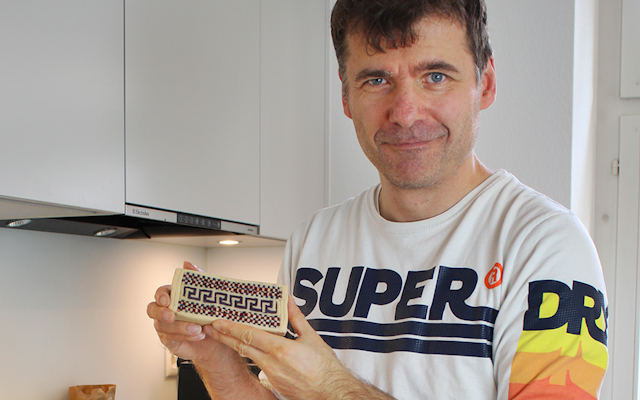
Creating intricately detailed pieces of art from pasta may not be the skill you would expect from a software engineer with early-onset Parkinson’s. Albeit one living in a picturesque town near art-rich Basel, the culture capital of Switzerland. But to 56-year-old Urs Bratschi, it is as natural a pairing as spaghetti and tomato sauce.
“Both professions demand creativity, and I find fulfillment in balancing the structured logic of software engineering with the expressive freedom of art,” he tells Parkinson’s Life.
It has been two years since Parkinson’s Life last spoke to Urs, when he was showcasing his early pasta artworks at his first exhibition. His art has greatly evolved in that time, he tells us, using his skills to not only share the techniques with others but to also open up conversations about his Parkinson’s journey.
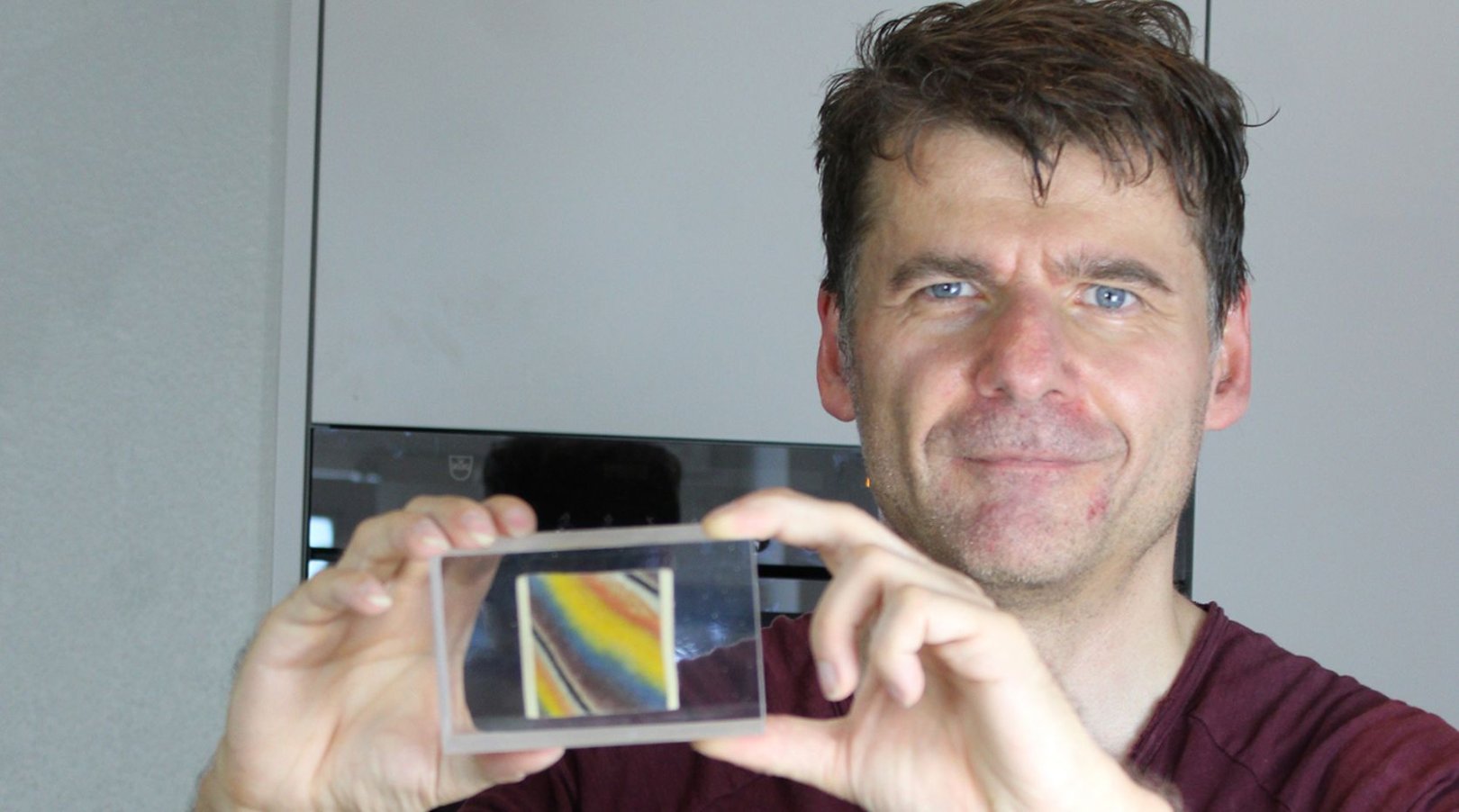
“I discovered joy in explaining my creative process to others—how I craft, preserve, and encase pasta in resin. Given the connection between my art and my Parkinson’s diagnosis, discussions often touch upon the disease,” he explains.
“While many are hesitant to broach the topic, I approach it openly, aiming to inform without seeking pity. I prefer my art to stand on its own merit.”
Honing his craft has seen Urs explore new methods and styles, creating even more intricate images composed of multiple pasta elements, along with bowls and plates filled with various pasta types set in resin.
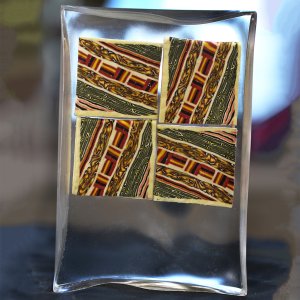
“I have essentially pioneered a new art form,” he explains. “However, many art enthusiasts and gallery curators struggle to categorise it, necessitating efforts to raise awareness.”
These efforts are paying off, with Urs taking part in 12 art exhibitions last year, in locations from London to Luxembourg, and Germany.
Pasta and Parkinson’s: a rich and fulfilling life
Likening each of his artworks to being “like a child” to him, Urs’ passion for his creative works is evident – and inspiring. More than a hobby, it is part of his drive to show that a life with Parkinson’s can still be rich and fulfilling.
“I am active in a support group for young Parkinson’s patients, sharing my experiences and journey,” he says. “Initially, some find it hard to believe when I say that many positive aspects have emerged from my diagnosis, making my life more exciting and meaningful. But living this truth lends it credibility.”
Last November, he appeared on Swiss television in a health program discussing life with Parkinson’s, and has also co-authored a book exploring art in the context of neurodegenerative diseases. “I delve into the question, ‘Why do I have Parkinson’s?’—a question I answer by the chapter’s end,” he says.
Accepting a life-changing diagnosis
This positive mindset was – understandably – not Urs’ first response to learning of his Parkinson’s diagnosis in 2014, at the age of 45.
“Upon receiving the diagnosis, my world collapsed,” he says. “I trembled uncontrollably – not due to Parkinson’s – and could not work. I often sat at my desk, overwhelmed with tears. Suicidal thoughts emerged, leading me to seek psychiatric help.”
Helping Urs climb out of that “abyss” took a team of friends and healthcare professionals who provided “immense support”, along with his belief that giving up was not an option. “A pivotal, albeit harsh, realisation was accepting that no one could cure me; Parkinson’s was here to stay.”
Once he accepted the diagnosis, he felt able to explore the condition, and even begin to consider a more positive approach. “For the first time, I seriously contemplated my life’s direction and aspirations. My perspectives shifted; some things lost importance, while others gained significance. Overcoming such a profound upheaval has been an invaluable experience, propelling me into unimaginable dimensions.
“This disease awakened me. I now internalise the belief that we have one life, and it is up to us to make it meaningful. Parkinson’s has become a driving force, motivating me to achieve. I’ve befriended my illness—it’s part of me, and I of it. I firmly believe that a positive attitude can influence the disease’s progression. Ten years post-diagnosis, I feel well and content with my life.”
An evolved worldview
As a gay man, embracing change and evolving his perspective is not totally new to Urs. “Before realizing I was gay, I knew little about it and held rather negative views,” he says. “Accepting and embracing my sexuality was challenging—I did not want to be gay. This reinforces my belief that it’s not a choice; it is inherently part of us.”
Looking back, Urs can draw parallels between the two parts of his identity, as well as key differences. As with Parkinson’s, coming to terms with his sexuality turned his “world upside down” and challenged him to adjust his perspective on life, Urs says.
However, he adds: “Unlike Parkinson’s, being gay isn’t inherently problematic—unless one lives in a society that persecutes or marginalises LGBTQ+ individuals. Nonetheless, I had to work on myself, and reshape my worldview. Both journeys expanded my horizons and opened my heart. The Parkinson’s diagnosis came about 20 years later.
Having previously navigated such a life-altering realization perhaps equipped me better to handle this disease. Often, it is the negative experiences that teach us the most. Today, I live happily as a gay man and would not change that. I also live contentedly with Parkinson’s, though I would gladly part with it if I could.”
While research suggests challenges facing people in the LGBTQ+ Parkinson’s community can include discrimination in healthcare, a lack of recorded data around gender identity and the need for best practice guidelines and inclusive support groups, Urs says he has had a positive experience to date.
“In Switzerland, LGBTQ+ individuals are largely accepted and integrated, though rural areas might be slightly less progressive. I have never felt discriminated against when seeking medical care,” he says.
“My artistic endeavours even pique the interest of neurologists. For instance, the University Hospital in Bern produced a video about me, highlighting the intersection of art and Parkinson’s.”
He also participated in an exhibition organised by the University Hospital in Zurich last year, featuring artists with Parkinson’s.
Collaboration and community
Along with cultivating a positive mindset, building good relationships is another part of Urs’ approach to living well with Parkinson’s. This includes being part of a “wonderful” support group for young people with Parkinson’s patients, and maintaining a good relationship with Parkinson Switzerland.
“Interacting with fellow ‘Parkis’ is often special,” he says. “Even without knowing each other well, there is a deep sense of understanding and empathy. I speak very openly about deeply personal things. But that didn’t come naturally. I didn’t grow up in a family where people talked openly about feelings or problems—I had to learn that myself.”
In the future, he hopes to also see improved collaboration between conventional and alternative medicine. “Often, there’s mutual misunderstanding. However, from a patient’s perspective, there’s a significant demand to integrate both approaches.”
Urs Bratschi’s pasta art for beginners:
Interested in having a go at pasta art? Urs’ impressive creations are the results of years of experience, but he has set out a simple guide below for budding pasta artists to try it out.
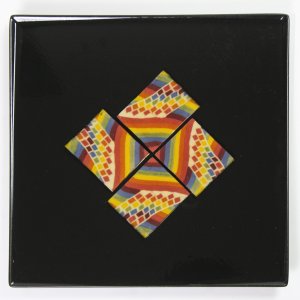
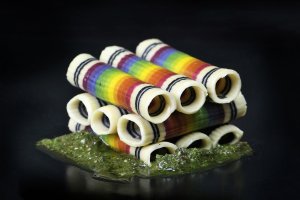
- Starting with stripes is the simplest. Lay alternating colored strips on an uncolored dough sheet (a tagliatelle cutter can help), then roll it out again
- This technique allows you to craft ravioli, tortelloni, rigatoni, or penne with striped patterns.
- To colour your dough, vegetable powders are effective. With the popularity of smoothies, powders like spinach or beetroot are more readily available and can be mixed into the flour during dough preparation
Visit Urs Bratschi’s Instagram page for more pasta art and video demonstrations.