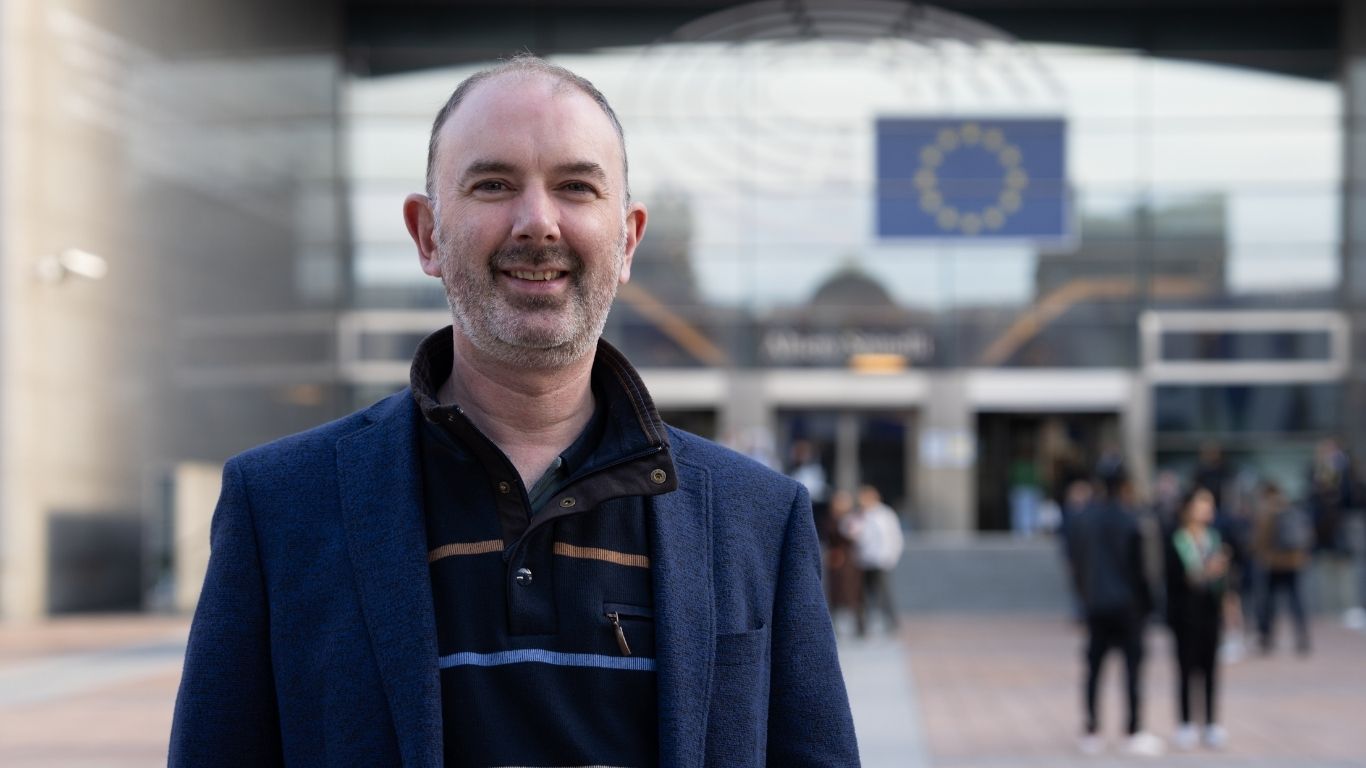
In addition to his role as Advanced Nurse Practitioner at Mater Misericordiae University Hospital, Brian Magennis admits he has ‘many strings to his bow’. He sits on the boards of both Parkinson’s Europe and the Dublin Brain Bank, as well as several committees, and is an assistant professor at University College Dublin (UCD). Having started out as the second Parkinson’s Nurse in Ireland, Parkinson’s Life finds out more about his impressive achievements for the Parkinson’s community, and the people who inspired him.
Brian, please tell us how you came to be one of the first Parkinson’s nurses in Ireland.
“My dad was around 27 when he was diagnosed with Parkinson’s. Now in his 80s, he is a man of steel, and a big influence for my nursing career.
“I started training in Beaumont Hospital, the neurology centre of Ireland, in 1992, then the National Children’s Hospital in Dublin. But I always had my sights on a career as a Parkinson’s nurse.
“My biggest influence was meeting Rosemary Maguire, the first Parkinson’s nurse specialist in Cornwall back in the late 80s. We got chatting and I said, ‘I think this might be something I’d like to do’. She was really good at guiding me.
“Then I did the Parkinson’s specialist course in Cornwall around 1999. I wrote to all the neurologists around the country and connected with Professor Tim Lynch at the Mater Hospital, Dublin. In 2003 the role of Parkinson’s Nurse (only the second in Ireland at that time) came up and I got the job, working as a Clinical Nurse Specialist.
“It was a new role, so there was no template. Myself and Tim Lynch got the whole nationwide movement disorder service up and running. We were not only covering Parkinson’s, but others such as Huntington’s Disease, tremors, Tourette’s etc. We even had patients coming from Paris, Spain and the UK. As the role evolved, it was very busy. I was covering the DBS (Deep Brain Stimulation surgery) service, the pump therapy service, the inpatients and the outpatients clinic. I did that for 15 years as a clinical nurse specialist.
“While I was covering neurology, I was also covering medicine for the older person. Because in 2005, professor Joe Duggan (consultant geriatrician) and I had set up a movement disorder clinic in medicine for the Older Person department.
“Then in 2017 I successfully applied for an Advanced Nurse Practitioner post, and moved from neurology to medicine for the older person.
Tell us about your current role as Advanced Nurse Practitioner at Mater Misericordiae University Hospital.
“I am coordinating and providing the specialist nursing service for the Parkinson’s service that I had originally set up with Professor Duggan, who retired in June 2025 (Dr Róisín Purcell now has taken over the clinic). I also am coordinating and providing the specialist nursing service for the whole of the dementia service too, the memory clinic. So it’s huge.
“My role involves diagnosis, assessment and managing Parkinson’s, right up to palliative care. I get to know the patients and their families very well. I am the continuum in the team, because the national or the non-consultant hospital doctors (NCHDs) rotate every six months depending on their grade. So I am the one that patients see all the time.
“I think that really helps in chronic disease management, that the person living with the condition gets to know the one person. Monitoring the condition is paramount. You see the progression, and the response to medications.”
What are the most important qualities a Parkinson’s nurse requires?
“The Parkinson’s nurse has that vital role in education, training the patient and family, the healthcare professionals. But also being the advocate for the patient and their families, and helping them cope.
“When I took the Parkinson’s nurse specialist course in Cornwall, I did not think I knew much about Parkinson’s. But I could relate all the different stages to my dad. It was a huge asset for me, because he had been through DBS, and is on pump therapy. So I have my dad as the encyclopaedia.
“We had an excellent tutor who always said to ‘treat the person in the hospital bed as if they were your mother or your father’. I could relate to that. I think you have to have that empathy and kindness, while being competent and knowledgeable in your own specialty as well.”
How do you feel the role of Parkinson’s nurse has changed care for people with Parkinson’s?
“There are about 25 Parkinson’s nurses in Ireland, including those in Parkinson’s Ireland. But for years there was only myself and Margaret Richardson. When setting it up, I really relied on the UK and the Parkinson’s Nurse Specialist Association. They were a fantastic support.
“In Ireland, the role is very much defined by the national council within the Nursing and Midwifery Board of Ireland, with the competencies set out as patient advocacy, research, clinical focus, education, and training. It focused you, but I felt the patients needed that link person, on that continuous basis.
“So I set up a phone line, and email. The phone line really helped, as the patients that I saw in the clinic could call me if there was a problem. We incorporated the UPDRS (unified Parkinson’s Disease rating scale) into our assessment. That really changed things for the better. Because you can really track the progression and the severity of the condition that way.”
“Before Parkinson’s nurses, there was a huge specialised care gap. The nurses’ and doctors’ knowledge of Parkinson’s back then, and even now, was lacking. Parkinson’s medications were very difficult for people to comprehend.
“Around 2005, there was a unit within the Mater Hospital at the time called the Medical Intervention unit ( MIU), with 12 beds available to all medical services. We used it to admit people with Parkinson’s and movement disorders from our clinic, to review their medication, commence new therapies, have a full multidisciplinary team review and rehab as required.
“We would look at all the medications, motor and non-motor symptoms, lifestyle, from a whole person perspective. They did well after those two weeks. They would go home and be recharged, sometimes with a new medication regime. We did that for many years and we used apomorphine to great effect.
“We were stopping our patients from coming into the emergency department, by having them admitted electively to avoid that crisis. But the unit closed around 2008, and it really changed things for the worse.
“When people did come into inpatients, or were admitted from the emergency department, I would go through the regime, and teach the ward staff about the nursing needs, the importance of getting medications prescribed correctly and given on time.
“Patients actually improved because we could see compliance was better. We could see people improving when they were getting their medications on time. We focused on that because it was such an important feature.
“We introduced the on-off chart, which the nurses could see, and understand what the on-off fluctuation was. A lot of people didn’t really understand it at the time. For example, when someone was off, they couldn’t get out of the chair. They couldn’t walk to the bathroom. They couldn’t eat or drink because they were off. And then on, it was like a light switch and it was like a miracle. We created the knowledge and understanding.
“Reading things in a book is one thing, but movement disorders you have to see. Parkinson’s you have to see, and the staff, the health care professionals involved saw it.”
How has your role changed over time?
“Over the years, it has developed. If you have that knowledge and the training and the education behind you, you’ll be able to provide that expertise and best practice in care. That is what the patients want and deserve.
“I’ve moved from being a clinical nurse specialist to an advanced nurse practitioner. With that I’m a nurse prescriber, so I can assist in the diagnosis, and do a comprehensive geriatric assessment as well. I’m very much to the forefront in the clinics. Myself and the consultants see the patients together and we are joint decision makers.
“It is now more of a leadership role, but I’m still at the front door for patients. I see them in the clinic all the time. I have about 1,700 patients on my work list, but if they need me, they can contact me.”
Is there an element of mental health support within a holistic approach to Parkinson’s care?
“I’ve always said Parkinson’s is fought with the body, but won in the mind. There is a spectrum of people with Parkinson’s. They may be very prone to depression, or they may be prone to anxiety and panic attacks. It is those in the middle who cope well. So we try to get the patients back into that centre, and manage their depressive episodes or their anxiety and panic attacks.
“We work very closely with our psychiatry for older persons colleagues, who have a clinic in our daycare unit. That works really well because then I know they’re going to be managed from that perspective too.”
What are the challenges you face?
“The challenges are the resources within the healthcare system. There are so many things within the world of movement disorders and Parkinson’s that are moving very fast. It’s a constant wheel of trying to educate the new people coming into the clinic.
“In Ireland we are very lucky in prescribing medications, covered by the medical card for the over-70s. I know in other European countries there are a lot of restrictions regarding what medications you can prescribe from a dopamine agonist point of view. Being on the board of Parkinson’s Europe has opened my eyes, from a national perspective to a European perspective, of what the shortfalls are and the gaps are.

“Another challenge is the way there isn’t enough out there about what Parkinson’s is. There’s that profile that needs to be raised at a European level. The Dutch have done things well, and have a great advocate in Bas Bloem. They have a good model and we can all learn from that.
“The UK were just prolific in the whole Parkinson’s nurse implementation, going back to 1989 when Rosemary Maguire was appointed. They were the forerunners, and definitely the best practice go-to. We now have a WhatsApp group of the international movement disorder Parkinson’s nurses, and there are nurses from New Zealand, Australia, Singapore, Germany, all parts of the US. It is really growing and that’s great. We’re not fully there yet, but it has dramatically improved from 25 years ago.”
What changes would you like to see across Parkinson’s care in Europe in the future?
“Just that things improve. We are on maybe the first four steps of a ten-step ladder. We have a lot more to do, from an empowerment, awareness, data collection and innovation perspective. Even from a nursing perspective.
“The number of Parkinson’s nurses is growing. We have 25 in Ireland, and I think over 300 in the UK. We’re on the right road, we just need to keep focused on the needs of the person living with Parkinson’s.
“There’s a lot of brilliant research out there, but that needs to be translated and implemented into clinical practice. Some of the medications that are out there now need a lot of work, and the patients need a lot of support. I think that’s a big role for the Parkinson’s nurse, to provide that support and education and monitoring.”
What advice do you have for Parkinson’s nurses?
“Resources are very limited – [the wait for] MRI scans is over 18 months to two years. If patients have private insurance we use that. That really helps.
“Ask the right questions and you’ll get the right answers. That’s why we have a checklist of all the motor and non-motor symptoms.
“How you ask is important. For instance, if you ask someone, ‘do you have hallucinations?’, they might not even know what that means. Try wording it differently – ‘do you ever see funny things that aren’t there?’.
“It is the same with asking about constipation. Some people with Parkinson’s may have a bowel motion every four days, although a healthy bowel should go every day. It is trying to get them to realise that, and to educate them. So I will ask, ‘how often do you go? Are you on the loo for ages?’, instead of saying ‘are you constipated?’.
“All these little questions are so important. Constipation is the number one reason why people with Parkinson’s suddenly deteriorate, which I have published on. Because Parkinson’s doesn’t suddenly deteriorate unless there’s a reason. Once you find and treat that reason, they get back to their baseline. This list is 12 years old and it’s still working very effectively, because it’s very simple.”
What might surprise people to know about being a Parkinson’s nurse specialist?
“Everyone thinks I’m a doctor because I’m a man, when I walk into the room. So I have to explain that I’m a nurse. But it is a very rewarding, caring profession.
“Two people were a huge inspiration, and that’s why it was an honor for me to join the board of Parkinson’s Europe. Lizzie Graham and Mary Baker were huge inspirations for me. Just seeing them at the conferences back in the early 2000s, they were so inspiring. If I can be like that for the healthcare professions in Ireland, I’ve done a good job.”