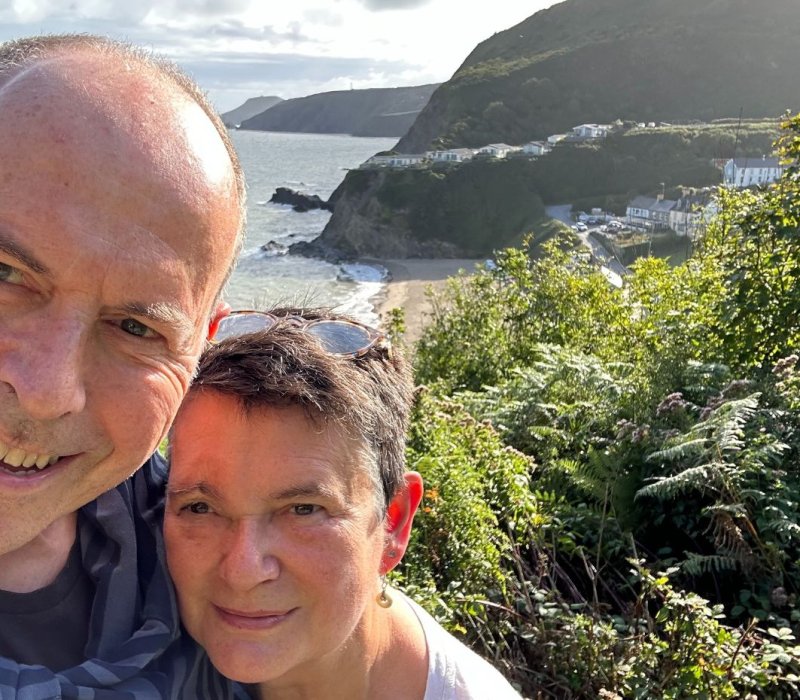
A person living with advanced Parkinson’s has spoken of their acute distress and lasting health effects after they were denied crucial Parkinson’s medication for eight hours while being detained at an airport in Portugal.
Inge Oosthuizen, who lives in Bedfordshire in the United Kingdom, was travelling with her husband Marthinus from the UK to Lisbon airport on 18 March 2026.
After a systemic Special Assistance failure by the airline TAP Air Portugal led to lost/mislaid documents, and subsequent administrative failures at Lisbon airport, Inge was detained by Portuguese Border Police (PSP) for sixteen hours.
This included eight hours during which Inge was deprived of her life-essential Parkinson’s medication, levodopa, as well as water and food.
Despite visible signs of distress, including Parkinson’s tremors, nausea and shaking, Inge’s repeated requests for her medication – which was stored in her checked luggage – were ignored by senior officers.
The airport (ANA) has also confirmed that no medical or nursing personnel were summoned by the police, despite Inge spiralling into an acute neurological “OFF” state during her detention.
Inge was released from detention on 19 March, and has since returned to the UK and received medical assistance from her GP, however she is still struggling to restabilise her medication levels.
Inge and her husband Marthinus are now working with organisations like Parkinson’s Europe, as well as their local MP, to raise vital awareness of how European airports and airlines are failing people with Parkinson’s.
Why Parkinson’s medication is time critical
As part of their Get It On Time campaign, Parkinson’s UK explains:
“People with Parkinson’s rely on their medication: not only to take it, but to take it on time. A delay as little as 30 minutes can mean the difference between functioning well and being unable to move, walk, talk or swallow. Missing doses can lead to severe and irreversible harm to their health.”
“In the most severe cases, this can lead to Parkinsonismhyperpyrexia syndrome (muscle rigidity, fever, reduced consciousness and impacts aspects of the nervous system), which can be fatal.”
Not the first time
This isn’t the first time a person with Parkinson’s has received poor treatment at the hands of the aviation industry. Last year, UK broadcaster Mark Mardell was left “humiliated” after being refused from boarding a Turkish Airlines flight because he didn’t have a doctor’s note, a policy of which Mardell was not informed and which was not held by any other airline. Turkish Airlines have since removed this requirement.
Elsewhere, David Allan from Scotland was left “crawling on his hands and knees” after his medication ran out during flight delays at Gatwick airport, while Irish airline Ryanair apologised to passenger Geoff Jackson after he was barred from flying when staff incorrectly interpreted his Parkinson’s symptoms as drunkenness.
Support from the Parkinson’s community
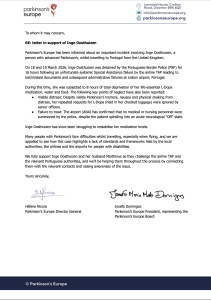
The Parkinson’s Europe team and Board were proud to provide Inge with an open letter of support from Parkinson’s Europe, which we are publishing here.
Please click the image below to read the letter in full:
Our President and Director General will also raise this issue on the global stage at the World Parkinson Congress in Arizona later this month, where we will be discussing the further rollout of the Parkinson Ready program, which provides vital training to public-serving members of staff at places like airports, hotels and railways stations to help keep people with Parkinson’s safe during travel.
The Portuguese patient organisation Associação Portuguesa de Doentes de Parkinson (APDPk) is also contacting the airline and airport involved in this incident to recommend they adopt the Parkinson Ready program, as well as approaching the Hidden Disabilities charity to see if they can expand their airports and airlines scheme to Portugal. The scheme is currently used in over 70 countries, including 23 in Europe, such as the UK, France, Germany, Italy and Poland.
Ana Botas, Vice President of APDPk, said:
“It was a very unfortunate incident. We now look to the future. We are going to contact all the institutions involved so that we can work together to prevent future situations”.
How you can help: use the Parkinson’s Passport
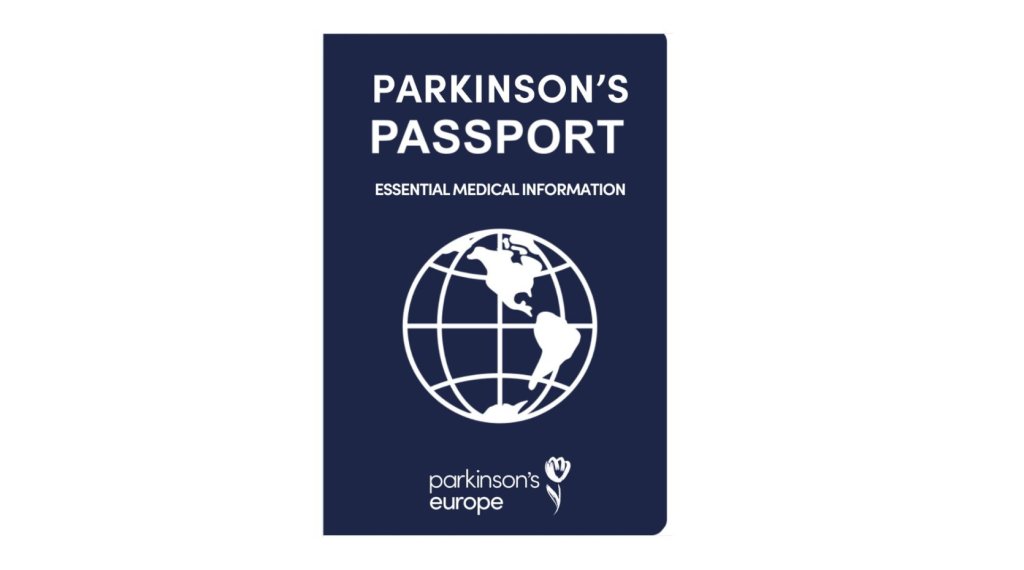
We are working hard to keep raising awareness of Parkinson’s and help people with Parkinson’s across Europe and beyond to live full, happy lives without prejudice or mistreatment. However, the sad truth is we still have far to go on this journey.
In the meantime, we recommend using our Parkinson’s Passport. This free downloadable resource provides essential medical information and helps others understand what people with Parkinson’s may need outside their own environment – in airports, hotels and other public places.