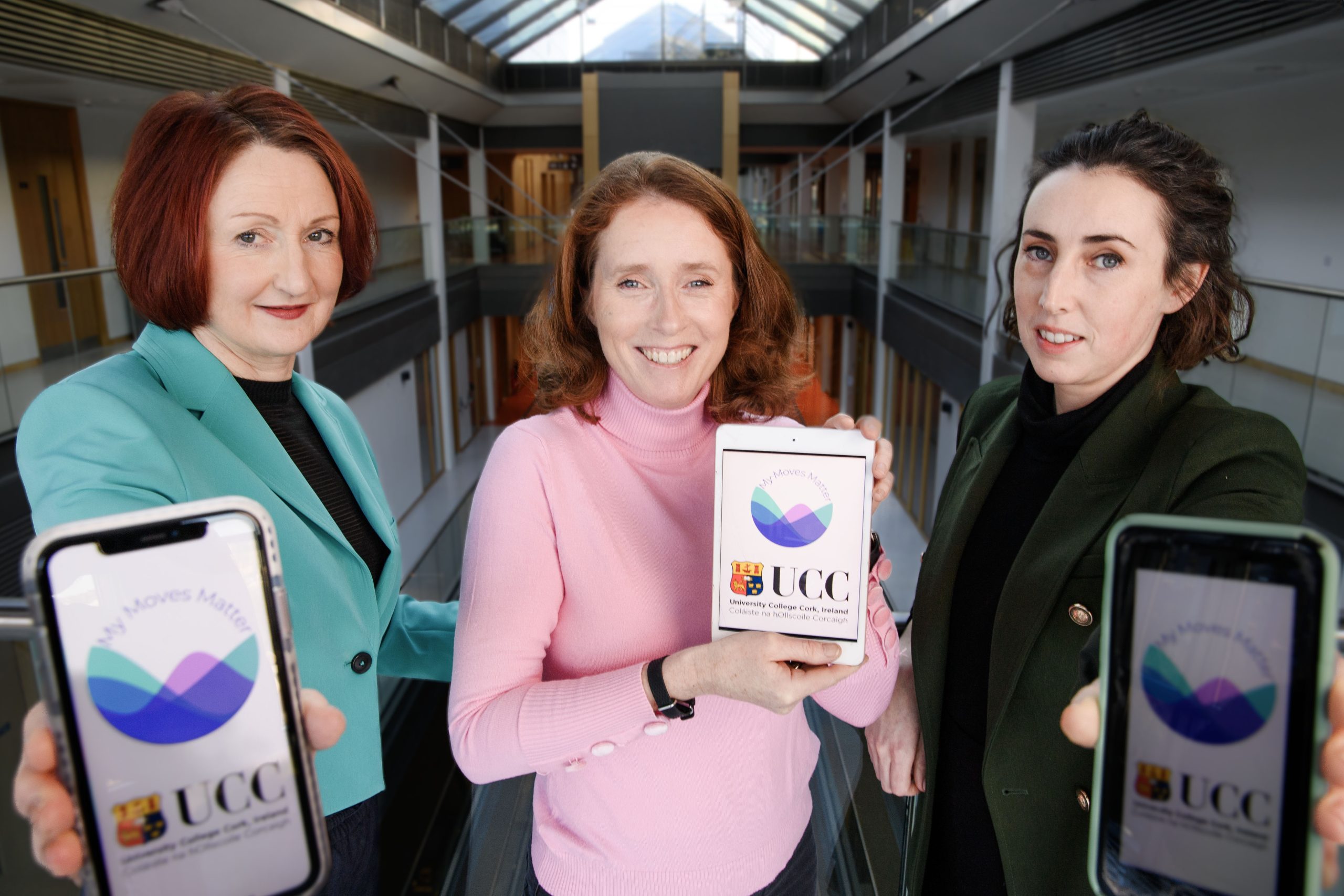
The impact of hormonal fluctuations on women with Parkinson’s is to be investigated in the first-ever study of its kind in the world.
The study by Ireland’s University College Cork (UCC) and led by Professor Aideen Sullivan and Research fellow Lucy Collins-Stack is being undertaken in collaboration with Richelle Flanagan, inventor of the Parkinson’s self-care app My Moves Matter, which will be used by women who take part in the study.
Supported by the Health Innovation Hub Ireland (HiHi) and Enterprise Ireland, the study will be anonymous and can be done remotely from anywhere in the world as participants can take part entirely online and through the app. Women of all ages with Parkinson’s can participate – from those who are menstruating to those who are pregnant, perimenopausal, menopausal and post-menopausal – with a view to improving care for women with Parkinson’s.
Flanagan is an Irish dietitian who was diagnosed with Young Onset Parkinson’s Disease shortly after the birth of her daughter.
The story of the app began when Flanagan noticed that her Parkinson’s symptoms worsened around the time of her period.
“My symptoms were worsening across my menstrual cycle. I have micrographia, and it also translates into typing. As a dietitian, I was working in my clinic and I would notice that my handwriting would be worse than usual and the same with typing the week before my period, so it would make it difficult to write and to type, and for my job I needed to be able to do that. The other thing is, in terms of non-motor symptoms, the fatigue would be a lot worse. Women who don’t have Parkinson’s report PMS symptoms of brain fog, forgetfulness and irritability, so I’d have all of those normal things as a woman with PMS, but then I’d have the extra burden of it affecting my Parkinson’s symptoms.”
After meeting other women with Parkinson’s at the WPC in Kyoto, and on social media, she realised that other women had also noticed their symptoms worsening before and during menstruation.
This led to Flanagan and two of her female friends with Parkinson’s, Kat Hill and Sree Sripathy, setting up the Women’s Parkinson’s Project. “We decided to do a survey of women around the world in 2021, and 80 per cent of them reported the same problem. It was a bit of an aha moment. Basically, women have been reporting that their medications don’t work as effectively either the week before or the week of their menstrual bleed.
“We hosted a webinar with Cure Parkinson’s, and there was a huge response. There were a lot of other issues, not just around the menstrual cycle. That’s where the paper, “Unmet Needs of Women with Parkinson’s” arose. I co-authored that with three neurologists: Indu Subramanian, Adrienne Keener and Elena Moro, and two other women living with Young Onset Parkinson’s, Annelien Oosterbaan and Soania Mathur. We realised we needed to have a means for women to be able to track their menstrual symptoms across their cycle, so they could basically validate what they’re feeling and be able to share this with their neurologist.”
The idea for the app was born, and it started to come to fruition when Flanagan won funding from a digital health hackathon in 2021, in which she pitched the idea of a health app which would allow women with Parkinson’s to track their symptoms over their cycle.
“We came up with what we call a neuro-friendly app design, so big buttons and the ability to log symptoms through voice, text, voice recordings, photos or videos,” she says.
Following its launch at last year’s World Parkinson Congress, the app currently has more than 800 users worldwide.
Flanagan hopes that with women recording their symptoms in real time on the app, the UCC study will finally provide proof that women’s hormones can negatively affect their Parkinson’s symptoms, so that a set of clinical guidelines can be developed and used to provide more personalised care for women in this situation.
In the long term, Flanagan hopes to secure more funding for the app to make it easier for users – male as well as female – to see patterns in their symptoms which they can relay to their neurologist, who can then adjust their treatment plan accordingly. This is something that Flanagan has personal experience of already, thanks to the app.
“I could see that my off times were coming a bit earlier, and I noticed my handwriting getting worse, so I took a photo of it, uploaded it onto the app and timestamped it and put in micrography and tagged my handwriting. Then I was able to look back, and I could see that I was going off half an hour earlier than my medication had been set. I brought that to my neurologist and was able to say, ‘Look, I’m definitely going off earlier,’ and they adjusted my medication and added an extra one in at the end of the day.
“My vision for the app is ultimately that it’ll be something that is prescribe-able to patients with Parkinson’s. It would be free to them, and they would get access to services through the app. In order to deliver therapeutics through an app you need to have evidence that it works.”
A French version of the app will be tested further during an upcoming study Flanagan is doing with Professor Elena Moro, funded by a grant from France Parkinson. For that trial, which will be run in four neurological centres in Europe, women’s symptoms will not only be tracked during the first phase, but they will be treated according to the app’s findings in a second phase.
For the current study at UCC, women will be asked to track their symptoms for four months. “That is a big ask but we hope that the app is easy enough and intuitive enough that it’ll encourage them to do it, but we ask for four months because we know that menstrual cycles fluctuate, so we need to have a few of them. The app is free to download on the Apple and Google Play Stores, and women will have to complete some surveys at the beginning and at the end. The data is anonymous, and the UCC will be analysing the findings.”
To take part in the study, download the app from mymovesmatter.com/get-the-app and participate in the study by filling out this survey.