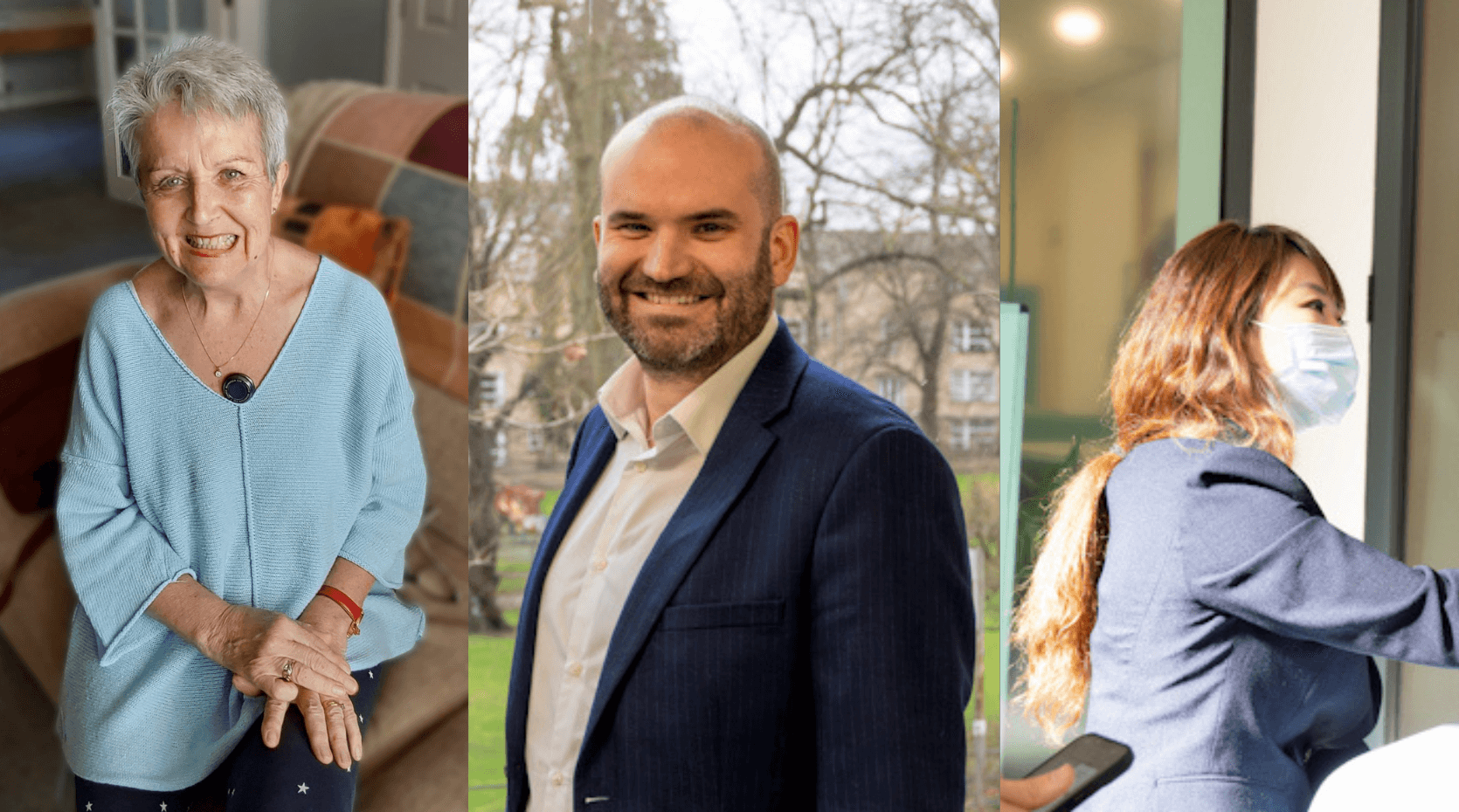
“I can now handwrite, I actually wrote my husband’s Christmas card this year — the first time in three years,” Elaine Paine explains in the latest episode of our Parkinson’s Life podcast, speaking about the difference it has made wearing a CUE1 Parkinson’s device designed to alleviate symptoms like freezing and slowness.
In the episode, Elaine — who was diagnosed with Parkinson’s in 2015 — speaks to movement disorder specialist Dr Alistair Mackett and Lucy Jung, CEO of Charco Neurotech (the company behind the CUE1 Parkinson’s device) about how technology can improve the lives of people with Parkinson’s.
Elaine is a self-confessed technophobe, but since her Parkinson’s diagnosis, she’s found herself adapting to a wide range of technology-based assistance, from running remote support groups over Zoom during the pandemic to learning how to use the CUE1 and its accompanying app, and more recently trying an apomorphine pen, which injects a dose of the dopamine agonist apomorphine directly under the skin.
The key to Elaine is simplicity: “The more complicated it gets, the less likely it is I’ll continue to use it.”
How technology should help — not replace — a face-to-face approach
“I’ve literally had to break up fights between a couple!” Dr Alistair Mackett describes, when talking about how frustrating it is to assess a patient in the small time window of an appointment when that doesn’t give an accurate picture of their day-to-day life. “They start walking, and I say ‘oh that’s pretty good’, and then that patient’s wife says ‘You never walk like this! You never swing your arms, you never pick your feet up… and now you’re walking perfectly!’ And I’m not quite sure what to do, because the person I’ve seen in clinic looks like they are managing well, but their partner at home is seeing a different picture.”
This is where technology can make a difference, Dr Mackett explains. A Parkinson’s device like a monitoring device worn on the wrist could give the clinician information about how symptoms like slowness of movement and tremor are affecting someone day to day.
“That would have been amazing,” Elaine agrees.
But both Dr Mackett and Elaine also agree that technology can’t replace a face-to-face consultation. And in fact, their discussion on the podcast shows that one of the best things technology can do is actually connect communities, from chatting on online forums to the potential for using technology to connect people who are at the same stage of their Parkinson’s, or maybe to set up a mentoring service.
And these face-to-face communities are what is helping people with Parkinson’s encourage each other to try new Parkinson’s devices and other technology.
“In my support group, we talk about them,” Elaine says, “This is how we find out about things. What we do is we say ‘Right, who’s using the apo [apomorphine] pen?’ So we can actually speak to the people who are doing it, rather than a clinician who’s doing their best for you, but might not really knowing how you might feel about it.”
Listen to the full episode on Spotify via the link above, or on your podcast provider of choice.
Parkinson’s Europe is sharing this article for information purposes only; it does not represent Parkinson’s Europe’s views and is not an endorsement by Parkinson’s Europe of any particular treatments, therapies or products.