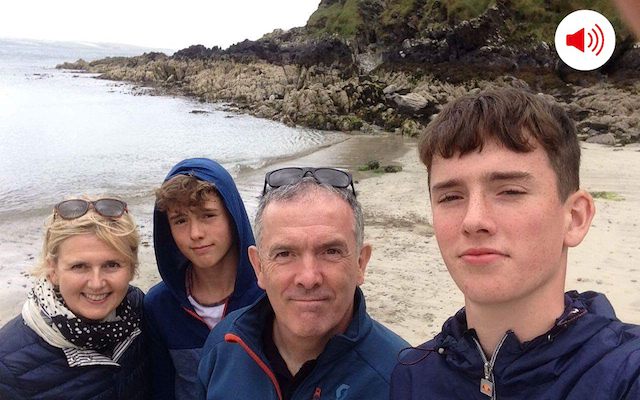
Colin Cheesman has had Parkinson’s for 20 years, but it didn’t stop him from taking up tap-dancing. In the latest episode of Parkinson’s Life podcast, he discusses life at an ‘advanced’ stage of the condition with geriatrician Dr Nishantha Silva – from coping with changing symptoms to keeping a positive attitude when things are unpredictable
Colin Cheesman, a 74-year-old former local authority chief executive based in Chester, UK, has lived with Parkinson’s disease for the last 20 years. But, he says, it’s only in the last four or five years that more challenging symptoms have started to “kick in”.
“It has really given me a lot of problems, both psychologically and in the physical sense. Now I do have problems with balance, I’m dyskinetic, I have problems with gait. I have to be very careful about things like riding a bike and so on – which I love doing. And the treatments have got progressively more of a challenge to keep the condition under control.”
In the latest episode of the Parkinson’s Life podcast, initiated and funded by Britannia Pharmaceuticals, Colin shares his experience of reaching an ‘advanced’ stage of Parkinson’s – a term which generally refers to the point at which symptoms have a bigger impact on day-to-day life and medications may not be as effective.
It’s important not to feel disheartened as symptoms change and treatment regimens become more complex, explains Dr Nishantha Silva, who joins Colin in conversation. As a consultant geriatrician specialising in Parkinson’s, he’s been working with people with the condition for over a decade – and was motivated by the experiences of his own father, who had the condition.
“I really wanted to bust the myth we have that advanced Parkinson’s disease means that everything is at the end – it is not the case,” he says. “It is a different stage of the disease, which needs different approaches, different treatments and adjustments.”
Making the most of life with ‘advanced’ Parkinson’s
Colin says that thinking positively has made a huge impact on his quality of life since he’s been diagnosed. At the age of 70, he bought himself a pair of tap-dancing shoes and a set of rollerblades – although he admits he’s now giving up the rollerblading.
“It’s really important to try and ensure that you are in control of your Parkinson’s, rather than your Parkinson’s being in control of you. I think once you let the condition lead where you go, you lose a degree of independent decision-making. So you’ve got to try and get your head round – with all the support there is – what the possibilities are,” he says.
Nishantha describes Colin’s approach as “inspirational” – and says that it’s likely to make the patient and caregiver journey more manageable. “You should not just spiral down and think, ‘Oh my god, I have been diagnosed with Parkinson’s disease – end of the story,’” he explains. “No, take it as a challenge. There are many things you can do. It’s never too late to develop new hobbies, and new personal connections and to do different things.”
Parkinson’s Europe is sharing this article for information purposes only; it does not represent Parkinson’s Europe’s views and is not an endorsement by Parkinson’s Europe of any particular treatments, therapies or products.