Parkinson’s may be present from birth in younger people with the condition, new research has found.
The study – conducted by Cedars-Sinai Medical Centre, US, and published in ‘Nature Medicine’ journal – used induced stem cells from people with young-onset Parkinson’s, to grow dopamine-producing neurons and observe them for early warning signs of the condition.
An abnormal pile-up of protein was found during the neurons’ development, including alpha-synuclein; which occurs in Parkinson’s. The scientists conjecture that Parkinson’s symptoms appear when the pile-up continues over 20 or 30 years.
The team also found that the drug PEP005 – currently used against skin precancers – could help treat the condition.
Michele Tagliati, vice chair and professor at Cedars-Sinai’s Department of Neurology and the study’s co-author, said: “This exciting new research provides hope that one day we may be able to detect and take early action to prevent this disease in at-risk individuals.”
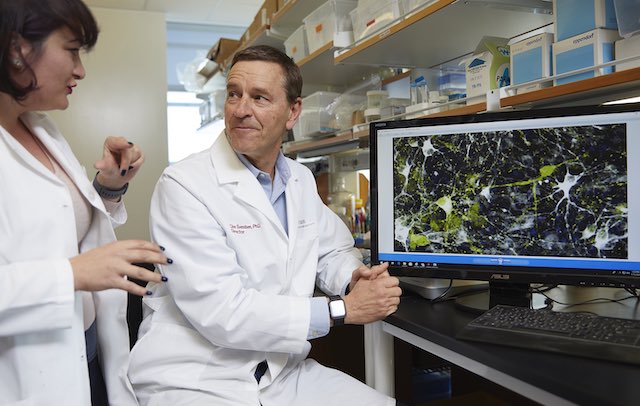
Lead image credit: Clive Svendsen, PhD, director of the Cedars-Sinai Board of Governors Regenerative Medicine Institute, right, and Nur Yucer, PhD, a project scientist, discuss a microscope image of dopamine neurons. Photo by Cedars-Sinai.