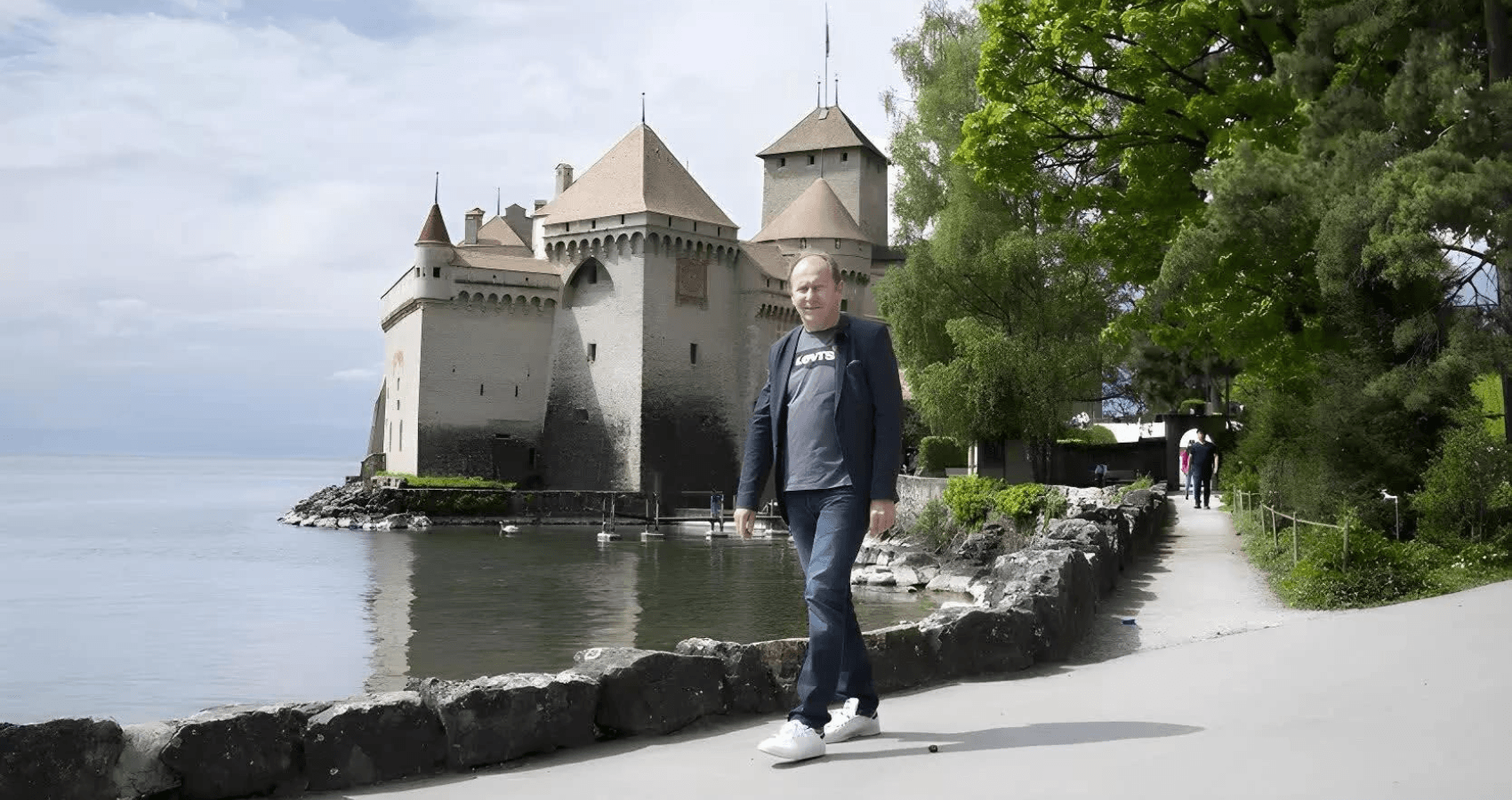
A man with Parkinson’s is able to walk without fear of falling, thanks to a new neuroprosthetic that stimulates his spinal cord.
Marc, 62, who lives in France, has had Parkinson’s for nearly three decades. Although dopamine treatment and Deep Brain Stimulation (DBS) have helped with tremors and stiffness, in recent years he developed a walking disorder which – until now – could not be treated.
“I practically could not walk anymore without falling frequently, several times a day. In some situations, such as entering a lift, I’d trample on the spot. As though I was frozen there, you might say,” said Marc.
Two years ago, he was the first person with Parkinson’s to be fitted with a neuroprosthetic that stimulates the spinal cord electrically and corrects his walking.
Grégoire Courtine is professor of neuroscience at EPFL, Lausanne University Hospital (CHUV) and UNIL, where Marc had his operation. He says: “The idea of developing a neuroprosthetic that stimulates the spinal cord electrically to harmonise the procedure and correct locomotor disorders in patients with Parkinson’s is the result of several years of research on the treatment of paralysis due to spinal-cord injuries.”
Courtine and his team developed the device along with Dr Erwan Bezard, neuroscientist at Inserm, affiliate at the CNRS and the University of Bordeaux, France.

The neuroprosthetic is made up of an electrode field placed against the spinal cord, which controls walking, and an electrical impulse generator, which was implanted under the skin of Marc’s abdomen.
Using a targeted programming of spinal-cord stimulations which adapts in real time to his movements, Marc has quickly seen his walking disorder subside.
Walking normally
After several weeks of rehabilitation with the neuroprosthetic, he is able to walk almost normally. He currently uses his neuroprosthetic for around eight hours a day. He only turns it off when he is sitting down for a long period of time or sleeping. “I turn on the stimulation in the morning and I turn off in the evening. This allows me to walk better and to stabilise,” he sayid. “Right now, I’m not even afraid of the stairs anymore. Every Sunday I go to the lake, and I walk around 6 kilometres. It’s incredible.”
Marc is the first person with Parkinson’s who has used the implant. Courtine and his team are working with ONWARD Medical on optimising the implant for large-scale use in other people with Parkinson’s.
Clinical tests will be carried out on six new patients at Switzerland’s NeuroRestore centre next year in order to identify those most likely to benefit from the treatment.
Read the detailed study published in Nature Medicine.
Parkinson’s Europe is sharing this article for information purposes only. It does not represent Parkinson’s Europe’s views. It is not an endorsement by Parkinson’s Europe of any particular treatments, therapies or products.