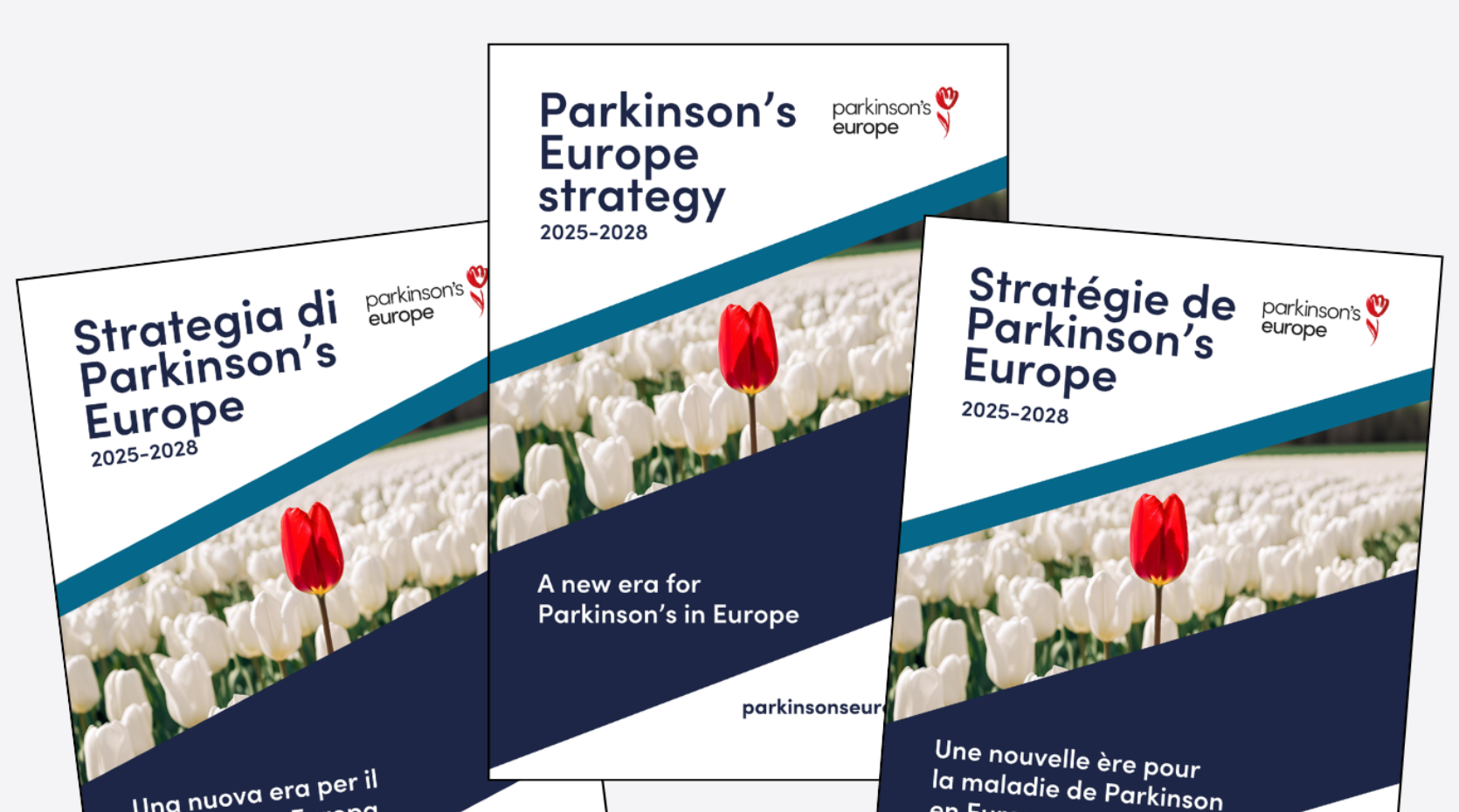
In the second in a series of articles spotlighting the three pillars in Parkinson’s Europe’s new strategy, we explore the issues surrounding the differences and inequalities experienced by the many Parkinson’s patient organisations and communities in Europe, and how we hope to empower them to bring about change.
Parkinson’s Europe’s work aims to empower all our communities to use the resources they have as effectively as possible, regardless of their starting point.
Our Strategic Director Amelia Hursey explains: “The more we support our member organisations, the more they can support their own communities. Our aim is to help them to help themselves. It is about enhancing the Parkinson’s community as a whole, which includes identifying the areas where some communities have less than others.”
The empowerment pillar of our new strategy has several key goals to help the community grow stronger across Europe. These include supporting our member organisations by creating and sharing knowledge-building resources, and connecting communities with each other across Europe. And the first steps we take in 2025 are just the beginning of a four-year journey.
What does inequality among different Parkinson’s patient organisations in Europe look like?
Parkinson’s Europe has a diverse range of national member organisations. This gives us a glimpse of the differences they experience with regards to accessing funding, resources and knowledge.
“Our organisations have memberships numbering between just over 100, right up to nearly 10,000,” says Amelia. “You might have an organisation with a very small team, or a very large one. As well as team size, the level of knowledge and experience the organisation has can depend on how new or old the organisation is.
“Look at some of our most recent members – the Association of Patients and Caregivers PAR.KIN.S.O.N. was set up in 2019, while the Catalan Parkinson’s Association (ACAP) was founded in 1985. It is the diversity of our member organisations that highlights to us the inequality regarding access to resources and experience.”
Better understanding to support and empower
The first steps in this four-year strategy will include gaining a better understanding of the landscape, with those most affected by Parkinson’s at its heart.
“We will start by creating a steering group to guide the work we are doing, and to make sure it is relevant to our members,” says Amelia. “This will be made up of representatives from all our stakeholders groups – people with Parkinson’s and their families and supporters, voices from the industry, healthcare professionals, and of course our member organisations. We want to make sure the whole Parkinson’s community is connected together, and that we are heading in the right direction in our ambition to make them feel empowered.”
Building connections and sharing assets
We know the spread of knowledge, understanding and engagement across the Parkinson’s community in Europe is not balanced. And we want to help.
“We recognise there are inequalities, but we know our members can empower and enrich each other. So our role is partly to bring them together to bring about that change,” Amelia says. “If we can support our members by connecting them to more expertise, this will decrease their feelings and experiences of inequality. Where some member organisations have access to more than others, how can we connect them to empower and support each other? What tools can we help provide them with to help connect with their communities? All of our empowerment work will focus on improving these connections.”
Taking inspiration from social enterprise models, Parkinson’s Europe’s approach will encourage the exchange and offering of assets to empower and strengthen the community as a whole. “It is about sharing ideas, expertise, knowledge, opportunities, connections, resources, and time,” says Amelia.
Uplifting partnerships
One of our ambitions is to connect national patient communities not just with each other, but with other members of the European Parkinson’s community, like healthcare professionals and research organisations.
Parkinson’s Europe’s successful Engagement Network is one tool we will use to achieve this. “Our ambition is to use the network to increase connections among volunteers,” says Amelia. “We plan to grow our volunteer base in 2025. This will give as many people as possible across Europe the chance to connect with opportunities and grow their knowledge.”
Parkinson’s Europe’s research partnership with independent non-profit foundation EUPATI is another example. The partnership supports EUPATI’s efforts to connect patients and their representatives with research and the development of medicines, empowering them to make meaningful contributions, and improving the availability of medical information.
“We will be enhancing the partnerships we already have to raise up the voice of the European Parkinson’s community from a global perspective,” Amelia adds.
Toolkits and services to enhance the support we offer
In the same way, Parkinson’s Europe will also be looking to evolve the services and opportunities already offered to its members. “We want to heighten and improve what we are already doing as an organisation, for example developing our member meetings,” says Amelia.
We also want to enhance what we bring to the table by being able to translate even more of our content into different languages. In this way, we can empower our member organisations to more easily share information with their own members.
Parkinson’s Europe Director of Communications Laura Vickers-Green explains: “As a Europe-wide organisation, language barriers have always been a major and understandable concern for our audience.
“With increasingly sophisticated translation software, as well as a growing pool of generous volunteers, we were able to produce resources in 12 languages last year. And as our long-term translation strategy takes shape, we’re going to be reaching more of the European Parkinson’s community than ever before.
Work will also be done on building and sharing toolkits on topics which our members have identified as areas where they need more information, such as fundraising campaigns. “We have also started creating the research toolkit to help members feel more confident about talking about research,” says Amelia. “ And as well as creating new toolkits, we will also highlight resources our members already have, bringing them into a central pot to be accessed by others.”
Using data to strengthen our fight for change
Using data will also be key to growing our understanding, and empowering our own – and our members’ – calls for progress. Our three strategic pillars are designed to work together, and we plan to use the insights gathered as part of our data & innovation pillar to drive empowerment.
Amelia points to a recent report, “Using a Sex- and Gender-Informed Lens to Enhance Care in Parkinson’s Disease”, as an example of how this could work. Co-authored by Parkinson’s Europe President, Josefa Domingos, the study identifies important differences in the symptoms and experience of men and women with Parkinson’s, and ways in which care can be improved.
“From this data, we can see a group being underserved,” Amelia says. “We can use this information to plan a campaign to help empower that part of the community, and improve care for them.”
Driven by a belief that we are stronger together, our empowerment pillar intends to show the power of connection, sharing knowledge and support that will benefit the whole European Parkinson’s community.
Find out more about Parkinson’s Europe’s new strategy.