
“Deep brain stimulation treatment takes teamwork,” explains Dr Michael Barbe, a consultant in the neurology department at the University Hospital of Cologne, Germany. “It’s not just down to one person – it’s an interplay between the person with Parkinson’s, the surgeon and the neurologist.”
Deep Brain Stimulation (or DBS) is a surgical treatment option that some people with Parkinson’s can consider implementing into their care regimen alongside medication and supportive therapies. The treatment works by sending electrical signals through thin wires to specific parts of the brain that control movement.
Alongside his daily work – which involves helping people with the programming of DBS devices, among other responsibilities – Dr Barbe undertakes extensive research to find out more about how to optimise this treatment.
“I see DBS as a great potential option for selected people,” he explains. “In neurology, it can be hard to find good treatments – often, we can diagnose conditions but we might not have any treatments to offer. With Parkinson’s and DBS, this is different, which is why I’ve chosen to go deeper into this topic.”
Customisable care for people with Parkinson’s
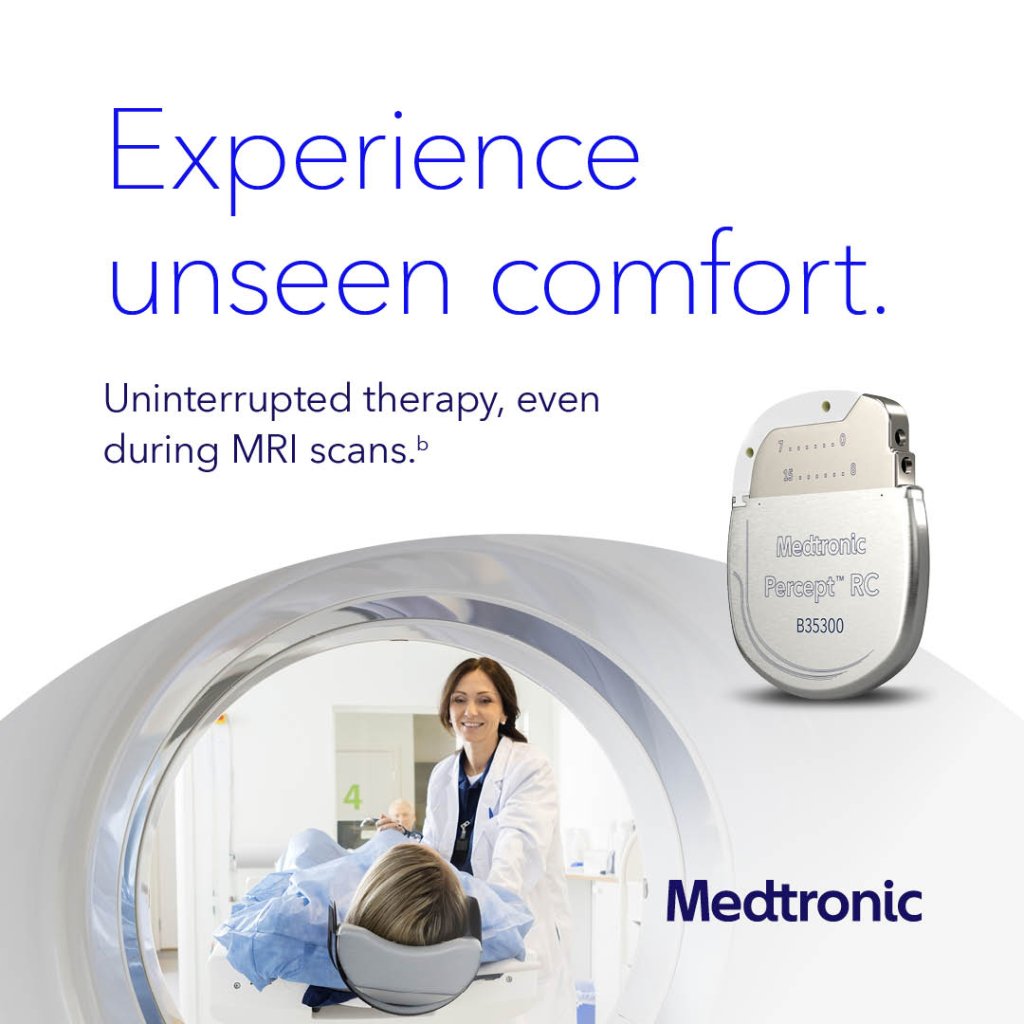
Dr Barbe says that clinicians must assess a candidate’s suitability for DBS individually and then work out which device is most appropriate for each person’s needs. In fact, he and his team offer three different Deep Brain Stimulation treatment options to members of the Parkinson’s community. Among these is the Percept™ RC Neurostimulator created by global medical technology company Medtronic.
Forming part of its complete technology portfolio, this device is an innovative DBS system with advanced programming capacity. While it is smaller and thinner than any previous model, Dr Barbe says that from a clinician’s perspective, the most “striking” feature is its sensing capability.
The device uses BrainSense™ technology to gather real-time data, offering insights into a person’s condition both inside and outside of a clinical setting – which can then feed into discussions around care options. Dr Barbe says that having access to this data “gives you another piece of the puzzle to find the best treatment for your patients”.
With a greater battery capacity than previous versions, the device can also be recharged quickly. “We already had access to a Medtronic device that was capable of sensing – but it wasn’t rechargeable,” recalls Dr Barbe. “The advantage of this latest version is that it combines rechargeability and sensing.”
Dr Iciar Avilés Olmos, a consultant neurologist at the Clínica Universidad de Navarra, Spain, first came across the Percept™ RC Neurostimulator in June 2020 after it obtained its CE marking. “The whole team was curious about it,” she recalls. “The BrainSense™ technology allows you to identify changes that when linked to clinical symptoms help programme the stimulation in a way that is customisable to evolving patient needs.”
Deep Brain Stimulation is “a powerful treatment option”
So, what might these evolving needs look like for people with Parkinson’s? According to Dr Barbe, DBS may be most suitable for those whose motor and non-motor symptoms have become difficult to manage with medication.
“That means that you will experience ‘on’ and ‘off’ cycles, which can occur after the ‘honeymoon phase’ when treatment has been working very well,” he explains. “Statistically, a lot of people after five to eight years of the onset of the condition experience these fluctuations – and they can be hard to treat with medication only.”
This is when deep brain stimulation might be a viable option: “The key benefits of DBS are that it can help reduce motor fluctuations, reduce the amount of medication required, improve tremor – and ultimately improve the quality of life for people with Parkinson’s,” says Dr Barbe.
“Whenever people show up for their first DBS session, I always tell them that it’s not a cure for the condition – but it can help manage the symptoms and often reduce medication postoperatively. This is why it can be a powerful treatment option,” he concludes.
This article was sponsored by Medtronic, a medical device company working on groundbreaking healthcare technology solutions for the most complex and challenging conditions.
Parkinson’s Europe is sharing this article for information purposes only. The article does not represent Parkinson’s Europe’s views and is not an endorsement by Parkinson’s Europe of any particular treatments, therapies or products.