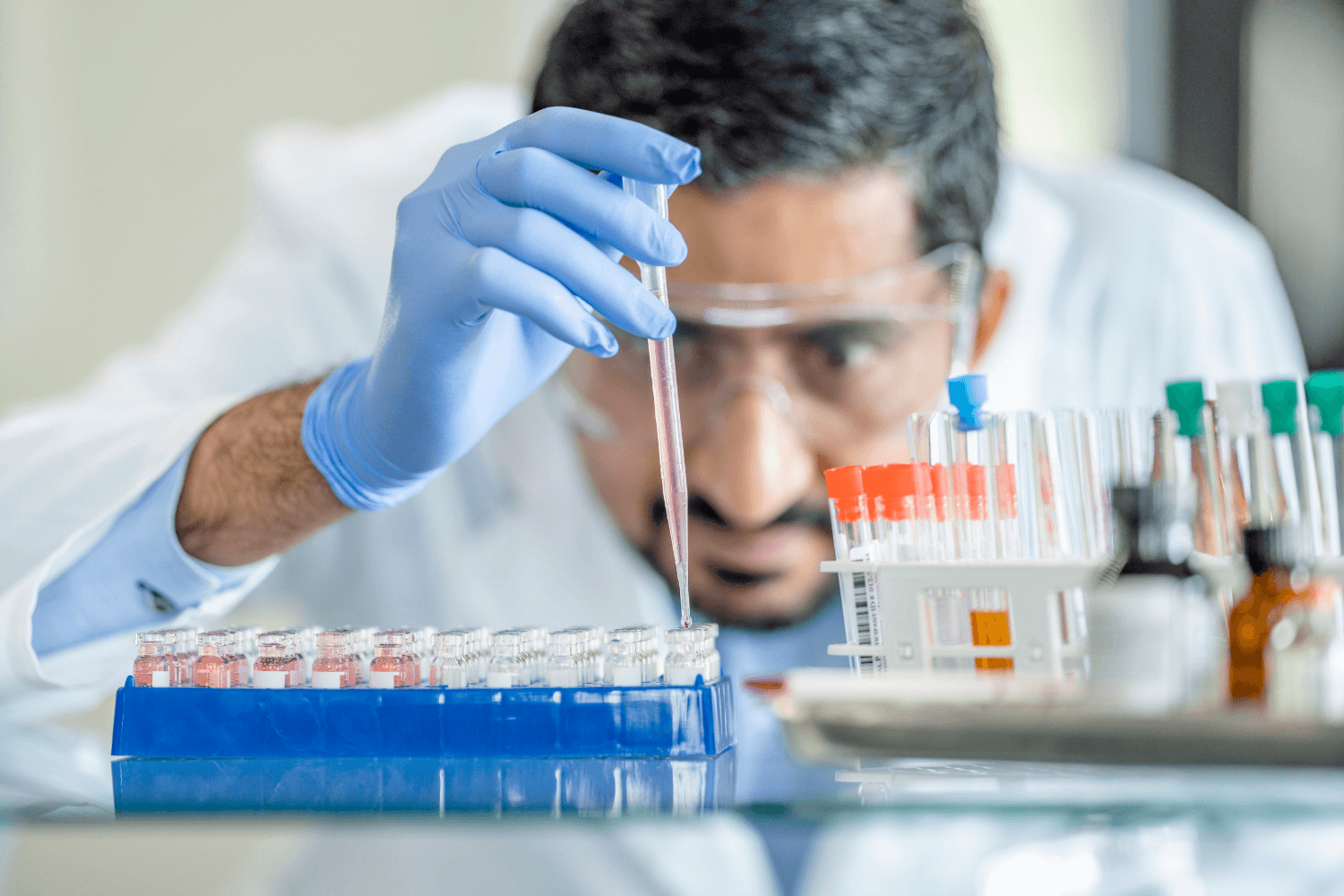
What is research?
We hear this question asked often and to be honest, it’s a very complex field. Here is the clearest definition we’ve come across:
‘Research is the process of solving problems and finding facts in an organised way following a process known around the world as the scientific method. To do this, researchers propose theories about a problem or observation and then do experiments to see if their theory was right or wrong.’
To put it simply, it’s a process. The process itself is broken down into different groups so we understand what scientific activities may happen and who may be involved in it. Some of the groups fall only into the scientific field and some don’t. Here is a list of different research groups that are linked with Parkinson’s:
- User research: collecting data about what people may want and need with regards to a product or service in everyday life. Find out more on the UK Gov website
- Basic research: lab-based investigations looking at tiny molecules and cells to see what they do, how they may change and what benefit they could potentially be once moved into people. Find out more about basic research in this eLife article
- Translational research: converting what is discovered in the laboratory into things that will directly benefit people. For more in-depth information, read this journal article
- Clinical research: research with people to understand health conditions, how they may be changed/improved/cured by means of intervention. See more: “Where and How to Take Part in Research”
History of research
Ever since the surgeon James Parkinson first reported on the condition that would later be named after him, scientists have been researching Parkinson’s to understand this condition more, and ultimately find a cure.
Here’s a brief history of Parkinson’s research:
1817
Initial discovery by James Parkinson describing the characteristic symptoms.
1861
Jean-Martin Charcot Introduced the term ‘Parkinson’s Disease’
1912
Frederick Lewy Identification of Lewy bodies in the brain
1925
Eduardo Brissaud proposed that damage to the substantia nigra is the anatomical basis of Parkinson’s Disease
1950
Dopamine is identified as playing a key role in motor control
1960
Dopamine depletion identified in the post-mortem brains of people with a Parkinson’s Diagnosis
1970
First approval of by the FDA of a symptomatic treatment for PD
1975
First levodopa combination, carbidopa/levodopa, became commercially available
1990
Identification of genetic mutations
1997
Alpha synuclein (a-syn) protein identified as a major component of lewy bodies
2002
Deep Brain Stimulations approved by the FDA for treatment of Parkinson’s Disease
2003
Heiko Brook proposes new hypothesis of how Parkinson’s disease pathology spreads in the brain
2011
First approval of the use of Dopamine transporter (DAT) SPECT to differentiate Parkinson Disease from essential tremor
2023
Identification of a synuclein seeding assay to provide definitive diagnosis of the presence of alpha synuclein in people living with Parkinson’s Disease
How can I take part in research?
There are various ways, from actually participating in a research trial to becoming a patient expert via an organisation like EUPATI to help researchers find ways to improve their work. Find out more in the FAQs below.
The best way to stay up to date on the latest research opportunities is by signing up to our Engagement Network
Our mission to support and improve Parkinson’s research
Here at Parkinson’s Europe, we have a Research Strategy – created in collaboration with the wider Parkinson’s community – which includes:
Creating a clear and streamlined system for how we share research news and opportunities (part of the reason we launched our Engagement Network)
Supporting the use of accessible language to bridge the communication gap between research professionals and the extended Parkinson’s audience
Helping our member organisation and partners understand the difference between research engagement and involvement activities, and how this can greatly benefit the Parkinson’s community
Find out more about our Research Strategy (including an Executive Summary available in 10 European languages) on our Research page
Research FAQs for people with Parkinson’s, partners, caregivers, family members and supporters
Why is research the way it is?
In the past, research wasn’t as closely controlled as it is now, to its detriment. That’s why today’s research structure is designed to make sure whatever is being explored is done so in a rigorous, controlled and safe way. If you are interested in learning more about the history of research, read about Dr James Lind and also the International Committee of Harmonisation.
How many things can research solve?
Research is at the heart of all human treatments and healthcare practices that you experience – no new medically approved method of treatment in the last 50 years has become available without it. Even research that doesn’t have a positive outcome can help shape and focus future research.
How can I access research?
You can access research in many ways, such as via academic institution websites, by speaking to your healthcare professional, or by reaching out to organisations like ours to see what is happening and if you can get involved.
Do not be afraid to ask, the more you ask, the more you will know.
Can I take part or participate in research?
Everyone can! There’s something out there for everyone, including many research trials that are looking for people who don’t have a diagnosis or known health condition. Find more information on our Where and how to take part in research page and receive opportunities straight to your inbox by joining our Engagement Network
In what other ways can I get involved in research?
You can also get involved with research from the design and creations point, to helping with sharing research results. Researchers are now more than ever desperate to understand from you about how to improve their research. If you are interested in becoming a patient expert please have a look at EUPATI, an organisation who specialise in providing training about research.
Is it possible for partners, family members and supporters to take part in research?
Yes – in fact, you are vital to research. There are many research trials that are looking for people who don’t have a diagnosis of Parkinson’s or any known health condition. One example is the PPMI clinical study which is looking to understand what risk factors might be linked to Parkinson’s and therefore need to look at people without Parkinson’s as well.
Why would someone not be able to take part?
With every research trial that is looking to recruit human participants, there is a list of criteria that specify who researchers are looking for – known as inclusion and exclusion criteria. These criteria are created so that the researchers can make sure they are doing research with the participants who are going to potentially benefit from it and also to make sure that the physical safety of the participants is as rigorous as it can be. Unfortunately not all research is for everyone.
Why should I take part in research?
You should take part if research is something you find interesting, feel passionate about or would like access to something new and novel that is not yet currently available through healthcare systems. Only you can decide if research is for you.
Where do I find the latest research news?
Keep up to date with all the most relevant and high-quality Parkinson’s research on our research papers page. You can also check out Parkinson’s Life, our online magazine, for articles and podcast episodes about research.
What benefits might there be for someone if they got involved in research?
There are many benefits people have told us they have experienced while taking part in research. Many people find it boosts their sense of hope and taking control of their condition. Others found it gave them access to and time with experts in the Parkinson’s field that they otherwise would never have met. Although results from research trials are not always significant, the things you will potentially learn about yourself are.
How do I know research is safe?
Research is now very heavily regulated and controlled. There are risks in all research trials, however every trial will have an information sheet for participants detailing the possible risks, so you can decide if it’s something you feel comfortable with or not. If you are unsure, speak to the researcher, research team or your healthcare professional.
When I take part in a piece of research, can I leave the research part way through?
Yes you can. You absolutely have a right to withdraw from the research whenever you think is right for you. However, before you do make that decision it is best to talk to the research team as depending on what research you are taking part in, there will be specific steps that have to be taken to ensure your safety.
If I take part in research, will it affect the care I normally receive from my doctor and medical team?
Research happens outside of your normal ‘clinical’ care, therefore it should not affect the care you receive from your current medical team. It can, however, give you an opportunity to speak to medical professionals who have more experience with Parkinson’s than your regular doctor. You can also ask them to share their findings with your doctor so that your medical team has more data about your condition, which can help your ongoing care.
Where is research happening?
Research is happening all over the physical world, as well as the virtual world – it all depends on the type of research taking place. Many research trials are now online so you can take part or get involved from wherever you are. Other research is happening in hospitals or medical centres, universities, specialist research centres and laboratories all around you. User research often happens whenever you log on to your computer or phone.
How is Parkinson’s research funded?
Research is funded in many ways. Some is from grants provided by governments, organisations or public funding bodies. Others are from profits made from the sales of products by pharmaceutical companies. These companies often put money back into the research and development of new products, keeping the learning moving forward.
Where can I access results from research trials?
You can access ask the research team themselves for their trial results, especially if you took part in that research, although it may take time to get access. All research is also required to be published in journals, many of which are open access, such as sections of the Movement Disorder Society journal. Otherwise, you can check out trusted organisations on social media like Parkinson’s News Today, and the Parkinson’s Europe website.
We hope these questions help – if you have other questions please email us at [email protected]