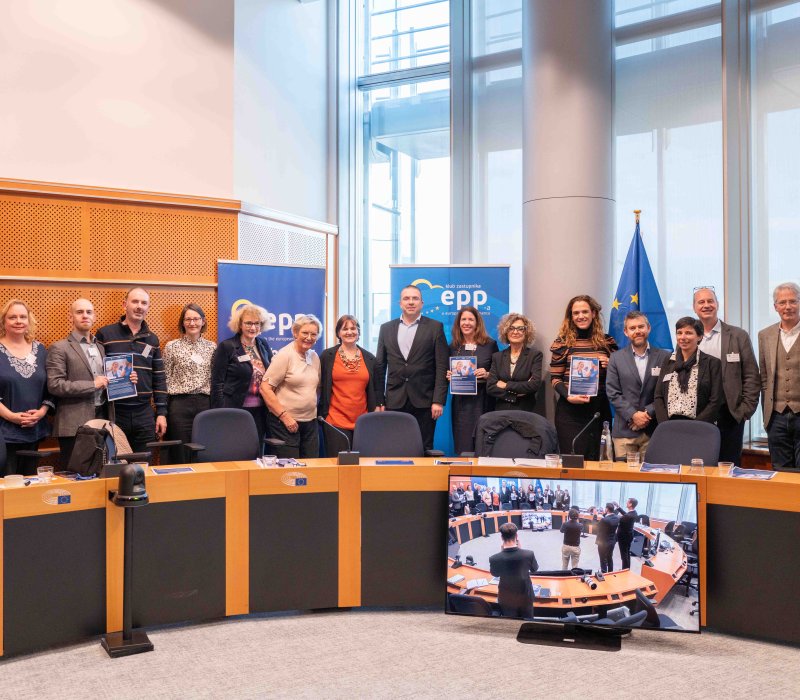
As we mark World Parkinson’s Day 2026, two Members of the European Parliament, MEP Sirpa Pietikäinen and MEP Tomislav Sokol have raised their voices in support of Parkinson’s Europe’s joint call to action for improved healthcare services for people with Parkinson’s in Europe.
Launched on World Movement Disorders Day in November 2024, the call to action was the result of a collaboration between Parkinson’s Europe, the European Federation of Neurological Associations, the International Parkinson and Movement Disorder Society and pharmaceutical company AbbVie.
It defined three areas for urgent improvement: the recruitment and retention of doctors, nurses and allied healthcare professionals who treat people living with Parkinson’s; the establishment of the professional profile of neurodegenerative nurses in all European healthcare systems; and the prioritisation of the adoption of innovative therapies and technologies to optimise timely access to care and supporting efficient and sustainable healthcare systems, notably in remote geographical areas.
Both MEPs outlined why they are backing Parkinson’s Europe’s joint call to action campaign.
In a statement he gave to Parkinson’s Europe, MEP Sokol, from Croatia, who belongs to the European People’s Party (EPP), said: “I support Parkinson’s Europe and this joint call to action because Parkinson’s is the fastest-growing neurological disorder and Europe needs a more coherent approach to improve care.”
MEP Pietikäinen, from Finland, who is also a member of the EPP, told Parkinson’s Europe: “We need better awareness, more effective joint action, and more EU [action] to combat, [find a] cure and help the lives of people with Parkinson’s.”
Both MEPs were united on the need to recruit more healthcare professionals. Asked what the EU needs to do to ‘close the care gap’, MEP Pietikäinen told Parkinson’s Europe: “More healthcare professionals: doctors, nurses, and other professionals to improve the accessibility and quality of the care.”
MEP Sokol spoke of “addressing shortages in the healthcare workforce, strengthening the role of specialised neurodegenerative nurses, and improving access to innovation, modern care pathways and clinical trials, particularly in smaller Member States and in hard-to-reach areas.”
Both MEPs also stressed the need for medications to be accessible for all people with Parkinson’s in Europe as some people with the condition are denied access to certain medications because there aren’t enough specialised healthcare staff to administer them.
MEP Pietikäinen, who has previously spoken about the importance of increasing EU collaboration in the research, development, purchase and storage of medicines, said that Europe needs to act as one to achieve “stronger competence in health”.
She added: “We also need to acknowledge, identify and establish the neurodegenerative nurse qualification in all member states and improve the use of innovative treatments and technologies.”
For his part, MEP Sokol spoke of “reducing inequalities in access to medicines and treatment across the European Union, while supporting research and innovation.”
He also mentioned that progress is now being made in the above area, while outlining the need for a Europe-wide strategy for neurological conditions.
“Important work in this direction is already underway through initiatives such as the recent SANT Committee hearing on brain health, which highlighted the growing burden of neurological diseases and the need for a stronger European policy response. More broadly, Europe needs a strategy for brain health, with due attention to Parkinson’s disease, so that patients with Parkinson’s are not left behind.”
Finally, MEP Sokol acknowledged that the European Parliament has a crucial part to play in helping to bring about the change that is needed.
“The European Parliament has a clear role in keeping these issues high on the European agenda and supporting a coherent European approach that delivers practical improvements for people living with Parkinson’s.”