Medical technology company Boston Scientific has introduced a further innovation in the field of deep brain stimulation (DBS): new directional leads specially designed to deliver more precise and personalised symptom relief in people with Parkinson’s.
Developed 30 years ago, DBS treatment involves a two-stage surgery followed by a programming phase. During the surgery, electrodes – or leads – are implanted into a patient’s brain. As their positioning is crucial, scans of the brain are taken pre-operation to guide the surgery. Next, a small device called a neurostimulator is inserted under the skin in the patient’s chest. The device is then connected to the leads in the brain. After a period of recovery, a neurologist will programme the device to administer electronic signals via the leads to specific areas of the brain with the aim of relieving various Parkinson’s symptoms.
Boston Scientific claims its new Vercise™ Cartesia™ X and Vercise™ Cartesia™ HX Directional leads, which are used in tandem with image-guided programming, will better enable neurologists to reduce specific Parkinson’s symptoms while minimising side effects, resulting in improved outcomes for DBS patients.

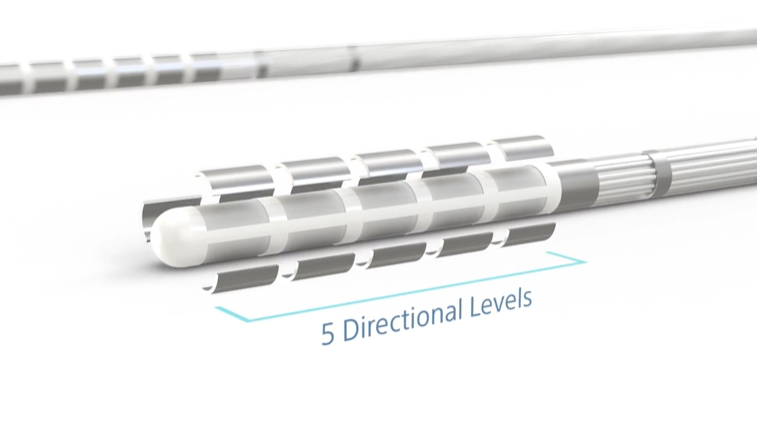
Created by hand by technicians using the same skill and precision of a watchmaker, the leads have 16 contacts – more than any other directional lead on the market. According to Boston Scientific, these allow the leads to provide 200 per cent more directional span – meaning more targeted stimulation in a particular direction – than other leads.
Professor Jens Volkmann is Chair of Neurology at the University of Würzburg, Germany, one of the ten centres involved in the Extend 3D study which tested these new directional leads for safety and efficacy. He explains the advantage an increased number of contacts brings:
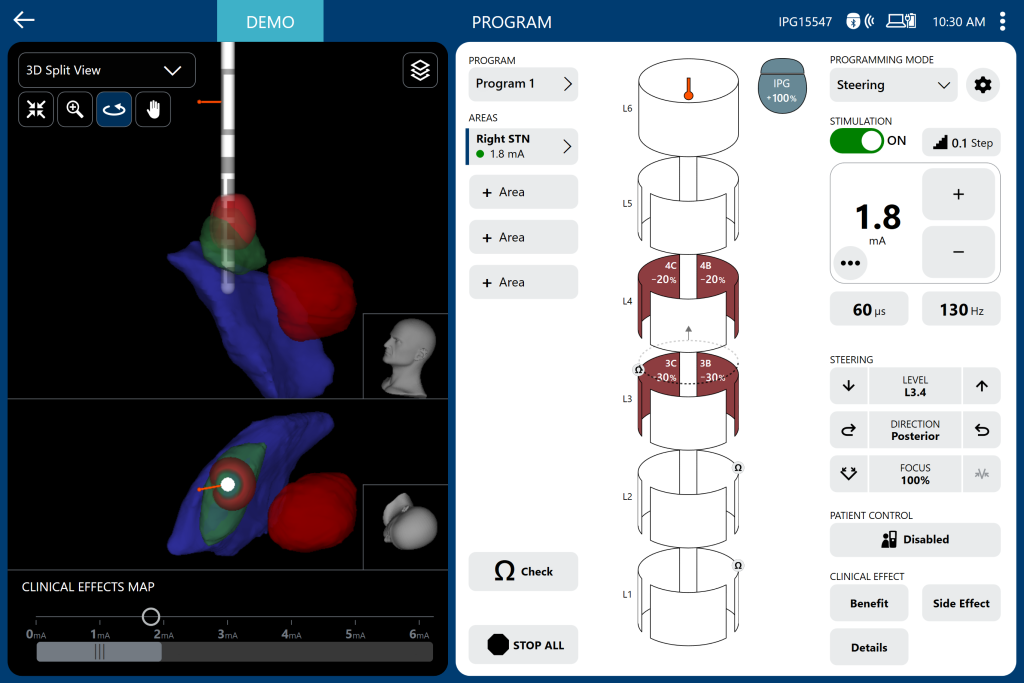
“The stimulation can only be delivered where there are electrical contacts. If you have more contacts, you have more flexibility of where to deliver the stimulation. The electrode has a longer span of contacts that allow a finer and more precise delivery of the stimulation, not only around the electrode, but also towards specific directions, and you can really shape and adjust the stimulation to the individual patient’s anatomy, using the image guided tools. We can perfectly adjust the shape of the electrical field to the shape of the area that needs to be stimulated.”
Essentially, he says, this increases the options available to a neurologist looking to relieve a person’s Parkinson’s symptoms.
“You get a lot more choices with the long-span electrode and Boston Scientific’s Multiple Independent Current Control (MICC) technology because you can position the stimulation field to any place, even between the contacts,” says Prof. Volkmann.
While the leads offer flexibility, they also provide precision. The system enables the creation of two separate stimulation fields on the same electrode, each with its own amplitude, pulse width and frequency.
Such flexibility and the targeted stimulation afforded by the leads may mean that a patient’s DBS can be optimised, with symptoms reduced and side effects minimised, more quickly and efficiently.
Prof. Volkmann describes how these new leads make it easier for a neurologist to address certain Parkinson’s symptoms.
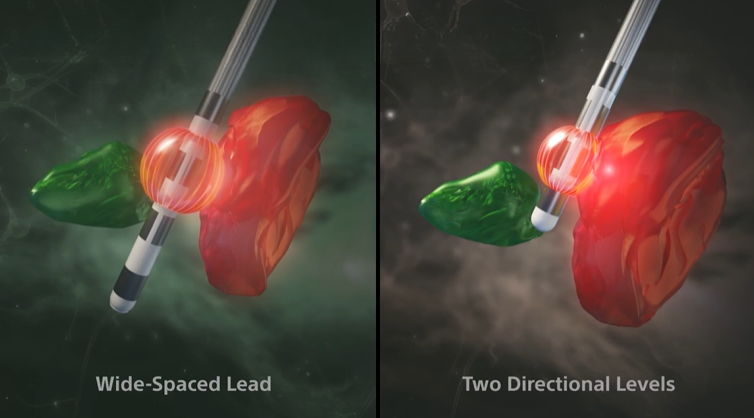
“For example, patients that have tremor very often need stimulation on two sites, not only inside the subthalamic nucleus, but also into some other fibres from the cerebellum to block the tremor, and there is much more flexibility to stimulate two sites with the Boston Scientific system and a long-span electrode,” he says.
In DBS, the painstaking placement of the lead in the brain has always been paramount in order for stimulation to reach the right places. While this remains crucial, the new leads feature five levels of directional contacts plus one non-directional level. This compares to other leads that may only have two levels of directional contacts. Having this increased number of directional contacts offers a broader range that is incredibly useful for the neurosurgeon as it ensures that the stimulation target for relieving symptoms should always be close to directional contacts.
A futureproofed solution
Prof. Volkmann believes that the increased directional range the leads offer will come into its own as a person’s Parkinson’s progresses and they experience more symptoms. It should simply mean that the DBS settings need adjustment rather than an invasive operation.
“If somebody develops gait freezing, and you want to try stimulating the substantia nigra [part of the brain], for example, then you’re right there. You don’t need to reposition the electrode.”
Boston Scientific believes the flexibility the leads offer with the precision from image guided programming will help deliver the personalised therapy that is the future of Parkinson’s treatment.
Prof. Volkmann says: “We have scientific studies from the last couple of years that have helped to show us that there are slightly different areas in the subthalamic nucleus that [when stimulated] improve tremor, bradykinesia, gait problems, speech and so on. So we may reach the point where we can really individualise the therapy to the symptom profile of a particular patient. With this very precise delivery of current, we can basically shape our stimulation to the required shape of the symptoms’ profile. That is a development that is now starting to take place.”
Finally, Professor Volkmann sums up the contribution Boston Scientific’s new directional leads may be able to make to DBS treatment.
“In a nutshell, they give us more flexibility in addressing an individual patient’s need, and also upgradability in the future, so when the symptom profile changes, we don’t have to revise or to reposition [the lead], because we have the option with these implanted electrodes to address different needs, even if they occur over time. I think that brings a lot of reassurance for the patient, to have a therapy that can be adjusted in the best possible way.”
Glossary
amplitude – the intensity of the electrical current given off by the electrodes
contacts – individual metal end points of the implant that can be turned on or off
cerebellum – the part of the brain at the base of the skull that is thought to be responsible for co-ordinating voluntary movements, posture and balance
directional span – think of the lead like a small tube. Now imagine placing a narrow vertical sticker on it. The directional span is simply the length of that sticker, the distance from its bottom edge to its top edge
electrical contacts – parts of an electrical device, specifically an electrode in this case
electrical field – the charged space around the electrode
electrode – a thin wire with electrical contacts on the end of it that is placed in specific areas of the brain and linked to an electrical source so that electrical pulses can be sent into that area of the brain
frequency – the number of cycles of an alternating current (AC) waveform per second
image-guided programming – the use of brain-imaging techniques such as f-MRI that tell the surgeons where to place the electrodes and then how to make sure the electrodes are programmed to best suit the patient
long-span electrode – an electrode that has more electrical contacts (see above) than a normal electrode, meaning it can have a stronger directional span (see above). This helps clinicians to program the electrodes
pulse width – how long an electrical pulse may last and how often
substantia nigra – area in the centre of the brain where many dopamine neurons are located. It is thought to be responsible for movement control, reward functions and thinking management. It is part of the basal ganglia circuit
subthalamic nucleus – a small, lens-shaped structure in the brain that is a key component of the basal ganglia circuit also connected with movement control, thinking and emotional functions
Parkinson’s Europe is sharing this article for information purposes only; it does not represent Parkinson’s Europe’s views and is not an endorsement by Parkinson’s Europe of any particular treatments, therapies or products.