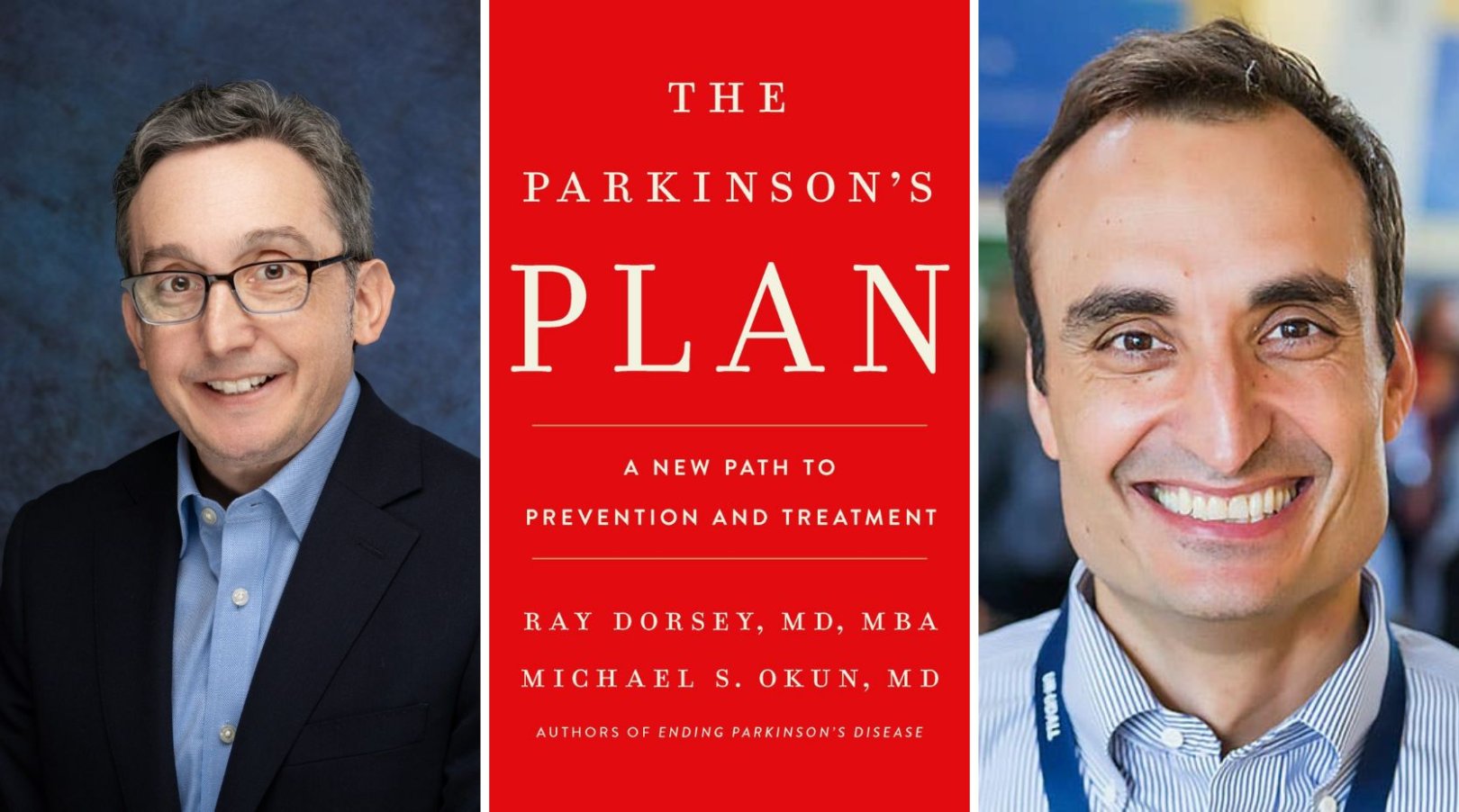
A blueprint for battling Parkinson’s has been set out in a new book by Ray Dorsey, MD, MBA, professor of neurology at New York’s University of Rochester, and Michael S. Okun, MD, professor of neurology at the University of Florida.
‘The Parkinson’s Plan: A New Path to Prevention and Treatment’ addresses the unforeseen steep rise in Parkinson’s – which they call “a manmade pandemic” – and set out what needs to happen to stop it.
In the book, which is divided into four sections – Prevent, Learn, Amplify, and Navigate – they discuss how care systems for people with Parkinson’s must change. They also outline which new treatments are the most promising, as well as provide tips on what everyone can do to prevent the condition.
They also set out an ambitious new goal – for there to be a 0 per cent increase in Parkinson’s cases by 2035.
In a quote for the new book, our President Josefa Domingos describes The Parkinson’s Plan book as a “a valuable tool to harness our knowledge for genuine impact”, adding: “It contributes meaningfully to our shared mission to improve lives, amplify voices, and advocate for change across Europe and beyond.”
Here, Michael Okun and Ray Dorsey discuss some of the book’s ideas with Parkinson’s Europe.
Your last book was Ending Parkinson’s Disease. Why have you come together to write new book The Parkinson’s Plan? How did it come about?
After Ending Parkinson’s Disease, we knew our work wasn’t done. The Parkinson’s pandemic has continued to explode. Folks thought we were alarmists in 2013 when we wrote Parkinson’s Treatment: 10 Secrets to a Happier Life and coined the phrase “Parkinson’s pandemic”. Fast-forward and our prediction from the last book was 12 million people with Parkinson’s by 2035. We are already at 11.8 million. Our work was clearly not done. Ray and I kept asking ourselves: “What’s next?” We realised people needed a clear, actionable playbook, not just a warning. The Parkinson’s Plan is that playbook. It’s our blueprint for prevention, asking why, better care and navigating new treatments.
Has the rising prevalence of Parkinson’s made this book more urgent?
Absolutely. The Global Burden of Disease data shocked even us at 11.8 million cases. This is nearly double what was predicted. It’s a wake-up call. We’re not just seeing a neurological condition; we’re witnessing a potentially man-made pandemic. This book is a direct response to that reality.
In the introduction to The Parkinson’s Plan, you write: “We have failed.” Why is this? Also, what do you hope this book will achieve?
We’ve published, we’ve cared, we’ve educated, however the incidence keeps rising, and too many people lack access to basic care. That’s failure. This book is about learning from that failure and pushing forward with a practical, unapologetic plan to do better.
The book is divided into four sections: Prevent, Learn, Amplify, and Navigate. Please explain.
It’s a four-part strategy:
- Prevent the disease by targeting causes.
- Learn by expanding and diversifying research and understanding why and when it starts and how it progresses.
- Amplify the voices of those affected and improve care delivery. We need a new model and we present one.
- Navigate to new therapies in the short-, medium- and long-term horizons.
We also need to keep in mind for the 11.8 million folks and growing that it is not just about the future, it’s about better lives right now.
In the book, you write about patient-focused care, “the patient is the sun”. What does better care for people with Parkinson’s look like?
Our current system is siloed and fragmented. We need truly integrated care with neurologists, physical therapists, social workers, mental health professionals and others, all orbiting around the person with Parkinson’s. That’s how we will improve outcomes and dignity. We need to move to a model of a larger Parkinson’s universe.
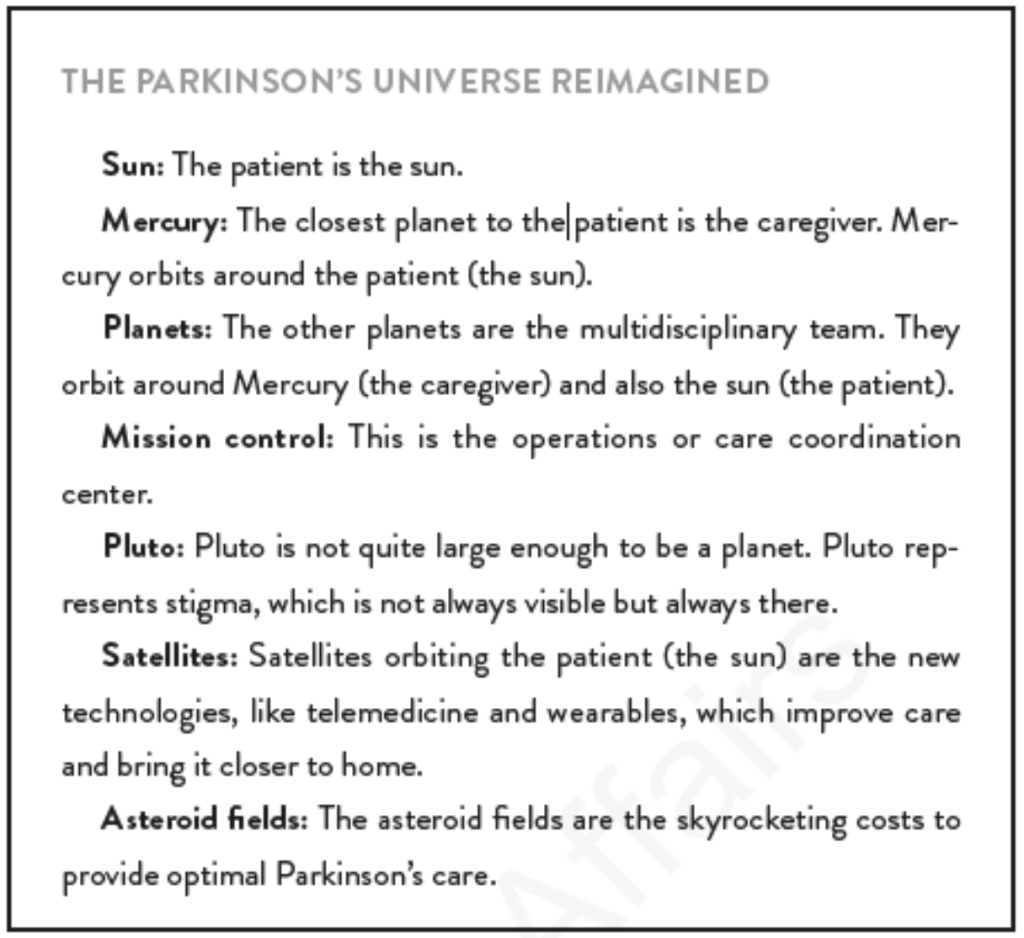
In the book, you list ParkinsonNet, Prof. Bas Bloem’s concept of multi-disciplinary Parkinson’s care in the Netherlands, as the latest in care. What can other countries learn from ParkinsonNet?
ParkinsonNet works. It’s multidisciplinary, evidence-based and cost-effective. Other countries can replicate it; however, it requires investment, training and political will. The biggest barrier is inertia. We need systems ready to change. In the US there is also a great model of care at the Norman Fixel Institute for Neurological Diseases at the University of Florida.
In your The Parkinson’s Plan book, you set a 0-10-100 goal for 2035: to see a 0% rise in new cases of Parkinson’s, a 10-fold increase in research funding and prevention, and 100% access to levodopa. It’s an ambitious plan for just ten years’ time.
Ambitious? Yes. Necessary? Yes. Realistic? Yes. We need to stop the rise in incidence (0%), increase research including prevention-focused research tenfold (10x) and ensure everyone has access to levodopa (100%). If we don’t aim high, we will remain stuck.
Why don’t we know what causes Parkinson’s and why does this matter?
Because we haven’t prioritised prevention. We’ve focused downstream on brain pathology when the causes are likely upstream like toxins, environmental exposures and gut health. If we don’t identify root causes, we’ll never prevent this disease.
Has research been misdirected?
Too often, yes. We’ve spent decades chasing alpha-synuclein and genetics, however 85–90% of Parkinson’s isn’t genetic. It’s time to look outside the brain to chemicals like TCE and to modifiable environmental risks. Science must be bold and willing to swim against the current.
TCE and PCE were finally banned in the US last year, but the ban was frozen earlier this year. What is your reaction to this?
This is a tragedy of public health in slow motion. TCE and PCE are neurotoxic, and we finally had a ban. We can’t keep putting economic interests over human health. It’s unacceptable.
Which scientific developments are most promising?
We are encouraged by many new innovations like nanoparticles, gene therapy, gene editing, adaptive deep brain stimulation, gut microbiome research and targeted therapies like LRRK2 inhibitors. We must however match scientific innovation with public health action. That is where the real impact will come.
Why aren’t governments moving faster on Parkinson’s?
There are many reasons for the slow pace. One big one is that Parkinson’s is still viewed as an old person’s disease. It doesn’t get the urgency it deserves. It is commonly confused with Alzheimer’s. However, we should make no mistake; we are in a brain health crisis. We need a Parkinson’s version of Operation Warp Speed and we have called for this in an op-ed we wrote after the book Ending Parkinson’s was published.
Paraquat is illegal in the EU and in the UK, but it isn’t outlawed in the US – how frustrating do you find that?
It’s unconscionable. We have compelling data linking paraquat to Parkinson’s, and yet it remains legal in the US and its sales keep growing. It’s like knowing cigarettes cause cancer but still handing them out. The science is there – we need policy to catch up.
Last summer, the US National Plan to End Parkinson’s Act became law, requiring the US government to develop a plan to prevent and end Parkinson’s. Is there any action on this yet? Are you involved in this?
The law passed and now we need action. Momentum is building but not fast enough. We have been honoured to contribute ideas, and The Parkinson’s Plan offers a ready-to-use roadmap. We hope it can serve as a template for the National Plan and we plan to help in any way possible.
What can people with Parkinson’s do to help themselves?
We offer a Parkinson’s 25 in the book. Exercise, eat a Mediterranean-style diet, stay socially and cognitively active and build your care team. Wash your fruit, make sure you have a good water filter and choose where you live carefully. Empower yourself with knowledge and use tools like our The Parkinson’s Plan book.
Final thoughts?
We have the science. We have the stories. What we need now is the will to stand together, demand change and chart a new course. Parkinson’s is beatable but only if we act and we come together and amplify our voices. We owe it to this generation and the next.
New book The Parkinson’s Plan: A New Path to Prevention and Treatment by Dr Ray Dorsey & Dr Michael S. Okun (PublicAffairs, £25), is published on 11th September.
Giveaway! We have three copies of ‘The Parkinson’s Plan: A New Path to Prevention and Treatment’ book by Ray Dorsey and Michael S. Okun, published in English, to give away.
For your chance to receive a copy, please email [email protected] with the subject ‘The Parkinson’s Plan giveaway’ – including your name and postal address – before midnight on 11 October 2025. For full terms and conditions please see Parkinson’s Europe Giveaway Terms and Conditions.