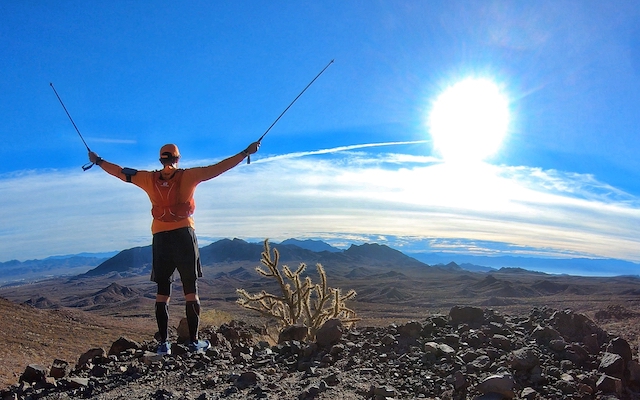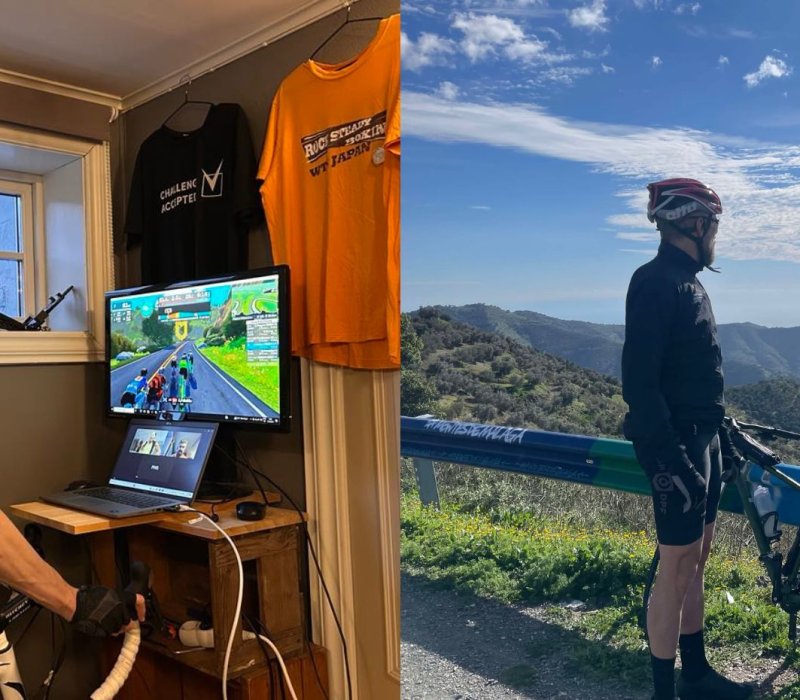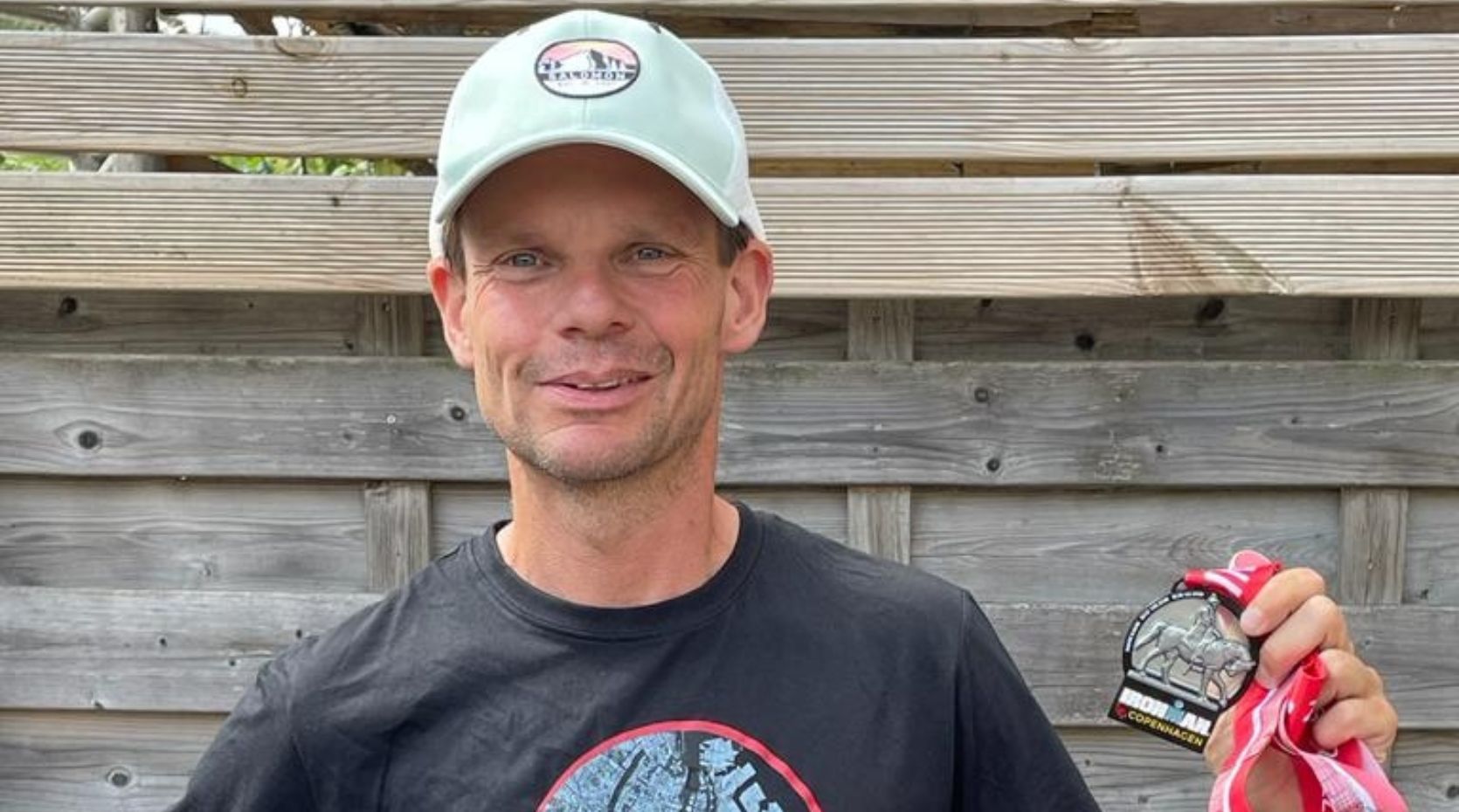
When sports coach Olivier Deharynck learned he had Parkinson’s, he saw no reason to cut back on his exercise regime. In fact, after a conversation with his neurologist, who gave him the ‘green light’, the 53-year-old triathlete decided his diagnosis would actually be a trigger to intensify his sports practice.
Olivier, who lives in Belgium, says: “When I learnt that I had Parkinson’s, the neurologist told me ‘go ahead, do as much sport as you can’. When I came back home, I told my wife: ‘I’ve got Parkinson’s but I need to do a lot of exercise’ – she thought the neurologist was crazy!”
Receiving a diagnosis changed not only Olivier’s perspective, but also his sporting performance. As a triathlete, “I saw my performances diminishing but I didn’t know that I had Parkinson’s. I was training more and more but performing less and less,” he says. “I became a triathlete with mediocre performances, but knowing that I had Parkinson’s, I became really good. My ego changed and I said to myself: “I’m not that bad after all”. So now for me finishing an ironman it’s all fun, even though I’ll finish it in the maximum time allowed.”
Although Olivier first began noticing symptoms in his forties, doctors suggested a combination of age and a demanding sports routine were the cause. It wasn’t until years later, at the age of 49, Olivier’s GP referred him to a neurologist. “I walked from the neurologist’s waiting room to his office, and he had already understood what I had,” he says. “It took me years to get to a diagnosis that was made in under 30 seconds.”
Despite the long wait, Olivier’s diagnosis was made easier by an “optimistic’ neurologist who delivered the news gently. “My neurologist was really good, saying ‘you might have a small but really a small Parkinson’s’ – as if a small Parkinson’s exists! Having no previous knowledge of Parkinson’s, I fell for it. He then added: ‘In any case I’m not worried for you as you’re an athlete, so you’ll manage easily. So it was very optimistic from his side, but he was right in the way he gently delivered the news. A specialist with a human approach, that’s rare!”
Positive approach to diagnosis
Determined to become an expert on the condition, Olivier began reading up on Parkinson’s – a process that helped him turn years of searching for answers into a new start.
While incorporating targeted exercises into his regime has helped – “I now have better balance than 20 years ago!” – Olivier recognises a supportive environment is key to coping with the daily challenges of life with Parkinson’s.
“The side effects from medication can be devastating,” he says. “You can’t really notice it when looking at me, but in reality I struggle and fight against cramps, against fatigue as sleep is bad, against slowness of movement (bradykinesia). Anything out of the ordinary is a catastrophe, especially in regards to my timetable and memory loss.” High, and fluctuating emotions, are among the non-motor symptoms he experiences.
“I need to live in a very protective and caring environment, as it becomes tough when stepping out of that world. In my sport challenges I do step out of my comfort zone, but I know how I will react, I prepare, and I receive good support from my friends and family.”
Concentrating on positive activities, such as sports coaching, have also helped. “I can’t say that it gets rid of the symptoms, but it makes my everyday life positive. Having exciting projects and being positive creates a dopamine substitute somewhere.”
Adapting exercise to a range of abilities
Exercise has always been a part of Olivier’s life. His son encouraged him to start trail runs, and a colleague got him into triathlons. So it’s not surprising that sport has remained an important part of Olivier’s life since his Parkinson’s diagnosis – but he’s careful to manage his expectations. “Now, if I finish my triathlon it’s an achievement in itself. I no longer expect from myself what I expected yesterday. I push and outdo myself of course, but I no longer have timed objectives. If and when I have to give up, which happens, well I give up. Onto the next!
It’s clear that Olivier’s passion for intense sporting challenges like triathlons and Ironman events, are a positive focus for him. Yet he recognises other people with Parkinson’s may benefit from a more gentle approach to exercise.
“When you have Parkinson’s, getting out of your chair and exercising is already tough. So starting off with a triathlon objective might be a little bit ambitious. I recommend balance circuits and nordic walking to get started. I focus on getting people to cycle in other ways (such as a velomobile or tricycle), in terms of balance or power output. Solutions exist, we need to share them within our circles. I think sport and exercising, getting started or getting yourself back in it, must come from the inside and from yourself.”
Physical and mental strength
Olivier’s challenges this year have included cycling approximately 1,600km on a velomobile (a three-wheeled recumbent bicycle) in ten days from Nivelles, Belgium, to Montpellier University Hospital, France, in May.
“The velomobile idea came whilst cycling with friends,” he says. “There was a strong wind coming from the side, it affected my balance and I didn’t have the power and agility to rectify it. I had a friend riding a velomobile with us, and he offered to switch bicycles. So I tried his velomobile and suddenly no issues at all in regards to the wind.”
The experience was enough to convince Olivier to purchase his own velomobile, although with typical ambition he did so with a goal in mind.
“I wasn’t going to buy one to go buy some croissants. It’s costly, so I wanted to do something ambitious with it. This same friend and I were planning on riding the Vélodysée (part of the Atlantic Coast Route), and then the Non Pharmacological Intervention Society (NPIS), based in Montpellier, asked us to join them there. So we finalised our plan from Nivelles to Montpellier. Two other friends joined us with their velomobiles and we were off!”
The challenge brought more than just sporting accomplishment, however. “It’s really more the emotions and friendships. The team cohesion was amazing; we left close friends and we came back friends of the heart. We were happy to see our wives and children, but actually quite sad not seeing each other everyday afterwards.”
The next month, Olivier completed a 108km Nordic walk from Liège, Belgium, to Dinant, Belgium, in 24 hours. “I always dreamt of doing a 100km. As I couldn’t do it running anymore, I decided to do it walking. I was pretty much always accompanied by someone, but I was the only one to do the 100km. The first 75km were totally fine, I nearly thought that it was too easy! But in the last 25km, with the accumulation of rain and humidity, I started developing blisters and it felt like walking on knives. That was really between the 75th and 85th kilometre, going from laughing to not laughing at all.”
The physical demands then became an internal battle. Olivier recalls: “On the 85th kilometre, people started questioning if I should continue or not, and the simple thought of other people deciding for me convinced me to continue. I wasn’t letting anyone stop me apart from myself! I managed to finish my challenge, quite tired though – I fell asleep at the bar terrace while having a drink. It was a really challenging experience due to the injuries. A nice experience however, more internal this time around and more about pushing back my limits.”
What lessons did he take from such demanding feats? “There are always solutions and we can always find something to learn. Maybe being a bit more prepared, you can never be prepared enough.
When presenting in a school about his projects, a teenager asked Olivier if Parkinson’s had brought him any positives. Stating he’d rather not have Parkinson’s, he replied that it has led to accomplishments that he wouldn’t have otherwise undertaken.
“Since this teenager asked me this question, I think about it everyday and I realise how lucky I am. I’m grateful when I’m out for a drink as much as when I’m cruising down France with my velomobile. Everything becomes pleasure as I realise my luck. And the more pleasure I take in accomplishing projects, the more projects I accomplish and the more my disease’s progression slows down.”
Communication and support
From finding sponsors to practical help such as adjusting his velomobile, friends and family have been an invaluable source of support, he says. “They’ll also remind me to take my dopamine for example when I’m in the midst of a challenge, I’ll usually forget! I’m very lucky to be surrounded by such caring people.”
New challenges on the horizon include a Montpellier-Annecy tricycle trip, rounded off with a lake tour in Polynesian canoes. Olivier is also calling for people with Parkinson’s to join in a 24-hour challenge at Lake Genval in Belgium in June 2025. Primarily a sailing race, it can be completed using any means where participants relay each other for 24 hours. “It’s very convivial and friendly. I’ll be doing it using a pedal-drive kayak, so the idea is to have a Parkinson’s team to complete it. As long as people can go in and out of the kayak, we’ll be very happy to welcome anyone for as long as they can”
Olivier is also planning a pedal-drive kayak tour of the Canary Islands, a Lille-Champagne cycle, and of course: “Whenever I can get a cheeky triathlon in, then I don’t hesitate to sign up”.
For the Parkinson’s community as a whole, communication is an important part of reducing stigma and raising awareness, he says. “Some people feel shame about their diagnosis, and don’t dare to talk about it. I’ve had people telling me that their colleagues thought they were alcoholics as they didn’t open up about their Parkinson’s. No condition or disease is shameful, so we need to talk about it.”
From competitive sporting events, to raising awareness of Parkinsons’, it’s clear Olivier believes in teamwork. “I’m a big believer in united we are stronger. We need to keep meeting new people and communicating new ideas between ourselves, that’s very important. When you bring people together, you can move mountains.
“Originally, I didn’t want to put myself forward and for people to think that I’m doing impossible things like Superman. That’s not true at all, I just believe in my dreams – otherwise, I’m Mr Everyman. If I can do it, everyone can.”