For the fifth year in a row, the Michael J Fox Foundation, Cure Parkinson’s and Parkinson’s research advocates have released an annual report on Parkinson’s drug therapies currently undergoing clinical trials, with the 2024 report showing numbers of trials have remained “remarkably” consistent with previous years.
Parkinson’s research trials in numbers: three key facts
- The 2024 report, published in the Journal of Parkinson’s Disease, revealed there were 136 active clinical trials registered on ClinicalTrials.gov as of January 31 this year, compared to 139 trials the previous year.
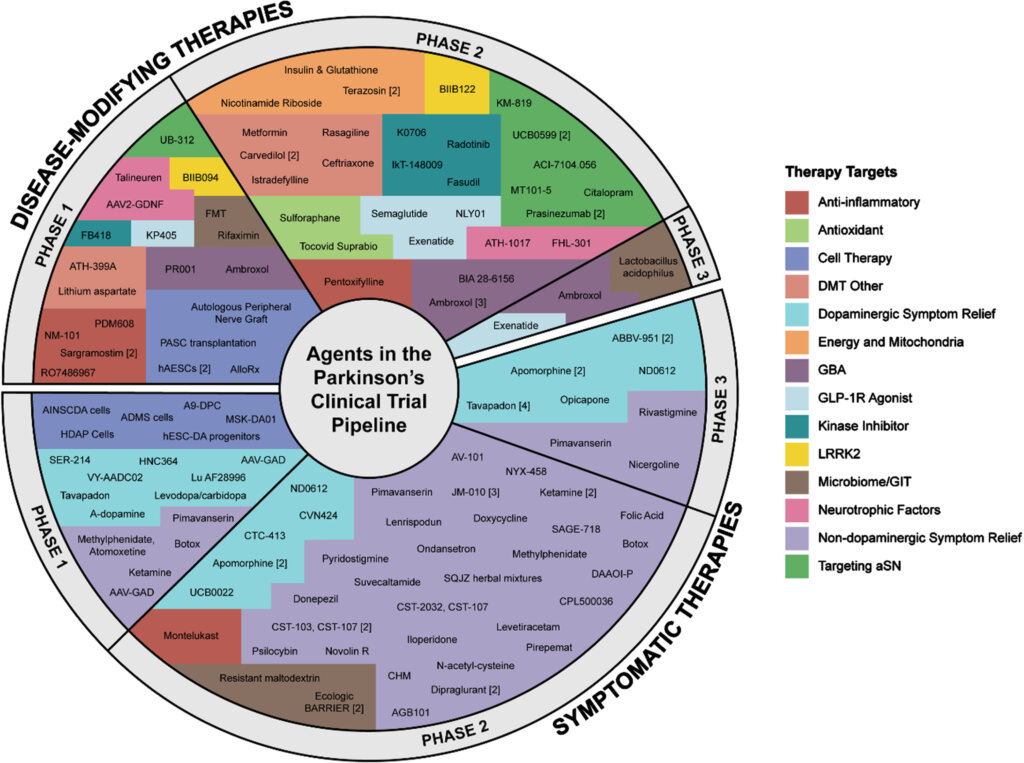
- Of the 136 active clinical trials this year, 56% were for “symptomatic treatments” – drugs which improve or reduce Parkinson’s symptoms – compared with 44% for “disease-modifying treatments” (DMT), which aim to slow down the progression of Parkinson’s. This is almost identical to last year’s 55/45 split.
- There are three phases to a drug trial, and this year’s report showed 58% of the trials were in Phase 2, 30% were in Phase 1 and only 12% were in Phase 3.
There were also more trials of drugs to help non-motor symptoms (symptoms not related to movement) this year.
Speaking of the consistency of Parkinson’s research trial numbers of the last five years, Cure Parkinson’s Director of Research, Dr Simon Stott, said:
“One of the truly remarkable features of the last five years of these reports is that the number of active clinical trials has stayed relatively stable. This is ‘remarkable’ because we had a global pandemic in the middle of this period of time. It is a testament to the participants and the researchers involved that activities were not more disrupted.”
The 2024 report included this pie chart showing the different Parkinson’s drug trials taking place:
Phase 3 trials remain a challenge
Drug trials are split into three phases:
- Phase 1 assesses the drug’s short-term safety
- Phase 2 assesses short-term safety and begins to explore how effective the drug is at treating the condition it’s designed for (in this case Parkinson’s)
- Phase 3 investigates the drug’s long-term safety and how well it works on a large group of people with the condition it’s supposed to treat.
This year, just 16 Parkinson’s drug trials were in Phase 3, and only three of these were disease-modifying therapies (DMT), designed to slow down Parkinson’s progression. This number has halved since last year’s report.
As a result, the 2024 report concludes that “the drug development pipeline for Parkinson’s is robust, but more progress needs to be made with late-stage testing of treatments to slow the disease”, with Cure Parkinson’s adding:
“With the importance of disease-modifying therapies for an eventual cure for Parkinson’s, there is a clear need for further initiatives that will facilitate the progression of drugs through the clinical trial pipeline and into subsequent phases of testing.”
Read more about Parkinson’s research here.