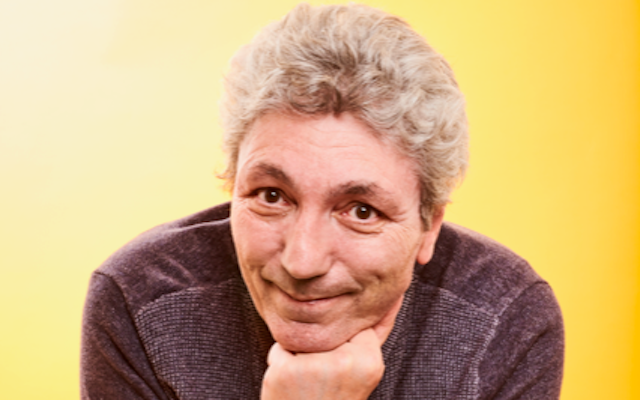
Best known as the co-writer of classic British comedy TV series The Vicar of Dibley and the film Esio Trot, Paul Mayhew-Archer has been making people laugh for more than 40 years. Now, following his Parkinson’s diagnosis 12 years ago, he is determined to help others see the funny side of the condition.
As well as writing, he made an award-winning documentary, Parkinson’s: The Funny Side (still available on BBC iPlayer and YouTube), and he tours the UK doing talks about Parkinson’s and performing his comedy shows The Funny Side of Parkinson’s and Incurable Optimist – including a performance at last summer’s World Parkinson Congress.
He is also one of the celebrities and people with Parkinson’s behind the regular Movers and Shakers podcast about life with the condition, which is co-presented by former TV broadcasters Jeremy Paxman, Rory Cellan-Jones, Mark Mardell and Gillian Lacey-Solymar, and retired judge Sir Nick Mostyn.
Paul spoke to Parkinson’s Europe as he prepares to perform The Funny Side of Parkinson’s in an online show at the end of October.
You were diagnosed in 2011. What were your symptoms?
My arm wasn’t swinging naturally – it sort of hung in front of me. Also, the neurologist said: “Your facial muscles are somewhat frozen, for example, you seem to be finding it quite difficult to smile.” And I found myself saying: “Well, that could be because you have just told me I’ve got Parkinson’s.” I didn’t know it was a symptom then, but my handwriting was very small. And I was moving more slowly. Whereas I used to walk ahead of my wife, my wife was saying: “Come on, Paul, hurry up.”
When did you first spot a funny side to having the condition?
In that very moment with the neurologist. Extraordinary. I remember going down the stairs after the appointment thinking: ‘This is funny!’ And I don’t know why. I suppose because I’ve worked in comedy for 40 years, and in a sense, you can’t do comedy without having a subject. I suddenly thought: ‘Here’s a subject.’ I just remember thinking: ‘There’s something odd about this – and funnily odd.’ I can’t explain it, but it’s been incredibly important. It’s helped me enormously.
How has it helped you?
The comedy has helped with my Parkinson’s. It keeps me cheerful, and hearing people laugh is incredibly rewarding so that when I’m performing, my pain in my back goes away; I don’t notice it. Meanwhile, Parkinson’s has helped with my comedy because I hadn’t performed for 40 years.
Comedy has helped with my Parkinson’s. It keeps me cheerful, and hearing people laugh is incredibly rewarding
You’ve done lots of writing and behind-the-scenes work.
I’d done lots of performing at school and at university. I started writing plays when I was teaching – I taught for three years. And I wrote some plays for the children at school and some for the teachers and I did a bit of performing then – and then stopped altogether. I didn’t really have the confidence to perform – certainly didn’t have the confidence to do stand-up or anything like that. Parkinson’s gave me that opportunity because it gave me a subject; it gave me something to write about that was different from anything that anybody else was writing about.
Do you think having Parkinson’s has made you more fearless?
Yes, certainly. And, amazingly, I discovered that people with Parkinson’s have a real sense of humour and are really keen to find the subject funny. There are 40 symptoms you can write jokes about. Also, the great thing about Parkinson’s is that a lot of the symptoms are to do with sex and bowels and all the things that are embarrassing and funny!
You performed your show at this summer’s World Parkinson Congress. What was that like?
I loved it. I was put in a room which seated about 200 people, and then so many people turned up we had to be moved to a room for more than 400 people – that made me feel fantastic. I see the show as a way of celebrating our strength in dealing with Parkinson’s. Different people have different ways of dealing with Parkinson’s and do amazing feats like climb Everest or cross oceans or cycle rides. I’m useless at any of those. Jokes I can do, so that’s my thing. Also, I’m trying to spread the word about Parkinson’s and educate people about it in a very accessible, friendly, cheerful, non-threatening way.
I see the show as a way of celebrating our strength in dealing with Parkinson’s
I’m assuming your symptoms have got worse in the past 12 years, but are you still able to see the funny side?
I tend not to talk about those times. I do jokes about the freezing that I have now – freezing is irritating and when I go off my hands are useless, that’s another thing that’s irritating. And my mood can be more miserable now at times, and that makes it more difficult for my wife. And I tend to get obsessive about things. So, there are all sorts of tell-tale signs of the Parkinson’s that affect me in many ways.
You’re part of the Movers and Shakers podcast – how often do you meet up with your co-presenters?
We meet up quite a lot. The most recent episodes – to be released very soon – were very interesting. One was with our partners, so we handed over the show to them and they were interviewed. Then the second was with our offspring, so my son did an interview as well as some of the children of the other members. They were very touching and moving because we get an insight into how they feel about Parkinson’s, about us dealing with it. They will be well worth listening to because I think they reflect what a lot of people are feeling who live with Parkinson’s.
When you’re having a down day, how do you cheer yourself up?
I probably try and search for some chocolate. I just try and think of positive things and remember funny moments that have happened. And I’ve been working on a film script about people with Parkinson’s who fall in love at dance class – I’m rewriting that – and if I think of a joke for that that cheers me up.
You can watch Parkinson’s: The Funny Side with Paul Mayhew-Archer online on Sunday, 29 October at 1700-18:30 GMT. The Movers and Shakers podcast is available on various platforms including Spotify and Apple
Parkinson’s Europe is sharing this article for information purposes only; it does not represent Parkinson’s Europe’s views and is not an endorsement by Parkinson’s Europe of any particular treatments, therapies or products.