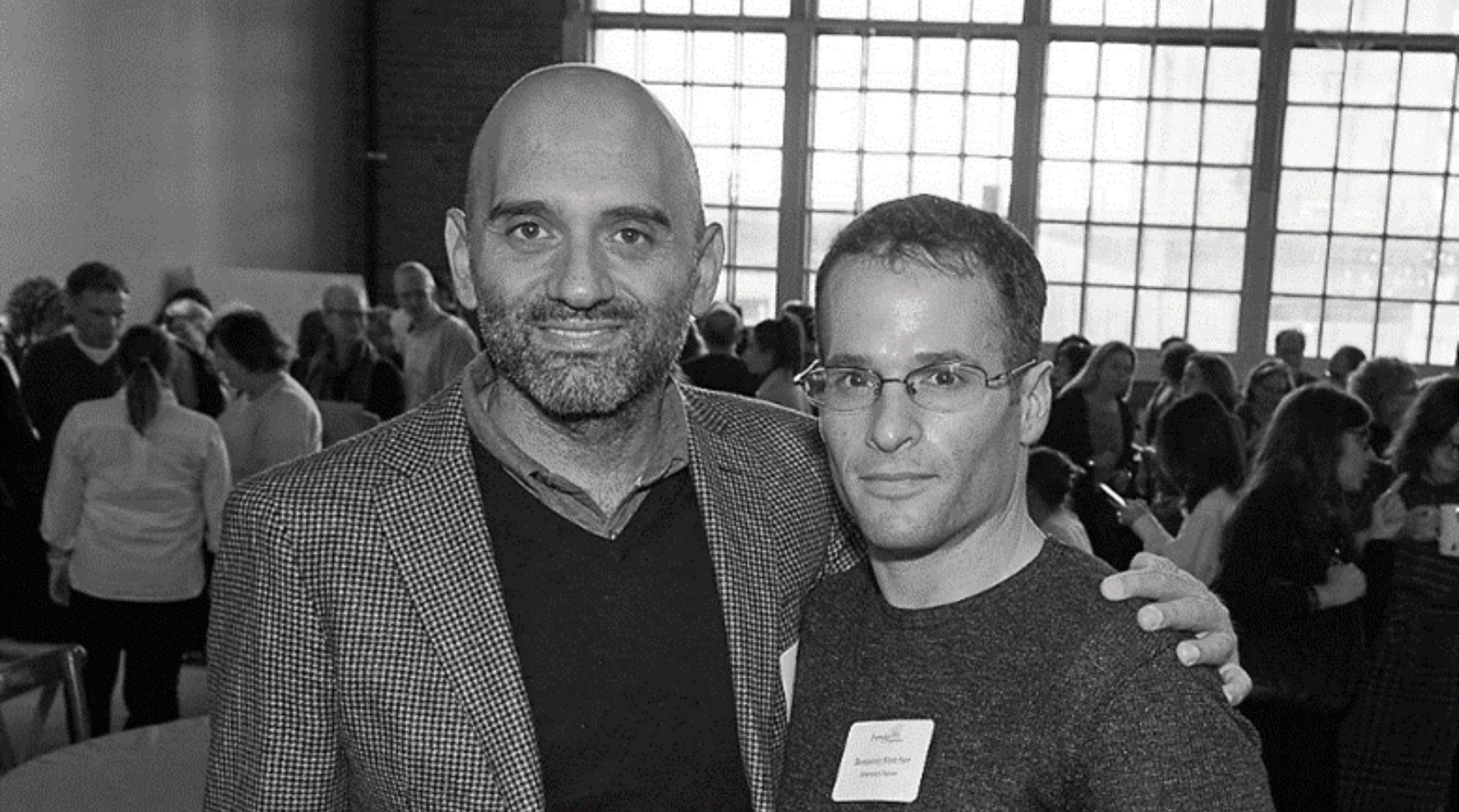
Parkinson’s advocate Ben Stecher is about to release his second Parkinson’s book.
Having grown up in Canada, 39-year-old Stecher was 29 when he was diagnosed with Young Onset Parkinson’s. After his symptoms became unmanageable with medication, he had Deep Brain Stimulation in June 2021, and by taking part in medical technology company Medtronic’s ADAPT-PD (Adaptive DBS Algorithm for Personalised Therapy in Parkinson’s Disease) trial, became the first patient in a North America trial to use the adaptive setting of one of the latest DBS devices.
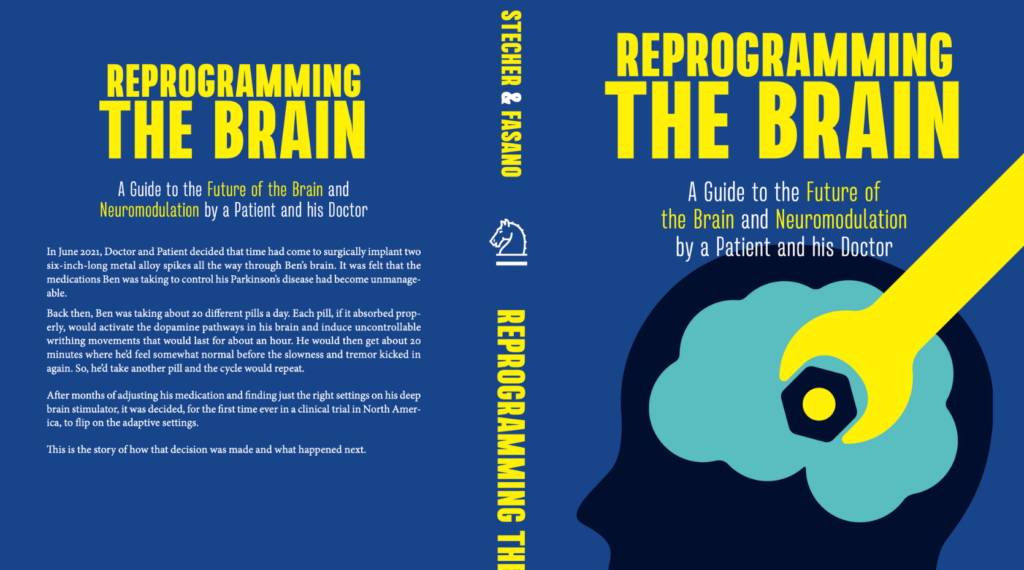
He has now written a new Parkinson’s book, Reprogramming the Brain, with his clinician, Dr Alfonso Fasano, Professor of Medicine (Neurology) at the University of Toronto, Canada, detailing how they came to that decision after months of adjusting his medication and the settings on his deep brain stimulator, and what happened after that. Published on 30 March 2024, this new Parkinson’s book is also a guide to DBS treatment and the future of this technology.
We talk to Ben about his new book:
You were diagnosed in 2013 when you were 29. What were your first symptoms?
My first symptoms were when I was 25 or 26 years of age. I had a mild tremor in my hand and in my foot, and some bradykinesia as well. The symptoms slowly progressed and progressed until I realised something was wrong with me and I needed to go to a doctor. At the time, I was working in China as an education consultant, helping Chinese kids get into American universities. I came home on a trip in November and that’s when I got my diagnosis. I had an aunt who’s a GP – she spotted my problem to begin with. She was the one who referred me to a Movement Disorder Specialist, so I was able to get my diagnosis pretty much straight away. I didn’t go through all the trouble that most people go through.
Did your diagnosis lead you to change your direction in your life and work?
Initially, no, because my symptoms were pretty mild at the time. I thought naively that ‘if this is Parkinson’s, I can deal with it.’ So, I went back to China and spent two or three more years there, trying to slog away, trying to ignore my disease to some degree. But then I slowly started to realise how much trouble I was in, and I started to plan more for my future. I realised that I needed to come back home to deal with this and find a more permanent solution to this problem.
What did you do once you were home?
I started to become a little more vocal in the Parkinson’s community. But I began by educating myself. I spent a lot of time trying to read the literature, trying to read the research publications, really trying to understand what was on the cutting edge of this disease. However, I soon realised that I needed to speak to these individuals as well because there’s only so much you can learn just by reading their papers. I started to travel the world, and I visited labs all over the place, asking a lot of probing questions, asking what they’re working on, what this disease really is and what future therapies were on the horizon.
Why did you have DBS?
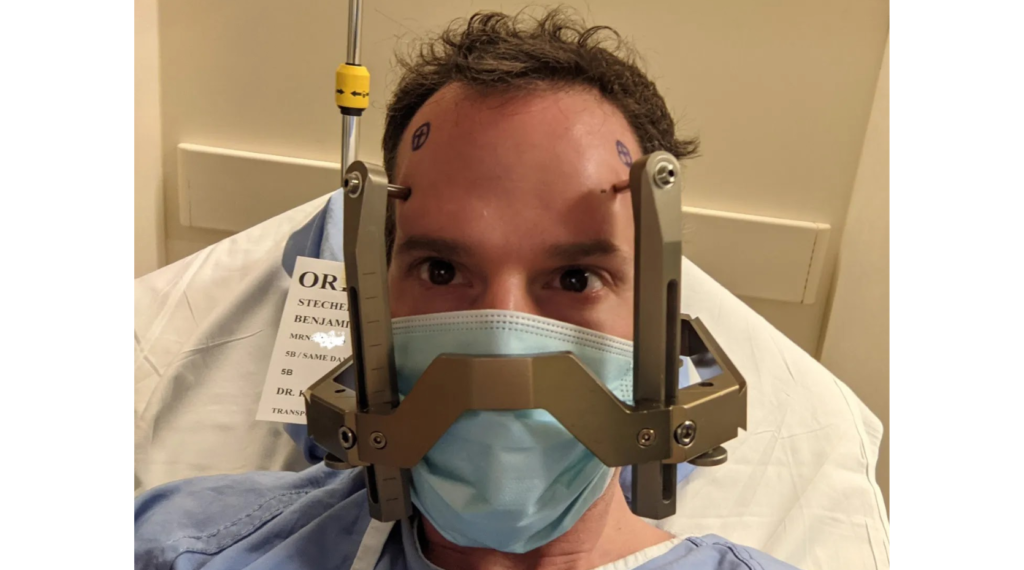
My whole day was spent going on/off, on/off. So, I thought, ‘OK, I need a better solution for this.’ About three years ago, Fasano and I started to talk more seriously about deep brain stimulation therapy. I decided to have it done as part of the Medtronic ADAPT-PD trial because it offered DBS with an adaptive setting – meaning that as well as continuous stimulation, it could provide varying levels of stimulation instead as needed. I thought adaptive DBS would eventually be the better option for most people with Parkinson’s. As our symptoms fluctuate throughout the days, weeks and months, we need something that can adapt to our ever-changing needs. The ability to fine-tune these devices to better meet the needs of individuals was the tipping point for me. In June 2021, I got the surgery done. It took some fine-tuning, but once we found the right continuous DBS settings for me, we turned on the adaptive settings. I felt an instant improvement over the previous continuous settings, so it seems like this trial was the right one for me.
How did it work for you?
It pretty much cleared up almost all my symptoms, although there are still some that come on from time to time. I had a mild tremor from time to time which still flares up but is nowhere near as bad as it was previously. My bradykinesia’s almost completely gone now, so’s my dystonia and my dyskinesia as well. I don’t have to take medication anymore. However, there are some side effects: my gait is a little bit more impaired than it was before, although if I focus on it, concentrate, I can deal with that. I’d say overall my symptoms are so much better than they were prior to the surgery that it’s like night and day for me.
How did the idea for the new Parkinson’s book come about?
There was a point at which I realised that there was a lot of information out there about DBS and about neuromodulation that has never been written down before. I approached Fasano with this idea. We’ve interweaved both our stories together into a narrative. Although the bulk of the book is my story, it’s also about the patients I’ve met along the way. I’ve mentioned a lot of people that are battling this disease: some good stories and bad stories about people who’ve had DBS in particular. But then we also sprinkle in Fasano’s takes on the future of this field and the future of neuromodulation therapies.
In the book, you describe that your treatment was the first time in a clinical trial in North America that the adaptive settings of DBS were turned on. Please explain what this is compared to “normal” DBS.
I have the new system from Medtronic called the Percept™ PC neurostimulator device. It allows for a clinician to go in and record from my brain the beta waves that emanate from everyone’s brains. Basically, there are three properties of electricity: frequency, amplitude and the shape of the wave. On the previous models the amplitude was always steady. This one is able to modulate the amplitude based on the sensing data that it reads out to the computer chip which is part of the battery placed under the skin above my right pectoral.
So, it’s always adapting to what you need at the time?
Yes. It’s not a perfect system yet, and in the future, there will be even better ones, but this is what we have today.
What difference did you notice from when you first had DBS to when you changed to the adaptive setting?
There’s a number of things: I noticed that I didn’t need to go in for as many adjustments anymore, so the time between clinical visits was spaced out further and further and, more importantly, it felt like my symptoms were better controlled. I felt that they were better managed.
So, your quality of life is much improved? Are there things you can do now that you couldn’t before?
Yes, before my DBS surgery, I was basically confined to my parents’ basement. I thought my life was quickly spiralling downwards, and afterwards I felt liberated. Like, I could jump on a plane and go anywhere in the world to get where I wanted to go.
DBS is only going to get better and better in the future. We talk a lot about the future of this technology as well in the book. And I can say pretty confidently that soon patients won’t have to go through the ardures that I had to go through. Soon, some of the things that I had to go through are going to look pretty barbaric.
What do you hope people will get out of this new Parkinson’s book?
I hope it inspires more advocates to pursue the path that I went down. I don’t think it’s for everybody, but if you have it in you to take years out of your life to first learn about this disease, then I think you’ll find that advocacy is very rewarding in a lot of different ways for you personally.
How much of your time do you spend advocating for people with Parkinson’s?
It’s my life, my full-time job. I chair the patient advisory board at Rune Labs, a software and data analytics company for precision neurology. Twice a month, I meet with the CEO Brian Peppin, and I give a lot of very critical feedback to the company about what they’re doing, and what the business’s practice is. I also set up my own company VeracityBio, which is trying to tackle the problems of biomedical literature by using new AI-driven, LLM solutions. I also write a blog on my website, Tomorrow Edition.
It’s literally how I function in this world – through my advocacy, through the work that I do. I owe everything that I have now to advocacy. I got this device through my advocacy – that’s part of the reason that I was allowed to be in this trial, because I am a vocal advocate for myself and for others – and it’s helped in keeping my relationship with Dr Fasano. All those reasons are why I feel I can do the things I want to do with my life again, and why I feel so good as well.
What do you hope to do with your life?
I’ve had a lot of thoughts – I’m actually debating that at the moment. I’m about to turn 40 in August of this year and am thinking about going back to China and becoming an advocate there. I speak Mandarin so I feel I could have an impact in a world like that.
Reprogramming the Brain by Benjamin Stecher and Alfonso Fasano will be published by Springer, on 30 March 2024, priced £19.99
Stecher’s first book Brain Fables: The Hidden History of Neurodegenerative Diseases and a Blueprint to Conquer Them came out in 2020, priced £11.99, and is also available to purchase